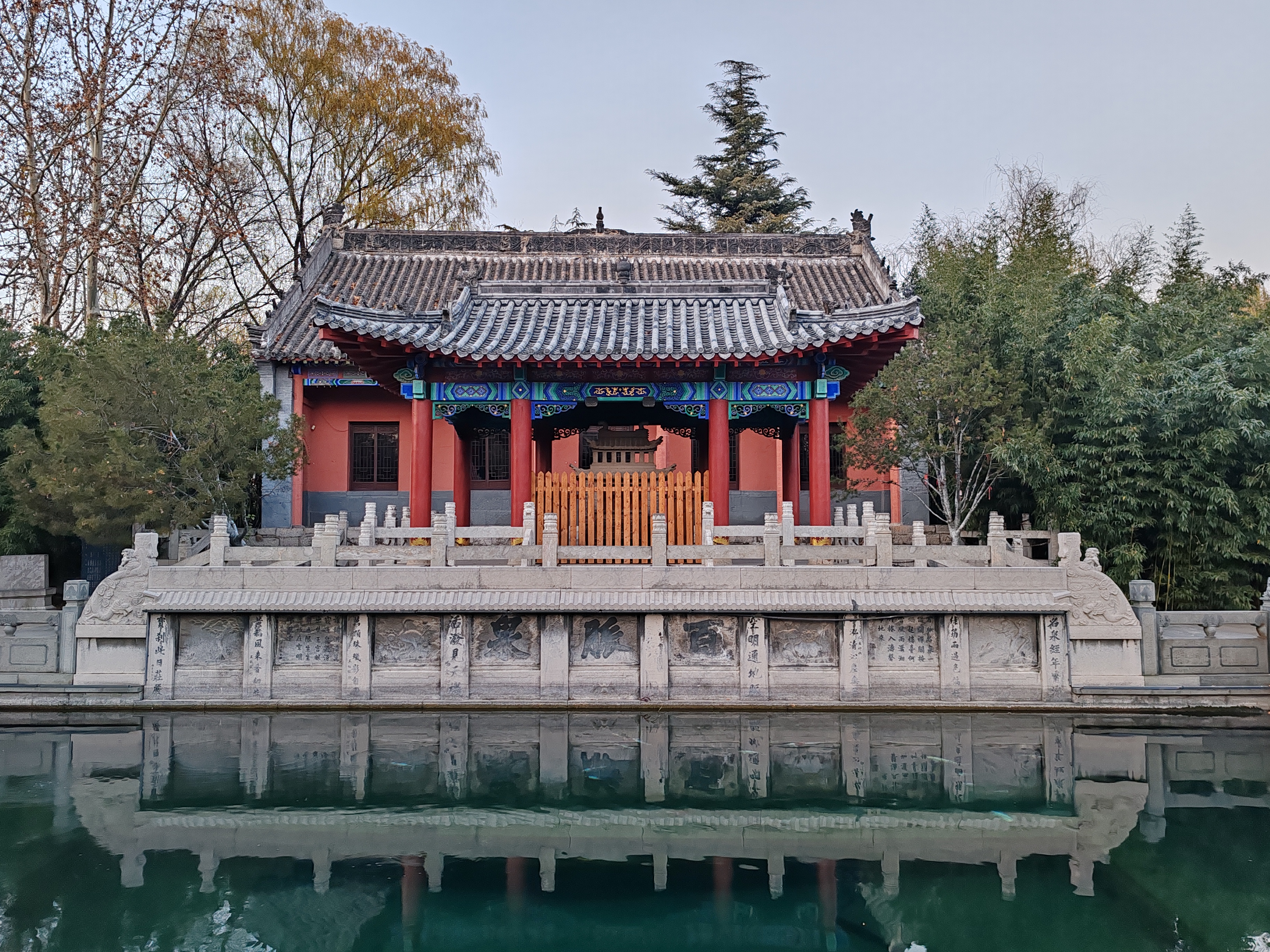
Baimai Springs
Li Qingzhao, the most celebrated female poet of the Song dynasty, once lived beside these waters. A thousand years later, the Baimai Springs still rise through limestone in the courtyard of the Dragon Spring Temple, filling a rectangular pool 25 meters long and 2 meters deep with water so clear that visitors can count the stones on the bottom. Located in Zhangqiu District, about 25 kilometers east of Jinan's city center in Shandong Province, the springs have been drawing poets, painters, and pilgrims for centuries -- not because they are the largest of Jinan's famous springs, but because they might be the most beautiful.
Water from Stone
The Baimai Springs are artesian karst springs, meaning their water is pushed to the surface by underground pressure through channels dissolved in limestone over geological time. The main spring pool sits inside the Dragon Spring Temple courtyard, but it is hardly alone. The surrounding 25-hectare park, established in 1985, contains several related springs and small lakes, including Wanquan Lake -- whose name translates to "Ten Thousand Springs Lake" -- all fed by the same underground aquifer. Among the individual springs in the group, Mo Spring stands out: its name means "Black Ink Spring," and calligrapher Shu Tong inscribed the stone handrail that surrounds it.
The Poet's Garden
What sets Baimai Springs apart from Jinan's other famous spring sites is its connection to Li Qingzhao, who lived here during the Northern Song dynasty. Li is widely regarded as one of China's finest poets, particularly celebrated for her mastery of ci, a lyrical form set to musical tunes. The park honors her with the Qingzhao Ci Poetry Garden, laid out according to the aesthetic principles of ci poetry around four romantic themes: wind, flowers, snow, and moon. Walking through the garden, visitors encounter the same landscape that shaped Li's verses -- the play of light on water, the rustle of reeds, the quiet persistence of springs that have never stopped flowing.
Jinan, City of Springs
Jinan has long been called the "City of Springs," and for good reason. The geology of western Shandong produces an extraordinary concentration of natural springs, with Baotu Spring in Jinan's center being the most famous. Baimai Springs, located in the Zhangqiu District to the east, offers a quieter alternative. The park surrounding the springs blends traditional architecture with natural landscape -- small bridges arch over channels of flowing spring water, willows trail their branches toward the surface, and lotus blooms carpet the lakes in summer. The temples and pavilions that dot the grounds date from various dynasties, though most have been rebuilt or restored over the centuries.
Living Water
For the residents of Zhangqiu, the springs are more than a scenic attraction. They are a measure of the region's ecological health. Karst springs respond sensitively to changes in groundwater levels, and periods of drought or over-extraction can reduce or stop their flow entirely. The fact that the Baimai Springs continue to bubble speaks to the ongoing recharge of the limestone aquifer beneath Shandong's surface. Visitors today find the springs at their liveliest after the summer rains, when underground pressure is highest and the water surges up through the temple courtyard with visible force, carrying with it the mineral clarity that first caught a poet's eye a millennium ago.
From the Air
Located at 36.72°N, 117.53°E in Zhangqiu District, east of Jinan, Shandong Province. Nearest major airport is Jinan Yaoqiang International Airport (ZSJN), approximately 30 km to the northwest. The springs are within the urban area and not individually visible from altitude, but Jinan's network of lakes and waterways is apparent from above. The flat terrain of the North China Plain extends in all directions. Best viewed at 2,000-4,000 feet.