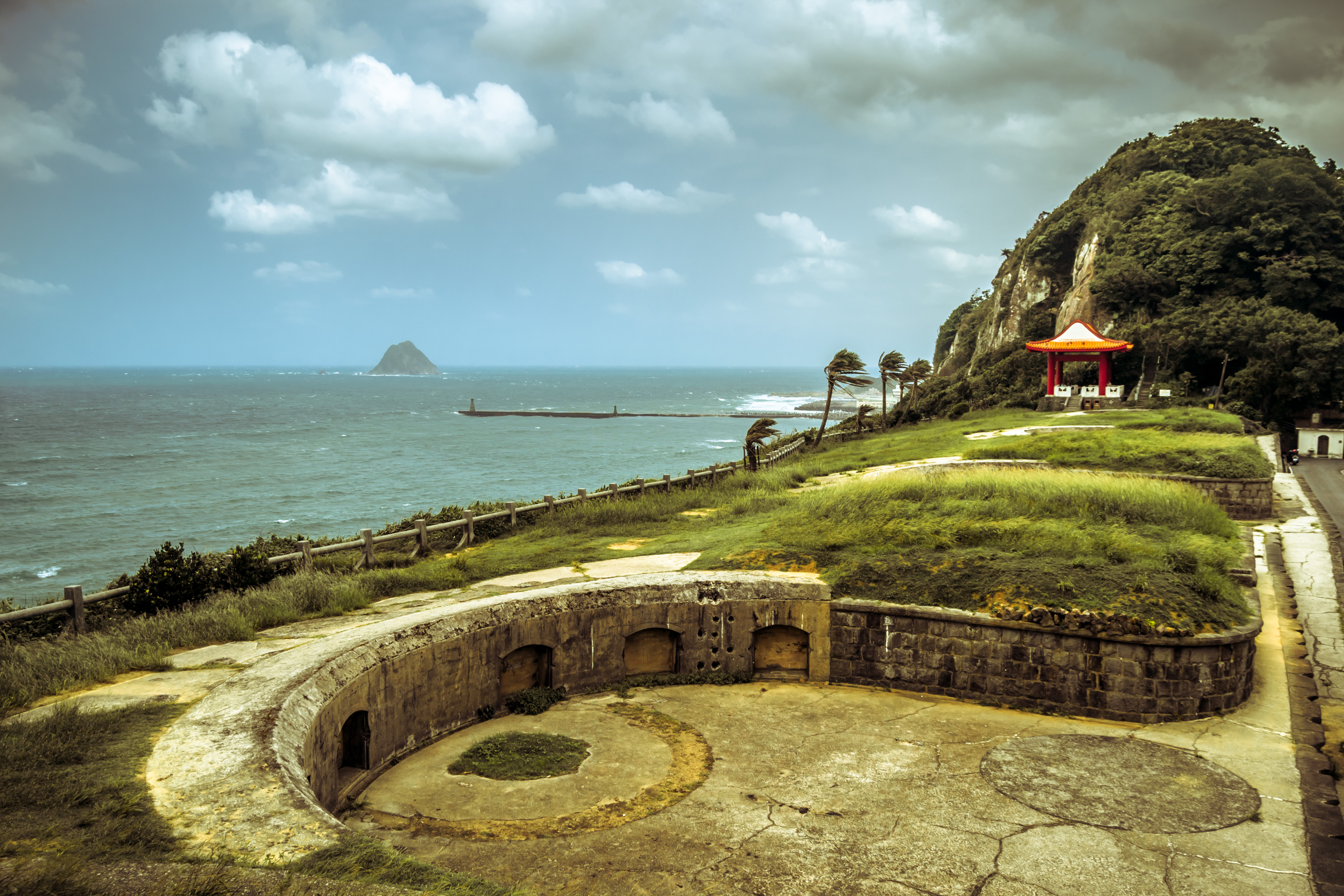
Baimiweng Fort
Four nations planted their flags on this rocky headland above Keelung Harbor, and each left something behind. The Dutch called it Holland Castle. The Spanish garrisoned it during their brief hold on northern Formosa. The French occupied it while fighting the Qing. The Japanese rebuilt it entirely. Baimiweng Fort, perched on a hill in Keelung's Zhongshan District, is less a single fortification than a palimpsest of empire, each layer written over the last but never quite erasing it.
The Colonial Carousel
Keelung's strategic harbor made it irresistible to every maritime power that entered the western Pacific. The Dutch East India Company established trading posts across Formosa beginning in 1624, and the Spanish followed two years later, building forts along the northern coast. Baimiweng Fort likely dates to this period, though its exact construction date remains uncertain. What is clear is that its position was chosen for commanding views of the harbor approaches. Any ship entering Keelung would pass under its guns. By the time the French Third Republic dispatched forces during the Sino-French War of 1884-1885, the fort had already weathered two centuries of colonial ambition. French troops occupied it briefly, adding another chapter to a story that no single nation could claim as its own.
Rebuilt in Concrete and Ambition
When Japan took control of Taiwan in 1895, the new colonial government remade the island's infrastructure with characteristic thoroughness. Baimiweng Fort was no exception. The Japanese remodeled the fortification into the form that survives today: a rectangular, sea-facing battery divided into three distinct sections. The barbette provided an elevated, open-topped platform for artillery. Behind it sat the control center, where officers coordinated fire. And at the highest point, the observation station offered unobstructed sightlines across the East China Sea. The design was utilitarian, built for function rather than display. Thick walls, clean angles, and clear fields of fire. It was a fortress designed by engineers, not architects, and it shows.
Silence and Restoration
The guns fell silent after the Japanese colonial period ended in 1945. For decades, the fort sat quietly on its hilltop, weathering typhoons and the slow creep of tropical vegetation. Unlike Keelung's more famous Ershawan Battery, Baimiweng drew few visitors. Its modest size and relatively remote position in Zhongshan District kept it off most tourist itineraries. But neglect, in its own way, preserved it. Without heavy foot traffic or ill-conceived renovations, the Japanese-era structure remained largely intact.
A Future for the Past
In September 2016, the Keelung City Government announced a plan to restore and preserve the fort, funded by the Ministry of Culture. The project reflects a broader shift in how Taiwan approaches its layered colonial heritage. Rather than emphasizing any single era, restoration efforts aim to present the fort as a site where multiple histories converge. Visitors can trace the evolution from seventeenth-century maritime outpost to modern heritage site. The views from the observation station remain unchanged: the same harbor entrance, the same open ocean, the same strategic geography that drew four colonial powers to this one stubborn piece of rock.
From the Air
Located at 25.1556N, 121.743E on a hilltop overlooking Keelung Harbor in northern Taiwan. Best viewed at 2,000-3,000 feet for the relationship between fort, harbor, and coastline. Nearest airport is Taipei Songshan (RCSS), approximately 20 nm southwest. Keelung's harbor is a strong visual reference point from any altitude. The northern coast of Taiwan is often affected by low clouds and drizzle, particularly from October to March.