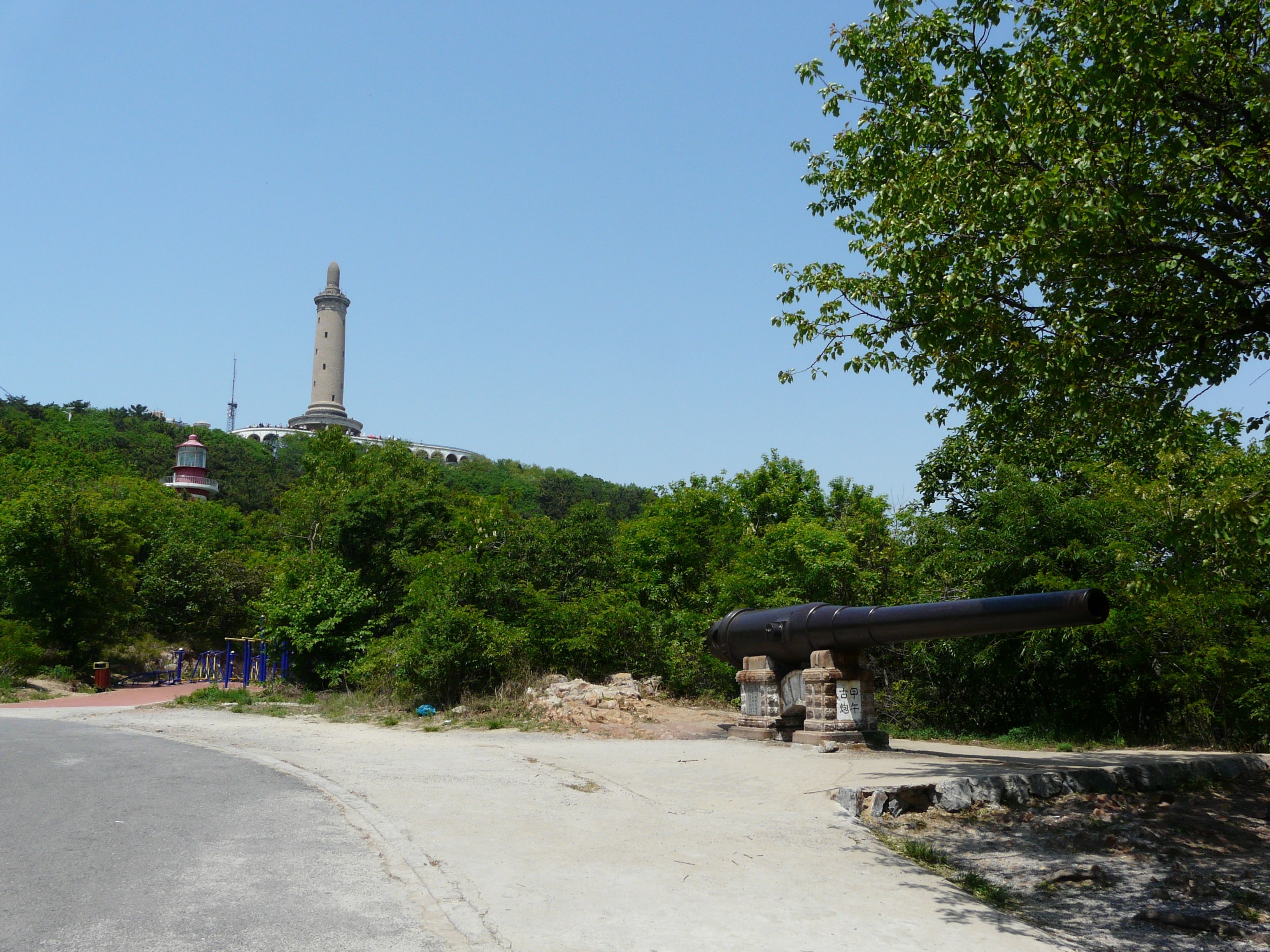
Baiyu Mountain
Where there is gold, there must be white jade. That is what Li Hongzhang reportedly said when he climbed to the top of this hill in 1880, looking across at the mountain called Gold Mountain and deciding that the view from here deserved a more elegant name than Xiguan Mountain. He was inspecting the new naval base that the Beiyang Fleet was building in the bay below -- China's most important military installation and the anchor of its modernization effort. Li could not have known that within fifteen years, the fleet would be destroyed, the base captured, and his 'White Jade Mountain' crowned with a Japanese war memorial built by Chinese forced labor.
A Mountain Between Empires
Baiyu Mountain rises 130 meters above the urban center of Lushunkou District in Dalian, Liaoning Province. Its position at the heart of what was once called Port Arthur makes it a natural observation point -- from its summit, you can see the naval harbor to one side and Tiger's Tail Peninsula stretching into the Yellow Sea on the other. This geography made it strategically significant long before it became symbolically charged. During the Self-Strengthening Movement of the late Qing dynasty, the Beiyang Fleet established its Lushun Naval Base in the bay at the mountain's foot, transforming a natural harbor into China's premier military port.
Li Hongzhang's Jade
The mountain's name dates to 1880, when Viceroy Li Hongzhang visited to inspect the new naval facilities. He was accompanied by Yixuan, Prince Chun, the father of the young Guangxu Emperor. According to one account, when the two men learned that the mountain across the bay was called Gold Mountain, Li declared that gold demanded white jade as its complement, and the hill was renamed on the spot. A less romantic version holds that the name simply describes the mountain's pale, jade-like terrain. Either way, the rechristening marked a moment of imperial confidence -- a viceroy surveying a modern naval base and finding it worthy of a poetic name.
The Tower That Forced Labor Built
After the Russo-Japanese War of 1904-1905, the Japanese built a tower on Baiyu Mountain's summit to honor their fallen soldiers at Lushun. Originally called Biaozhong Tower -- the 'Tower of Faithful Service' -- it was classified as a Tomb of the Unknown Soldier monument. The tower took two and a half years to complete, and the labor was not voluntary: more than 3,000 Chinese workers were forcibly recruited for the construction. The monument presents a deeply uncomfortable layering of history -- a memorial to the soldiers of one occupying power, built by the forced labor of the occupied people, on a mountaintop named by the officials of yet another fallen regime. Today the tower still stands, though its meaning has shifted across multiple political transformations.
Patriotic Education at 130 Meters
In 1995, the Chinese government designated Baiyu Mountain as a Patriotic Education Base for the city of Dalian. The site now serves a dual purpose: tourism and historical instruction. Visitors climb the road that winds to the summit, passing through the urban fabric of modern Lushunkou before emerging at viewpoints that reveal the harbor below. From the top, the naval port spreads out on one side, while Tiger's Tail Peninsula curves into the sea on the other. The panorama makes visible the strategic logic that drew three empires to this spot -- the natural harbor, the defensible heights, the access to open water. Baiyu Mountain does not shy from the painful layers of its history. The Japanese tower, the Qing-era naval base ruins, the forced-labor history, the renaming by a viceroy whose fleet would be annihilated -- all of it is part of the education the mountain is meant to provide.
From the Air
Located at 38.81N, 121.26E in Lushunkou District (formerly Port Arthur), Dalian, Liaoning Province, China. Baiyu Mountain is a prominent 130-meter hill in the urban center with the distinctive tower visible on its summit. The naval harbor is directly adjacent. Nearest airport: Dalian Zhoushuizi International Airport (ZYTL), approximately 35 km northeast. Best viewed at 2,000-4,000 ft on approach from the sea, where the harbor geography and Tiger's Tail Peninsula are clearly visible.