The Bell That Remembers
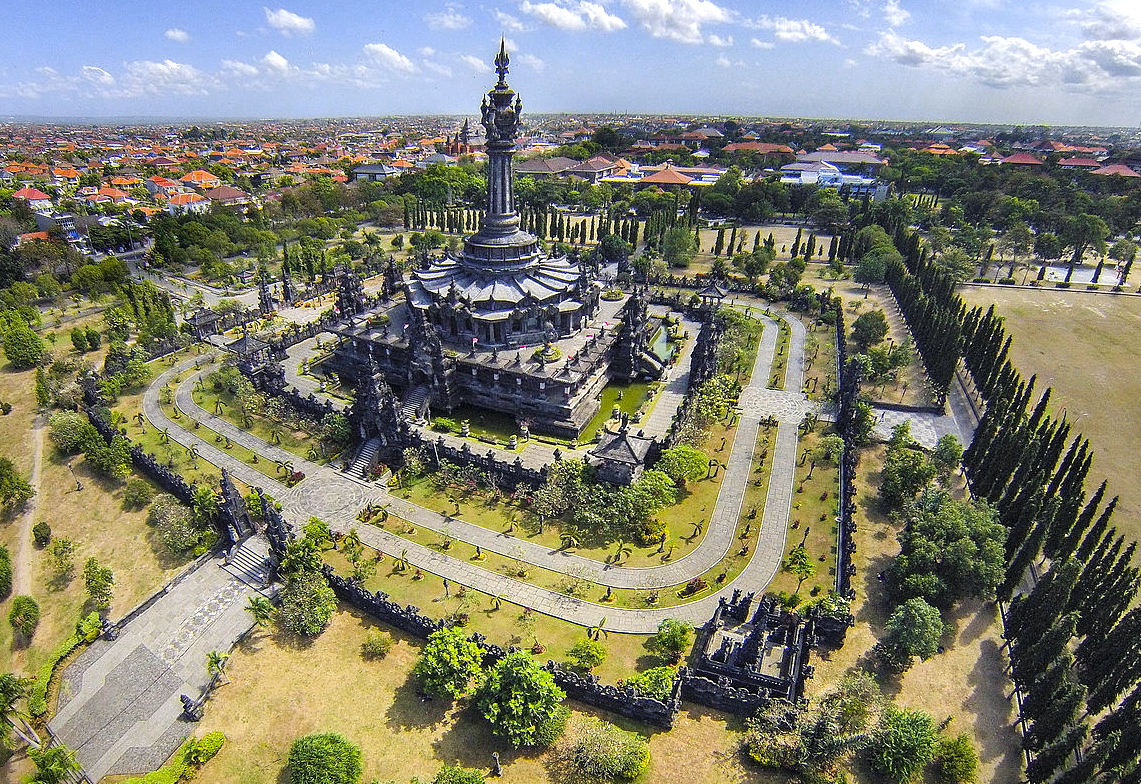
Seventeen gates. Eight pillars. Forty-five meters tall. The numbers are not arbitrary. They spell out a date - August 17, 1945 - the day Indonesia declared independence, encoded in stone and concrete at the center of Denpasar's Renon district. The Bajra Sandhi Monument rises from a reflecting pool like a giant prayer bell, which is exactly what it represents. In Balinese Hinduism, the bajra is the bell a pedanda - a high priest - rings while chanting Vedic mantras, its sound clearing the air between the human and the divine. This monument makes the same claim on a civic scale: that the struggles of the Balinese people deserve sacred remembrance, that resistance is itself a form of prayer.
From Concept to Concrete
The idea belonged to Ida Bagus Mantra, governor of Bali, who in 1980 envisioned a monument honoring the island's history of resistance. An architectural competition followed in 1981, won by Ir. Ida Bagus Gede Yadnya, whose design fused Hindu cosmology with nationalist symbolism. Construction began on the 13.8-hectare site that same year, then stalled. Work resumed in 1987, and the structure slowly grew to its full 4,900-square-meter footprint. But it would take another sixteen years before the monument was formally inaugurated - on June 14, 2003, by President Megawati Sukarnoputri, herself the daughter of Indonesia's founding president. The long gestation was fitting. The struggles the monument commemorates unfolded across centuries, and the monument took its own decades to reach completion.
Cosmology in Architecture
Every element of the Bajra Sandhi carries Hindu meaning. At the summit sits a kumbha, a ceremonial pot symbolizing the Jar of Amertha - the vessel of immortality from Hindu mythology. The base of the monument represents the body of Bedawang Akupa, the cosmic turtle that supports the world. A dragon's tail, representing the serpent Basuki, winds near the monument's lower levels, while its head appears at the Kori Agung, the grand entrance gate. The towering central structure evokes Mount Mandara Giri, the mythical mountain used to churn the ocean of milk. And the reflecting pool that encircles everything? That is the Ksirarnawa, the sea of milk itself. Visitors who know the stories see them everywhere. Those who don't still sense the weight of symbolism pressing outward from every surface.
Thirty-Three Acts of Defiance
Climb to the second floor and the monument reveals its interior purpose. Thirty-three dioramas line the walls, arranged clockwise in chronological order, tracing the Balinese people's story from prehistory through independence. The paintings depict events that shaped the island's identity - and several are devastating in their specificity. One shows the Puputan Badung of 1906, when the royal court of Denpasar marched into Dutch gunfire rather than accept colonial rule, men, women, and children choosing death over submission. Another depicts the Puputan Klungkung of 1908, a nearly identical act of mass self-sacrifice by the last independent Balinese kingdom. A third captures the moment Patih I Gusti Ketut Jelantik tore up a Dutch letter in 1848, a gesture of contempt that ignited war. These were not abstract acts of resistance. They were personal, costly, and deliberate - and the dioramas refuse to let visitors forget the human scale of each one.
Heroes Carved in Memory
Three names recur throughout the monument's narrative. I Gusti Ngurah Rai, the military commander who led Balinese forces against the Dutch in 1946 and died in the Battle of Marga rather than surrender - Bali's international airport bears his name. I Gusti Ketut Jelantik, the 19th-century commander whose defiance of the Dutch became a foundational story of Balinese pride. And I Gusti Ketut Pudja, the political leader who helped guide Bali through the transition to Indonesian independence. Together they represent three modes of resistance: military, diplomatic, and political. The monument honors all three equally, insisting that courage takes many forms and that the Balinese struggle was never a single act but a sustained effort spanning generations.
A Living Gathering Place
The Bajra Sandhi is not merely a memorial frozen in reverence. Each year, the open grounds in front of the monument host the Bali Arts Festival parade, a celebration so significant that Indonesia's president often opens the proceedings. Families gather on the surrounding lawns. Students visit the dioramas on school trips, learning their island's history through painted scenes rather than textbook paragraphs. The monument has even appeared on international television - it served as a pit stop on The Amazing Race 28 and the finish line of The Amazing Race Asia 5, its distinctive silhouette broadcast to millions who may not have known its meaning but could not miss its presence. Standing at the center of Renon, surrounded by government buildings and open parkland, the Bajra Sandhi functions as both memorial and meeting point, a place where Bali's past and present converge beneath the shadow of a prayer bell that never stops resonating.
From the Air
Located at 8.67°S, 115.23°E in the Renon district of Denpasar, the Bajra Sandhi Monument is visible from the air as a distinctive 45-meter tower surrounded by open parkland and reflecting pools. Ngurah Rai International Airport (WADD) lies approximately 12 km to the southwest. The monument sits near the Bali Governor's Office complex, identifiable by its large open green spaces in an otherwise dense urban area. Best viewed at altitudes of 3,000-5,000 feet in clear conditions, when the monument's bell-like shape and surrounding pool are most distinct. The area between the monument and the coast to the south includes the Sanur Beach district.