Bakuya Kofun: A Prince's Tomb in the Clay Hills
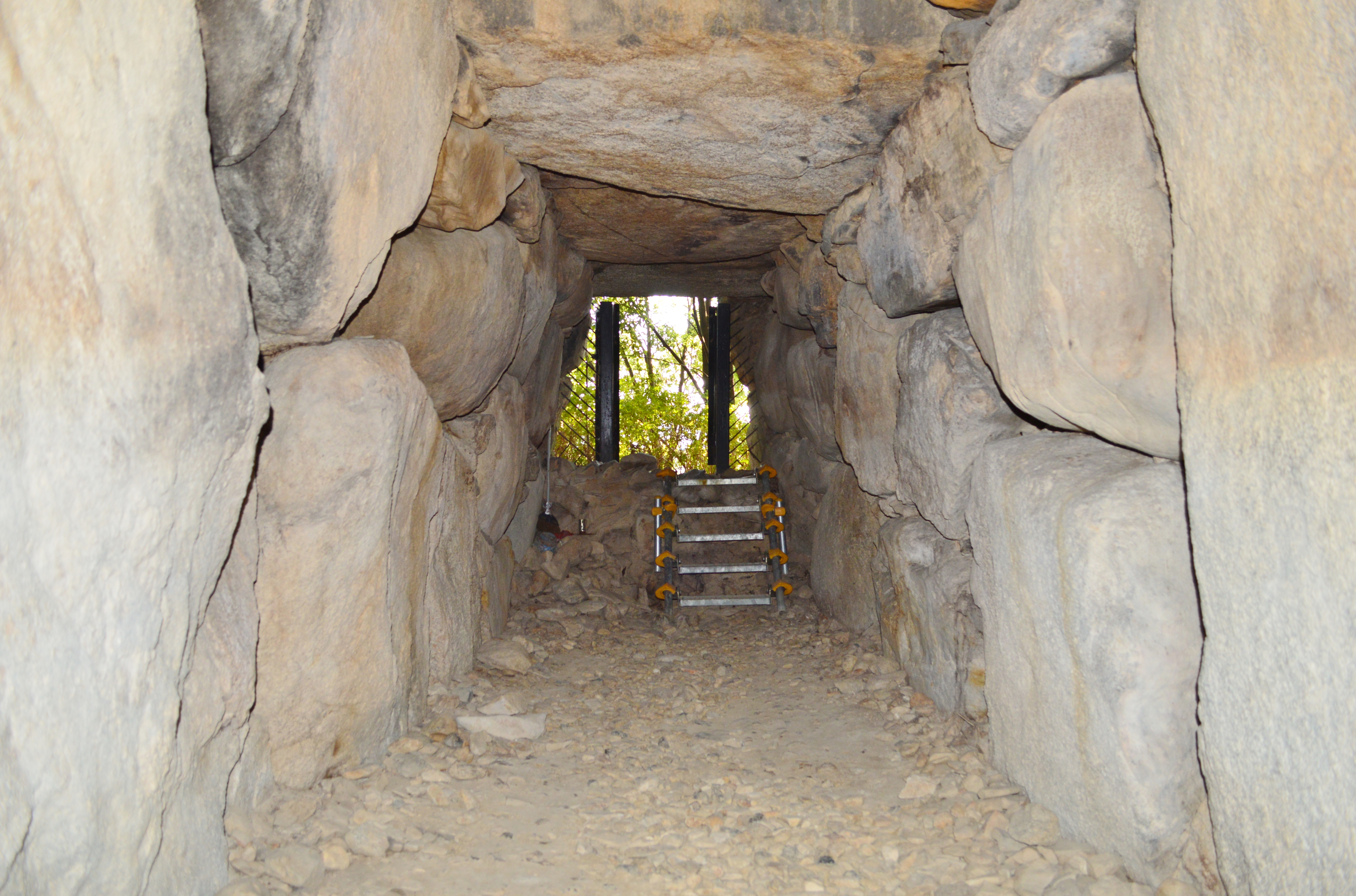
The Umami Hills of western Nara Prefecture are made of clay. They produce no stone. Yet someone in the late 6th century hauled granite monoliths weighing nearly sixty tons into these hills and assembled one of the largest stone burial chambers in the prefecture -- 17.1 meters from entrance to back wall. The effort required to move those stones across terrain that offered nothing to work with tells you everything about who was buried inside. Archaeologists believe the occupant was Prince Osasakahikohito, eldest son of Emperor Bidatsu, a figure important enough to warrant engineering on a scale that bordered on the absurd. The tomb was robbed long ago, its house-shaped stone coffins smashed and emptied. But the robbers missed the ground itself, and when excavations began in 1983, the earth around those broken coffins yielded over 20,000 artifacts.
Stone Where No Stone Belongs
The Bakuya Kofun is a circular burial mound built in three tiers on the tip of a small ridge in the center of the Umami Hills. It measures 48 to 60 meters in diameter and rises 13 meters high. The construction is impressive on its own terms, but the real engineering feat is invisible from the surface. The burial chamber beneath is a double-sided horizontal-entry stone passage with an opening facing south, built entirely from massive granite blocks. The largest of these weighs nearly sixty tons, making it the second heaviest stone used in any kofun in Nara Prefecture -- surpassed only by the ceiling stone of the famous Ishibutai Kofun. Every one of these blocks had to be quarried elsewhere and transported into clay hills that offered no local building material. The logistics of that effort, in the 6th century, speak to the power and resources of whoever commissioned the tomb.
Twenty Thousand Things
Tomb robbers had long since broken into the burial chamber and damaged the two house-shaped stone coffins inside -- one hollowed from a single block, the other a composite construction that no longer survives. But the robbers were interested in what was inside the coffins, not what had fallen to the ground around them. When systematic archaeological excavations began in 1983, the floors and passageways delivered a remarkable haul: over 20,000 individual artifacts. Gold rings and beads of gilt bronze, glass, crystal, and amber spoke to personal adornment. Horse equipment included two sets of gilt bronze-plated iron stirrups, fittings with metal rims, and a heart-shaped mirror panel. Weapons included a silver-plated iron sword and nearly 400 iron arrowheads. Concentrated in the passageway were containers including a gilt bronze-plated wooden box and 58 pieces of Sue ware pottery. The pottery styles date the tomb's construction to the second half or end of the 6th century, the late Kofun period.
Borrowed Haniwa and an Uncertain Identity
Fragments of haniwa -- the distinctive clay figurines that adorned kofun exteriors -- were found scattered on the outside of the mound. But none remained in their original positions. Archaeologists concluded they had been taken from other burial mounds in the Umami Kofun cluster and placed on the Bakuya Kofun to dress it up, a kind of decorative recycling. The identity of the tomb's occupant remains officially uncertain, but the evidence points in one direction. The mound's size, the extraordinary scale of the stone chamber, and the sheer abundance of high-quality grave goods all indicate someone of the highest rank. The prevailing theory identifies the occupant as Prince Osasakahikohito, the eldest son of Emperor Bidatsu, who reigned from 572 to 585 AD. The Bakuya Kofun is one of the few tombs in the Umami group that features a horizontal-entry burial chamber, making it architecturally distinctive as well as historically significant.
The Park on the Ridge
Today the Bakuya Kofun has been developed as Bakuya Historical Site Park, a quiet green space on the ridge where the mound sits. Access to the burial chamber itself is restricted for most of the year, but the site opens to visitors for designated periods, allowing a glimpse into one of the most impressive stone chambers in all of Nara Prefecture. The three-tiered mound is visible as a grassy hill, only the top tier perfectly circular due to the terracing. Japan designated the site a National Historic Site in 1983, the same year the major excavation campaign began. The park sits approximately three kilometers northeast of Kashiba Station on the JR West Wakayama Line, in the town of Koryo. The Umami Hills around it contain dozens of other burial mounds from the Kofun period, making this corner of western Nara one of the densest concentrations of ancient tombs in Japan.
From the Air
Located at 34.554N, 135.724E in the Umami Hills of western Nara Prefecture, Japan. The burial mound is visible as a round, tree-covered hill on a ridge in otherwise gentle terrain. Kansai International Airport (RJBB) is approximately 35 nautical miles to the southwest; Osaka Itami Airport (RJOO) is about 20 nautical miles to the north-northwest; Yao Airport (RJOY) is roughly 15 nautical miles to the west. Best viewed at 2,000-3,000 feet AGL. The surrounding Umami Hills contain numerous other kofun burial mounds visible as circular or keyhole-shaped tree-covered mounds.