The Billiard Hall That Became a Revolution
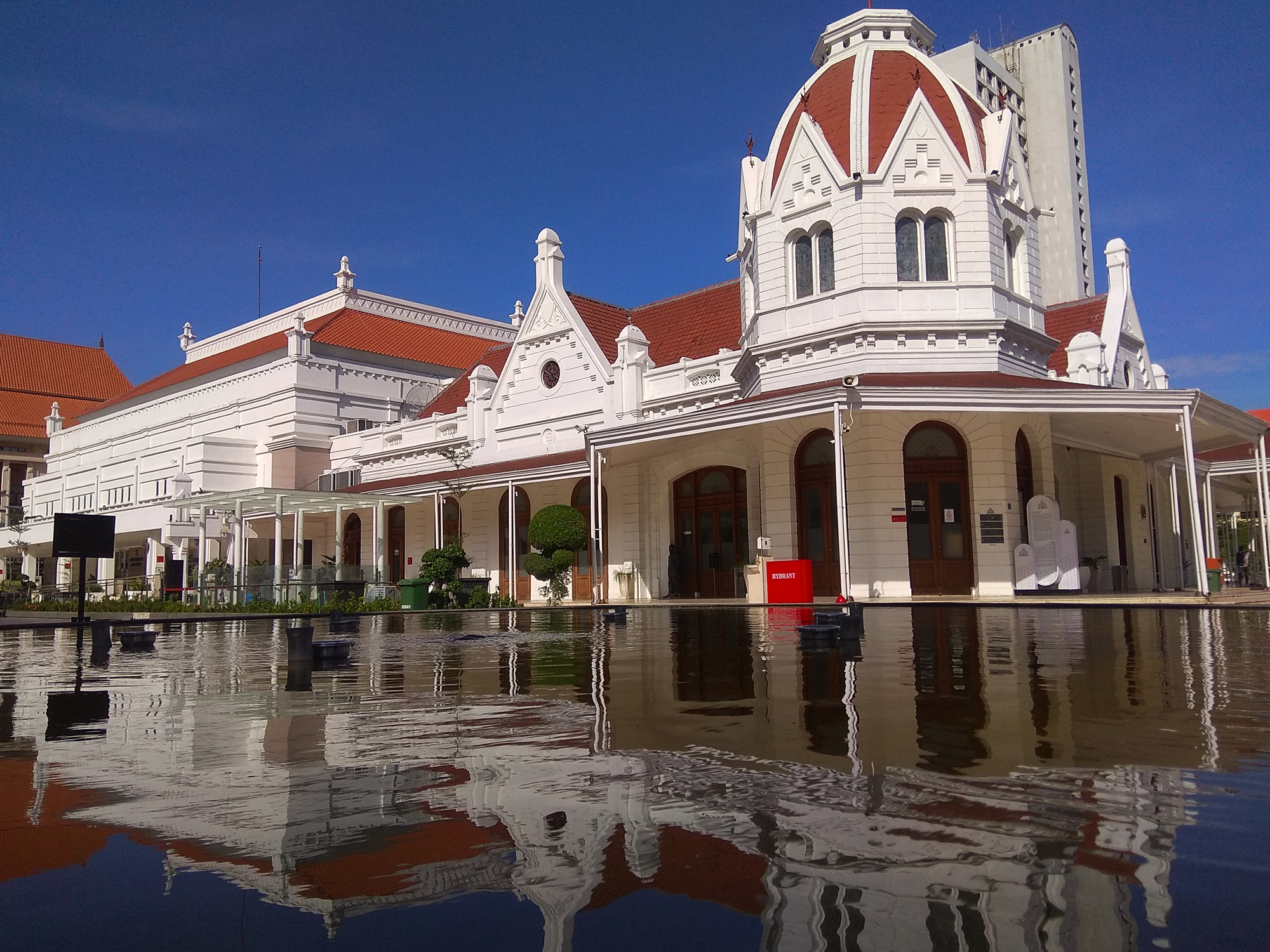
The locals called it Roemah Kamar Bola -- the House of the Billiard Room. In 1907, when Dutch architect Westmaes designed the Simpangsche Societeit for Surabaya's colonial elite, the building's purpose was exclusion as much as entertainment. European residents danced, played tennis, shot billiards, and held the informal meetings that shaped policy in the Dutch East Indies, all beneath a distinctive crown-shaped dome. Indigenous Indonesians were not welcome. The building was among the first in Surabaya constructed with a steel frame, an engineering novelty that announced its modernity. What it could not announce was its future: within four decades, the people it was built to exclude would storm through its doors and claim it for a revolution.
Behind the Crown-Shaped Dome
The Simpangsche Societeit occupied a prominent position in colonial Surabaya's social geography. Designed in a Neo-Renaissance style, the building featured the steel-frame construction that was cutting-edge technology for early 20th-century Indonesia. Its dome, which locals said resembled a crown, dominated the surrounding streetscape. Inside, the facilities catered to every leisure pursuit the colonial class required: billiard tables, a dance hall, card rooms, tennis courts.
The club was more than a social venue. It was where Dutch officials and businessmen conducted the informal negotiations that oiled colonial governance. Membership was restricted by race -- a policy that was standard practice across colonial Southeast Asia but no less bitter for its commonness. For Surabaya's Indonesian majority, the building represented both the sophistication and the arrogance of the occupying power.
October 1945
Indonesia proclaimed its independence on August 17, 1945, but declaring sovereignty and holding it were different matters. In Surabaya, young revolutionaries -- the pemuda -- began seizing buildings that symbolized colonial and Japanese control. On October 4, 1945, under the leadership of Soemarsono, the Laskar Pemuda Republik Indonesia stormed the Simpang Club and claimed it as an operational headquarters.
The timing was not accidental. British forces were already approaching Surabaya, ostensibly to accept Japanese surrender but understood by Indonesians as a prelude to Dutch recolonization. The pemuda needed command centers, and what better statement than converting the most exclusive colonial social club into a revolutionary nerve center? Within weeks, the Battle of Surabaya would erupt -- the largest single engagement of the Indonesian revolution -- and the city's youth would fight with a ferocity that gave Indonesia its national Heroes' Day.
From Simpang Club to Youth Hall
The building's transformation after independence was both symbolic and practical. In 1957, amid the political upheavals of Indonesia's early nationhood, it was formally renamed Balai Pemuda -- the Youth Hall. The name honored the pemuda who had seized it twelve years earlier and, more broadly, the generation that had fought for independence when older politicians were still negotiating.
The renaming completed a reversal that few colonial architects could have imagined. A building designed to keep Indonesians out became a building dedicated to Indonesian youth. The billiard tables gave way to meeting rooms for civic organizations. The dance hall became a venue for cultural performances. What had been a fortress of racial exclusion became, at least in aspiration, a house of popular culture and democratic participation.
Heritage in a Modern City
Today Balai Pemuda serves as one of Surabaya's cultural anchors. The building houses the Surabaya Public Library and hosts art exhibitions, musical performances, and community events. Its grounds include Alun-alun Surabaya, an outdoor public space with a food court and exhibition area that draws families and young people on evenings and weekends.
The Neo-Renaissance architecture survives largely intact, the crown dome still rising above the surrounding streets. Surabaya has designated the building as a protected heritage site, one of several colonial-era structures the city has chosen to preserve rather than demolish. The preservation carries an implicit argument: that history is worth keeping even when it is uncomfortable, that a building can outlive the ideology it was built to serve. The billiard players are gone. The youth remain.
From the Air
Balai Pemuda (7.26S, 112.75E) sits in central Surabaya near the city's main commercial district. The colonial-era building with its distinctive dome is embedded in dense urban fabric. Juanda International Airport (WARR/SUB) is approximately 15 km to the south, with runway 10/28 (3,000m). The building is near the Jembatan Merah (Red Bridge) colonial quarter and the Sunan Ampel Mosque district to the north. Expect tropical monsoon conditions year-round, with heavy rain November through April and persistent humidity.