Balaputradeva Museum
A defeated prince makes an unlikely museum namesake. In the 9th century, Balaputra -- head of the Sailendra dynasty and sovereign of the Srivijaya kingdom -- lost a power struggle in Java to Rakai Pikatan of the rival Sanjaya dynasty. Driven from the island, he crossed the strait to Sumatra and settled near what is now Palembang. His name survives not because he won, but because what he built in exile endured. The Balaputradeva Museum, South Sumatra's state museum, carries his name as a reminder that this province's history did not begin with European arrival. It began with stone, bronze, and Sanskrit.
The Prince in the Inscription
We know Balaputra existed because strangers wrote about him. An inscription discovered at Nalanda, the great Buddhist university in northern India, records his sponsorship of a monastery there -- evidence of a ruler whose influence reached across the Indian Ocean. A separate 9th-century Javanese inscription documents his defeat and departure from Java. These two fragments, one from India and one from his former homeland, bracket the story of a king who lost his throne but retained his ambitions. When Indonesian officials chose a name for South Sumatra's provincial museum in 1978, they chose his. Construction began that year, and the museum opened on November 5, 1984, one of a network of state museums established across Indonesia's provinces to preserve regional identity.
Before the Written Word
The museum's megalith section reaches back to a time before Balaputra, before Srivijaya, before any kingdom. In the highlands of Pagaralam, among the western ridges of the Barisan Mountains, archaeologists have documented 22 megalithic culture sites. The statues recovered from these sites are arresting in their specificity: a mother cradling a child, a figure astride a buffalo, men entwined by serpents. These are not abstract forms. They depict human life as it was lived in the South Sumatran highlands thousands of years ago, shaped from stone by people whose names are lost but whose art survives in the museum's ground-floor galleries. The megalithic tradition of South Sumatra remains less famous than the stone monuments of Nias or the megaliths of Central Sulawesi, but the Pagaralam finds demonstrate a sophisticated artistic culture that flourished long before the maritime kingdoms arrived.
The Srivijaya Rooms
Palembang was the heart of Srivijaya, the Malay Buddhist kingdom that dominated Southeast Asian maritime trade from roughly the 7th to the 13th century. The museum's Srivijaya section holds pottery, beads, metal castings, and -- most importantly -- replicas of the inscriptions that proved the kingdom's existence and Palembang's centrality to it. The 7th-century Kedukan Bukit inscription, the Telaga Batu inscription, the Kota Kapur inscription, the Talang Tuwo inscription: these stone records, mostly written in Old Malay with Sanskrit loanwords, mapped a political and spiritual world centered on the Musi River. The originals reside in Jakarta's National Museum or at the Sriwijaya Kingdom Archaeological Park, but the replicas here allow visitors to see the full collection in one place. Hindu-Buddhist statues from the same period stand alongside the inscriptions, evidence of a kingdom where Buddhist monasteries and Hindu temples coexisted along the same waterways.
Songket and Sovereignty
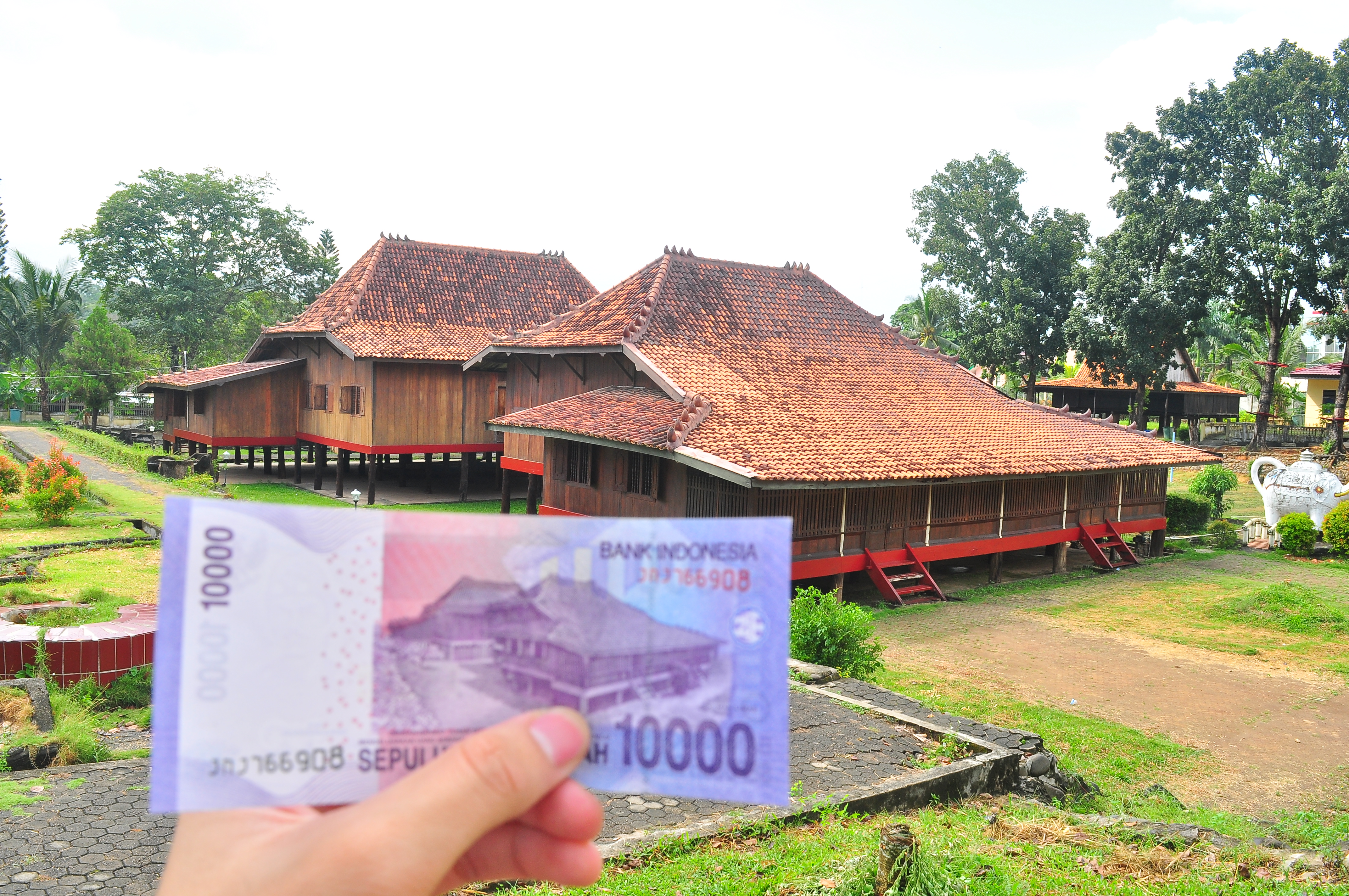
The Palembang Sultanate section shifts the story forward to the 18th century, when Islamic rule had long replaced Buddhist kingship. Here the centerpiece is textile: songket, the gold- and silver-threaded fabric that represents the apex of South Sumatran weaving. The museum displays looms alongside finished cloth, including a six-meter songket piece decorated with Naga Besaung motifs -- dragon-serpent patterns that carry pre-Islamic symbolism into Islamic-era artistry. Wooden furniture carved in traditional Palembang patterns fills the surrounding galleries: couches, chairs, and ornately worked doors that once graced the homes of the sultanate's elite. In the courtyard, two traditional houses anchor the collection in architecture. A rumah limas, Palembang's iconic pyramidal-roofed house, stands beside a rumah ulu from elsewhere in South Sumatra. The rumah limas is authentic -- it was transported here in 1984 from the site of what is now the Sultan Mahmud Badaruddin II Museum, a physical link between the two institutions that together preserve Palembang's layered past.
Three Museums, One Story
The Balaputradeva Museum is one of three public collections in Palembang that together cover the full sweep of Srivijayan and South Sumatran history. The Sultan Mahmud Badaruddin II Museum, housed in a former colonial residency on the Musi River, holds additional Srivijayan-era artifacts in its gardens. The Sriwijaya Kingdom Archaeological Park preserves inscriptions and ruins in an outdoor setting. Visiting all three traces a continuous narrative from prehistoric megalithic cultures through the Buddhist maritime empire, the Islamic sultanate, Dutch colonialism, and into the modern Indonesian state. Balaputra himself would recognize the pattern: power shifts, capitals move, dynasties fall, but the river keeps flowing through Palembang, and the people along its banks keep building.
From the Air
Located at 2.95S, 104.73E in Palembang, South Sumatra, approximately 4 km west of the Musi River. Sultan Mahmud Badaruddin II International Airport (WIPP) lies about 10 km to the north. From the air, Palembang sprawls along both banks of the Musi, with the Ampera Bridge as a prominent landmark. The museum sits in a parklike campus distinguishable from the surrounding urban grid. Best viewed at 2,000-4,000 feet for campus and city context.