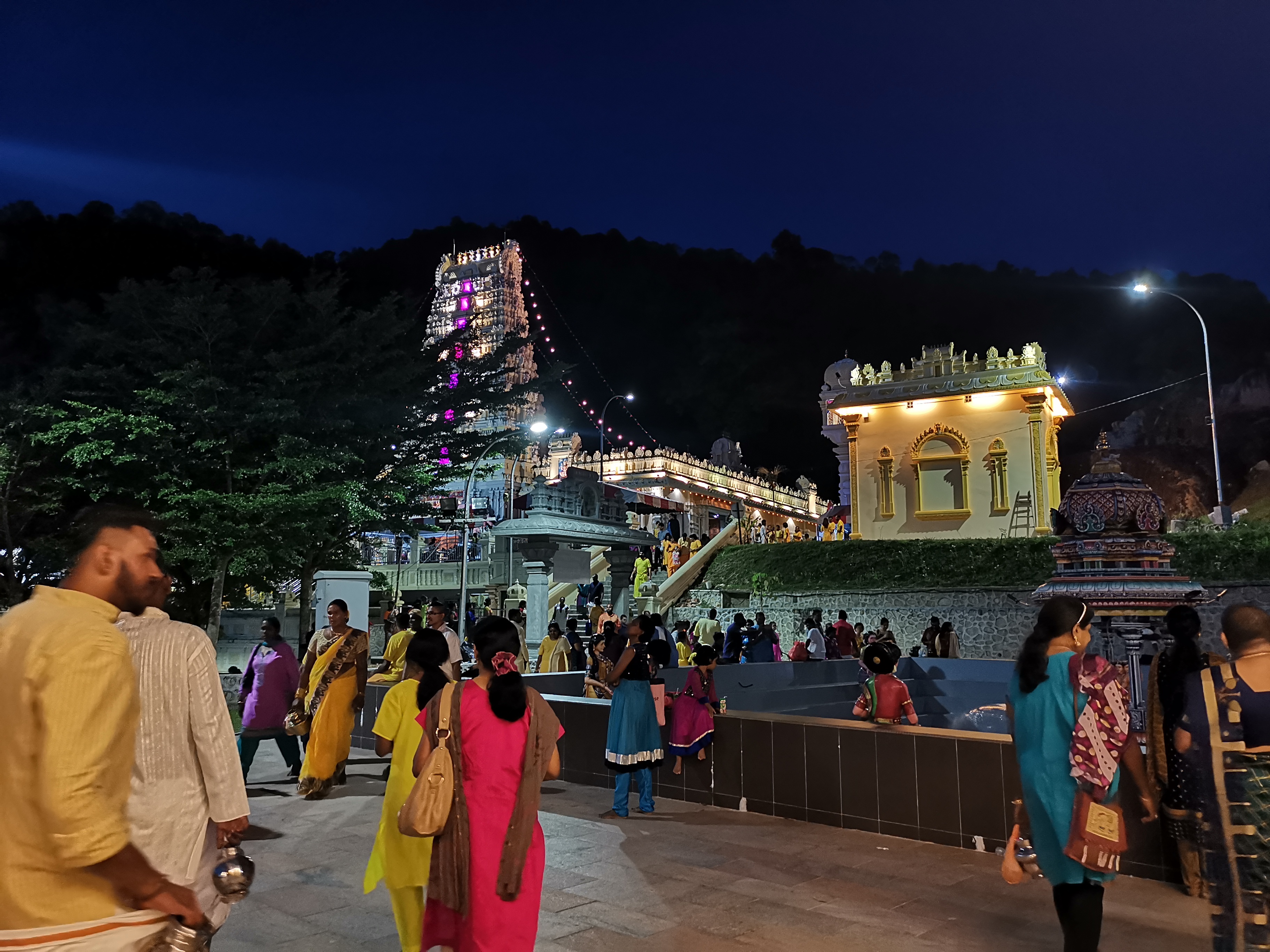
Balathandayuthapani Temple
Five hundred and thirteen steps. That is what separates the foot of the hill from the shrine of Lord Murugan at the Arulmigu Balathandayuthapani Temple in George Town, Penang. Known locally as the Waterfall Hilltop Temple, this complex perches higher above its surrounding terrain than Malaysia's more famous Batu Caves -- and it claims the distinction of being the largest Lord Murugan temple outside India. At the summit, a seven-storey gopuram rises 21.6 meters into the humid Penang air, its ornate tower visible well before the first step of the climb. The temple is the culmination of a community's devotion, built by Indian settlers who arrived as waterfront workers in the 1920s and planted their faith on a hilltop.
From the Waterfront to the Hilltop
The temple's origins trace to Penang's Indian immigrant laborers, many of whom worked the docks and wharves of George Town's busy port. In the late 1920s, these waterfront workers established the Hindu Mahajana Sangam -- a community organization also known locally as Gandhiji Ashram. At the foot of the hill, they built a community hall originally called Madaalayam, or Kootakadai Madam, which still stands today as the Dewan Mahatma Gandhi. It is considered the only surviving building in Malaysia based on South Indian architectural principles. From this base, the community developed the hilltop temple complex over subsequent decades, with the Arulmigu Sree Ganeshar Temple constructed in 1951 on the foothill as the gateway to the climb above. An 8.23-meter statue of Lord Shiva now stands at the hill's base, greeting those who begin the ascent.
The Climb and the Complex
The 513 steps are more than a physical challenge; they are a pilgrimage. Devotees traditionally begin their journey from Lorong Kulit, carrying offerings of milk pots or bearing Vel Kavadis -- elaborate frameworks adorned with peacock feathers and flowers, considered the highest form of offering to Lord Murugan. The kavadi bearers endure the weight and the climb as acts of devotion, their progress accompanied by chanting and prayer. At the summit, the main temple spreads across 70,000 square feet of hilltop ground, built at a cost of RM10 million. The complex includes several smaller shrines: the Thannermalai Sri Ayyappan Swamy Temple sits beside the main structure, while the Arulmigu Naga Naathar Temple -- a small shrine dedicated to the King Cobra deity -- occupies its own corner of the sacred hilltop.
The Golden Chariot's Journey
Thaipusam transforms the temple grounds and the streets below. The festival's centerpiece is a golden chariot, valued at RM3 million, that processes through George Town carrying the sacred vel -- a 0.9-meter-tall golden spear symbolizing the weapon given to Lord Murugan by his mother, Parasakthi. According to tradition, Parasakthi appeared in 18 forms before merging into a single indestructible vel, presented to Murugan during the full moon in the Tamil month of Thai. The chariot travels from the Arulmigu Sri Maha Mariamman Temple on Queen Street to the Arulmigu Sri Ganesha Temple on Jalan Kebun Bunga, covering three kilometers through streets thronged with devotees. Its first trial run on 2 February 2017 drew large crowds who watched it roll along Jalan Tunku Abdul Rahman, Jalan Macalister, and Jalan Utama.
Three Days on the Hill
The annual Chitraparuvam Festival, celebrated in the Tamil month of Chithirai each April or May, stretches the hilltop temple's significance across three days. A panchaloha deity of Lord Subramaniyaswami is carried in procession from the Queen Street Sri Mahamariamman Temple, winding through George Town's streets before arriving at the foothill Ganesha temple. From there, the deity is carried up the 513 steps to the hilltop shrine. On the second day, a procession circles the hilltop temple compound in the evening. On the third, the deity descends and returns by chariot to Queen Street. In the festival's earlier years, the entire journey happened in a single day -- the chariot departed at seven in the morning, reached the Gandhiji Ashram by afternoon, and returned by evening. Since the early 1970s, the expanded three-day celebration reflects the festival's growing significance. In 1992, the Hindu Mahajana Sangam imported a new chariot from India to replace the original, which had decayed beyond repair.
Bells, Pipes, and the Hours of the Day
Daily life at the temple follows a rhythm measured in ritual rather than clock time. Four ceremonies mark the day's progression: the Kaala Santhi at dawn, the Ucchikalam at noon, the Sayaratchai in the evening, and the Ardha Jamam at night before the temple closes. Each ceremony follows four steps -- abishegam (sacred bath), alangaram (decoration of the deities), naivethanam (food offering), and deepa aradanai (waving of lamps). Priests chant from the Vedas in Sanskrit and the Thirumurai in Tamil while the nadaswaram -- a penetrating double-reed pipe instrument -- fills the air alongside the rhythmic pulse of the thavil drum. Temple bells toll to mark each transition. The darshan hours run from 6:45 in the morning to 9:00 at night, with a midday break, and the cycle of bathing, dressing, feeding, and illuminating the deities repeats as it has since the temple's founding.
From the Air
Located at 5.43N, 100.30E on the western slopes of Penang Island's interior hills. The seven-storey gopuram tower is the most visible feature from the air, rising above the surrounding tree canopy. The Kek Lok Si Buddhist temple complex is nearby on the same hillside, making the area a cluster of prominent religious architecture. Nearby airport: Penang International (WMKP), approximately 8 km to the south. Best viewed at 2,000-4,000 feet for the hilltop temple and surrounding George Town sprawl.