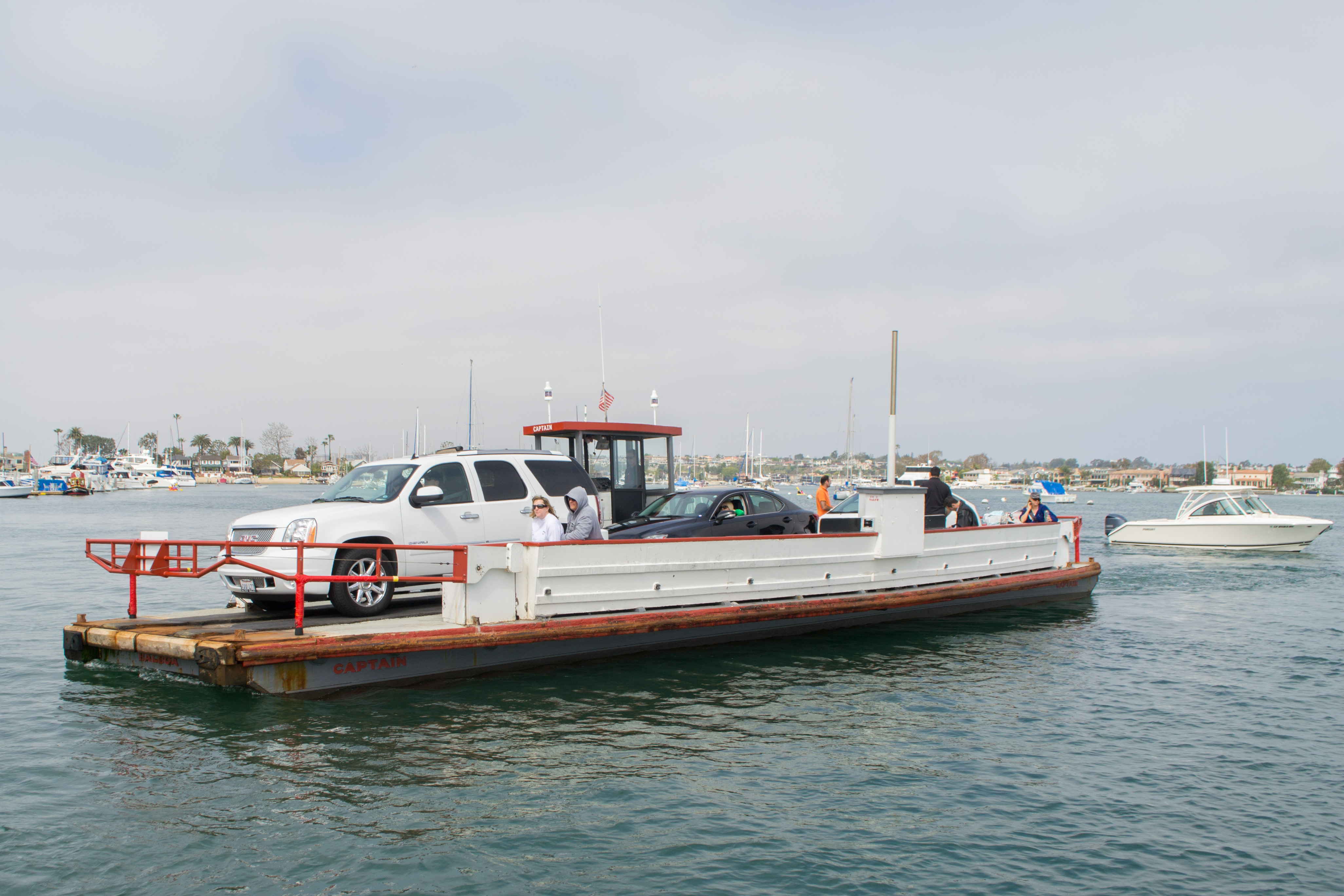
Balboa Island Ferry
At four miles per hour, the Balboa Island Ferry might be the slowest way to cross anything in Southern California. That is precisely the point. Since 1919, when Joseph Allan Beek first pushed off from shore in a giant rowboat called The Ark, this three-vessel fleet has carried passengers less than a thousand feet across Newport Harbor, docking approximately every five minutes, day after day, year after year. The speed limit in the harbor is five miles per hour. The ferry runs just under it. Beek's three sons still run the business, and the three wooden boats their father built in the 1950s remain in service, having transported more than two million passengers between Balboa Island and the Balboa Peninsula.
The Ark and After
Joseph Allan Beek obtained ferry rights from Newport Beach in 1919 and started with what he had: an oversized rowboat equipped with a small engine and a set of oars in case it failed. There was no schedule. Customers telephoned when they needed a ride across. The fare was five cents. Three years later, Beek built the Fat Ferry, a vessel capable of holding twenty passengers. He then added a small one-car barge that the Fat Ferry pushed across in front of it like a floating trailer. Progress came incrementally. In the 1950s, Beek constructed three double-ended wooden boats, the Admiral, the Commodore, and the Captain. Each holds three cars and seventy-five people. These three vessels still operate today, making at least 22,500 dockings per year, traveling roughly 3,200 miles annually, all within that same thousand-foot stretch of harbor water.
Hollywood on the Water
The ferry's unhurried charm caught the attention of filmmakers early. In 1949, director Max Ophuls chose the ferry for scenes in The Reckless Moment, a film noir starring James Mason and Joan Bennett. The Commodore appeared in the 1999 Disney telefilm The Thirteenth Year. California's Gold, the beloved public television series hosted by Huell Howser, featured the ferry in Episode 10009. The appeal is obvious: few settings capture mid-century California coastal life quite like a three-car wooden ferry puttering across a harbor at walking speed, the Fun Zone's Ferris wheel turning in the background, the Balboa Pavilion standing watch from its perch nearby.
Landmarks Within Reach
The ferry deposits passengers at the Fun Zone, established in 1936, where a merry-go-round and Ferris wheel still operate among shops and food stands. The Balboa Pavilion, Newport Beach's most famous landmark, dates to 1906, built as a sister project with the Balboa Pier to lure land buyers to the peninsula. The Rendezvous Ballroom once stood nearby, a 1928 dance hall that burned in 1966 and now exists only as a commemorative plaque. Larger ferries depart from the peninsula for Catalina Island, but the Balboa Island Ferry belongs to a different scale entirely. Its crossing measures in feet rather than miles, in minutes rather than hours, in cents rather than dollars.
A Dollar and Change
Current fares reflect over a century of modest inflation. Adults pay $1.25. Vehicles cost $2.25. Children five to eleven ride for fifty cents; those under five travel free. Adults with bikes pay $1.50, children with bikes seventy-five cents, motorcycles $1.75. The boats require constant maintenance but rarely interrupt service. A two-week shutdown in 2008, the first extended closure in fifty years, allowed rebuilding of the automobile ramp. In January 2022, construction limited the ferry to foot traffic only. In 2024, an $8.3 million grant provided a lifeline for continued operations. Through it all, the Beek family has maintained what their father began: a crossing that takes about as long to complete as it takes to read about it.
From the Air
Located at 33.60N, 117.90W in Newport Harbor between Balboa Island and Balboa Peninsula. The ferry route is visible as a short crossing near the Balboa Fun Zone and the distinctive Balboa Pavilion building. John Wayne Airport (KSNA) lies 5nm north. Best viewed at 1,000-2,000 feet AGL to see the ferry boats making their continuous crossings alongside recreational boats in the harbor.