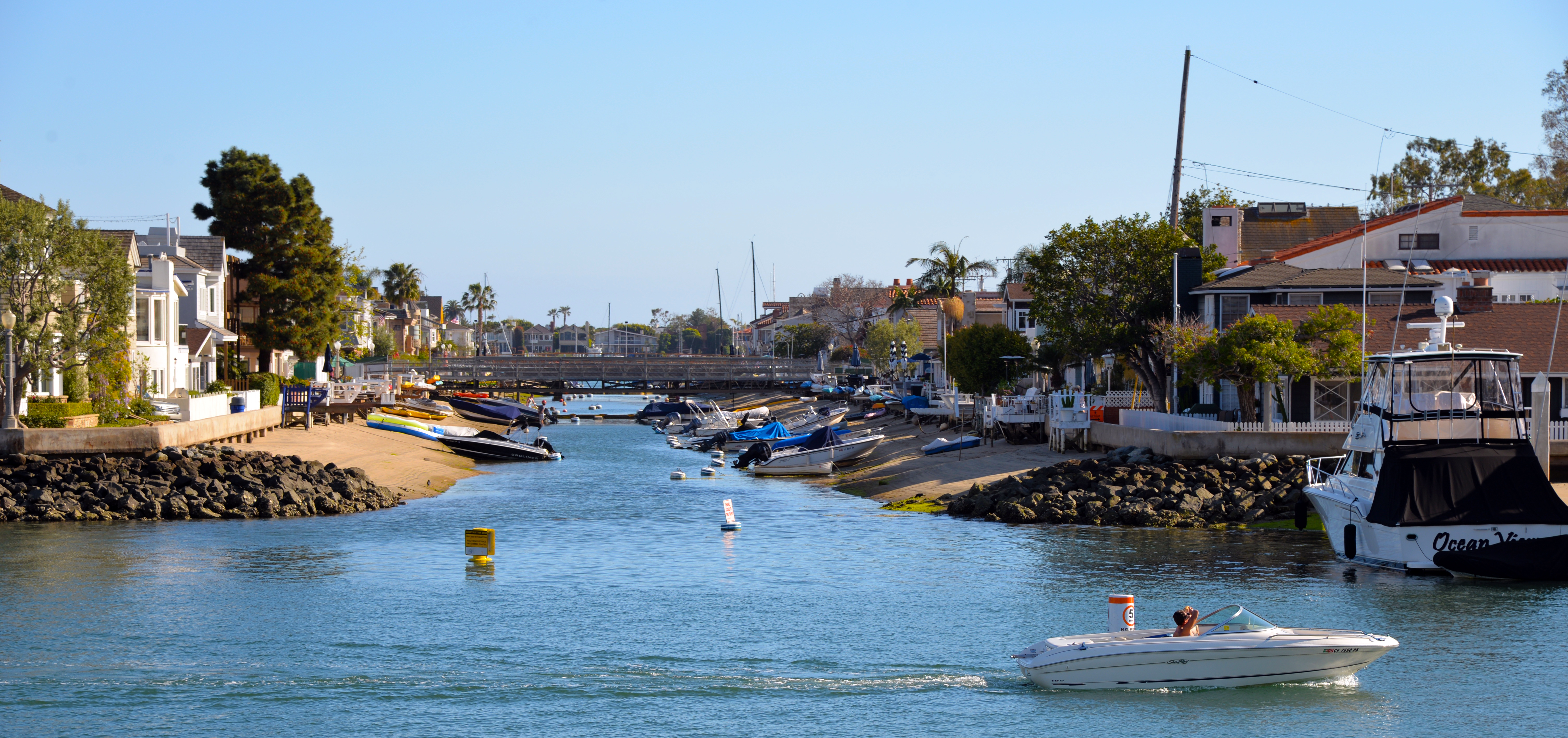
Balboa Island, Newport Beach
In 1906, Collins built a dredge and began pumping sand and silt onto mudflats that would become Balboa Island. He sold the first lots for twenty-five dollars, promising streets, sewers, streetlights, and ferry service. The wooden bulkhead he erected drained sewage onto beaches at low tide to keep the discharge out of sight. Today, those same lots sell for two million dollars before a house ever goes up. Interior new construction runs four million; bayfront properties reach nine million. The population density exceeds San Francisco's. Balboa Island rose from harbor mud to become one of the most expensive real estate markets in North America outside of Lower Manhattan, and the frozen banana stand from Arrested Development is not even the strangest thing about it.
Dredged Into Existence
Originally, there was no island at all. The site was a mudflat surrounded by swampland in what would become Newport Harbor. In the late 1860s, James and Robert McFadden purchased much of this future shoreline and began subdividing. Captain Samuel Dunnells established Newport Landing in 1870 after his steamer Vaquero ventured into the bay with lumber and shingles. The McFaddens acquired the landing in 1875 and operated a shipping business for nineteen years. When the federal government chose San Pedro as Southern California's major seaport in 1899, the McFaddens sold to the Southern Pacific Railroad and the commercial era ended. What remained was real estate potential. Collins and Hanson partnered with Henry E. Huntington, who had acquired the Pacific Electric railway. By 1906, the Red Cars brought thousands of visitors from Los Angeles to the Balboa Peninsula and Pavilion. Collins started dredging a channel and depositing the fill where Balboa Island now stands.
Three Islands in One
The community actually comprises three modified or artificial islands in Newport Harbor. Balboa Island proper is the largest. Little Balboa Island lies to the east, connected by a two-lane bridge. Collins Isle sits to the northwest, joined by a one-lane bridge. A short two-lane bridge links Balboa Island to the mainland on its northeast side, while the privately operated Balboa Island Ferry provides access to the Balboa Peninsula to the south. The island became part of Newport Beach in 1916. The Balboa Island Improvement Association, founded in 1918, pushed for bulkhead repair, a sewer system, water, gas, electricity, paved streets, and streetlights. Jamboree Road, originally a muddy trail called Palisades Road, became a major thoroughfare ending at the island. According to the 2000 Census, approximately three thousand residents live on just under forty-five acres, giving Balboa Island a population density of 17,621 people per square mile.
Bananas and Film Noir
The island's cultural footprint extends beyond its property values. The 1949 film noir The Reckless Moment, directed by Max Ophuls, was set primarily on Balboa Island, a change from the novel it adapted. In the 1958 RKO musical The Girl Most Likely, Jane Powell's character Dodie lives on the island and commutes by ferry. The sitcom Arrested Development placed its family-owned frozen banana stand here. The Netflix series Dirty John featured characters leasing a waterfront property after dating only five weeks. Even the indie game Raft sends players to gather materials on Balboa Island. The Village Inn, locally known as VI, has served as the island's only bar for more than eighty years, sitting near the end of Marine Avenue where small businesses, restaurants, bakeries, and craft shops line the commercial spine.
Waterfront Living
Marine Avenue and Agate Avenue form the island's commercial center. A fire station and post office serve the community. The perimeter along the bayfront bristles with private piers for homeowners' boats. A paved concrete boardwalk circles the island, open to pedestrian traffic. Lot sizes run thirty by eighty-five feet. Some owners combine parcels to create one-and-a-half or double lots for larger homes. Notable residents have included actor and dancer Buddy Ebsen, silent film star J. Warren Kerrigan, and retired basketball player John Vallely. The island maintains several associations: the Balboa Island Improvement Association, the Business Improvement District on Marine Avenue, and the Little Balboa Island Association for homeowners on the smaller adjacent island. What began as dredged mud sold for pocket change now commands prices that would buy entire city blocks elsewhere.
From the Air
Located at 33.61N, 117.89W in Newport Harbor, Balboa Island appears as a distinct developed island connected by bridges and ferry. The island's grid pattern of streets is visible from altitude, surrounded by yacht-filled harbor waters. John Wayne Airport (KSNA) lies 4nm north. The Balboa Peninsula extends south with its pier and Fun Zone. Best viewed at 2,000-3,000 feet AGL to appreciate the island's artificial shape and dense development against the natural harbor geography.