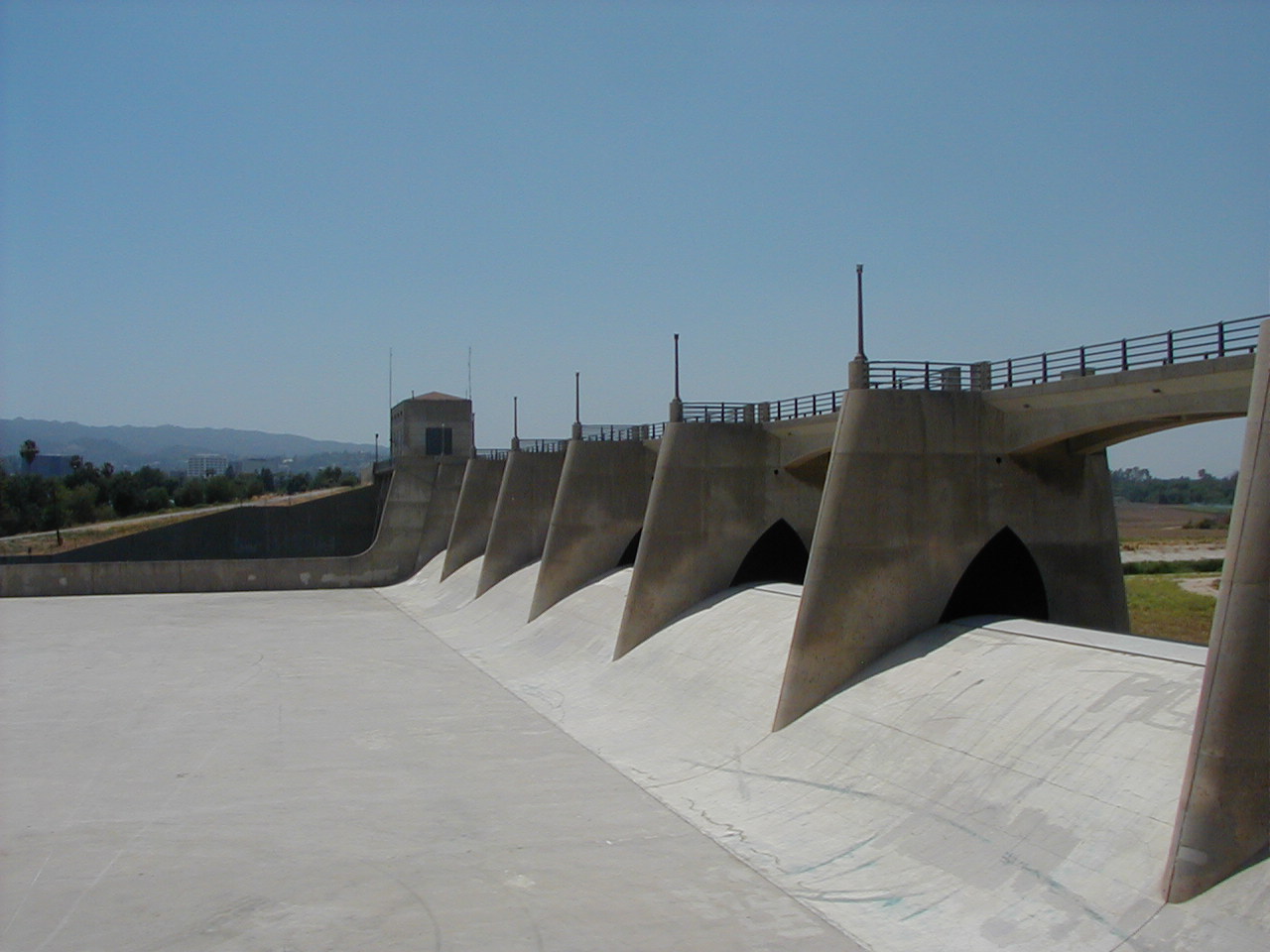
Baldwin Hills Dam Disaster
It took only 77 minutes for the reservoir to empty. After three hours of increasingly serious leakage through the east abutment, the Baldwin Hills Dam breached on December 14, 1963, sending 250 million gallons of water roaring down Cloverdale Avenue, La Brea Avenue, La Cienega Boulevard, and Jefferson Boulevard. Five people died. The flood destroyed 277 homes and damaged countless others. Some 16,000 people lived in the path of the water, and 500,000 lost their supply. The reservoir had been built to protect Los Angeles from catastrophe, to ensure safe water in case of earthquake, fire, or war. Instead, it became the catastrophe itself.
A Reservoir Built on Shifting Ground
The Baldwin Hills Reservoir sat atop unstable ground from the start, though the full extent of that instability would only emerge in decades of legal disputes and engineering conferences that followed its collapse. Engineer Ralph Proctor, who designed the dam, had previously worked on the reconstruction effort following the catastrophic 1928 St. Francis Dam failure that killed over 400 people north of Los Angeles. He had devised new methods of compacted earth fill specifically because of that disaster. Yet he pressed forward with the Baldwin Hills project despite safety concerns and design disagreements within his own department. The reservoir was constructed in an area where the Inglewood Oil Field had been extracting petroleum for decades, causing ground subsidence of approximately twelve feet half a mile west of the site.
The Day the Dam Broke
Signs of lining failure appeared first, followed by leaks that grew more serious by the hour. Then the dam breached at its east abutment, along the alignment of a previously unknown fault. KTLA deployed a helicopter to cover the disaster as it unfolded, the first aerial news coverage of a dam failure in progress. A 17-year-old photography student named Richard N. Levine rushed to a high vantage point and captured the evolving dam break in 35-millimeter photographs. The floodwaters swept through Village Green, a residential development where three of the five victims lived. Maurice Clifton Carroll, 60, was found several blocks from his home. Arch Young, 58, was discovered in a pile of rubble about 1,200 meters from where he had been. The glasses of 70-year-old MacDonald, executive director of the Los Angeles Furniture Mart, were found by a youth in Ballona Creek and identified by his eye doctor.
The Oil Connection
The cause of the failure became a decades-long controversy entangled in lawsuits and conflicting expert testimony. The California Department of Water Resources concluded vaguely in 1964 that the failure resulted from "an unfortunate combination of physical factors." But the US Geological Survey was more direct: in 1976, they concluded that 90% or more of the ground displacements causing the reservoir failure were attributable to exploitation of the Inglewood Oil Field. Geologist Douglas Hamilton discovered in 1970 that oilfield waste brines were seeping along the fault that had ruptured beneath the reservoir. Engineer Thomas Leps, serving as a neutral reviewer, determined that about seven inches of fault offset had occurred beneath the reservoir during its life, with roughly two inches happening in the months just before failure, coinciding with repressurization of the oilfield.
Whose Fault Was It
The legal implications shaped the scientific debate. A team led by Arthur Casagrande, Harvard successor to the legendary soil mechanics pioneer Karl Terzaghi, argued that oilfield operations played no significant role, attributing the failure entirely to defective siting and design. This view, which exonerated the oil companies, was sponsored by Standard Oil. Other engineers reached different conclusions. The matter was settled out of court by 1972, but discussions continued in engineering conferences for decades. In 2001, researchers Mahunthan and Schofield introduced another theory: that overcompaction of the dam fill and lining had made the structure dangerously unstable, a finding that contradicted conventional American geotechnical engineering practices of the time.
What Remains
The former reservoir site is now Kenneth Hahn State Recreation Area, a community park where joggers and families have replaced the water that once threatened them. A plaque was placed at the site on the 50th anniversary of the disaster in 2013. But the story is not entirely history. The associated faults to the southeast, in the Stocker-LaBrea and Windsor School areas, continue to move as of 2012, causing damage to private and public facilities. The current oilfield operator, Plains Exploration and Production Company, does not acknowledge any causal connection between fault movements and oilfield activities. Shallow hydraulic fracturing has been introduced to stimulate production in the southeast part of the Inglewood field, generating public concern. The ground beneath Baldwin Hills continues to shift, a reminder that the forces which destroyed the reservoir have not gone dormant.
From the Air
The former Baldwin Hills Reservoir site, now Kenneth Hahn State Recreation Area, is located at approximately 34.008N, 118.364W in South Los Angeles, roughly 8 nautical miles southwest of downtown. The area sits in the Baldwin Hills, a low range rising from the Los Angeles Basin. The distinctive green parkland is visible from altitude, surrounded by urban development. Nearby airports include Los Angeles International (KLAX) approximately 5 nm southwest, Hawthorne Municipal (KHHR) approximately 3 nm south, and Santa Monica (KSMO) approximately 6 nm northwest. The site lies beneath the LAX Class B airspace, requiring clearance or careful navigation around the shelf. The Inglewood Oil Field is visible to the west with its characteristic pumpjacks.