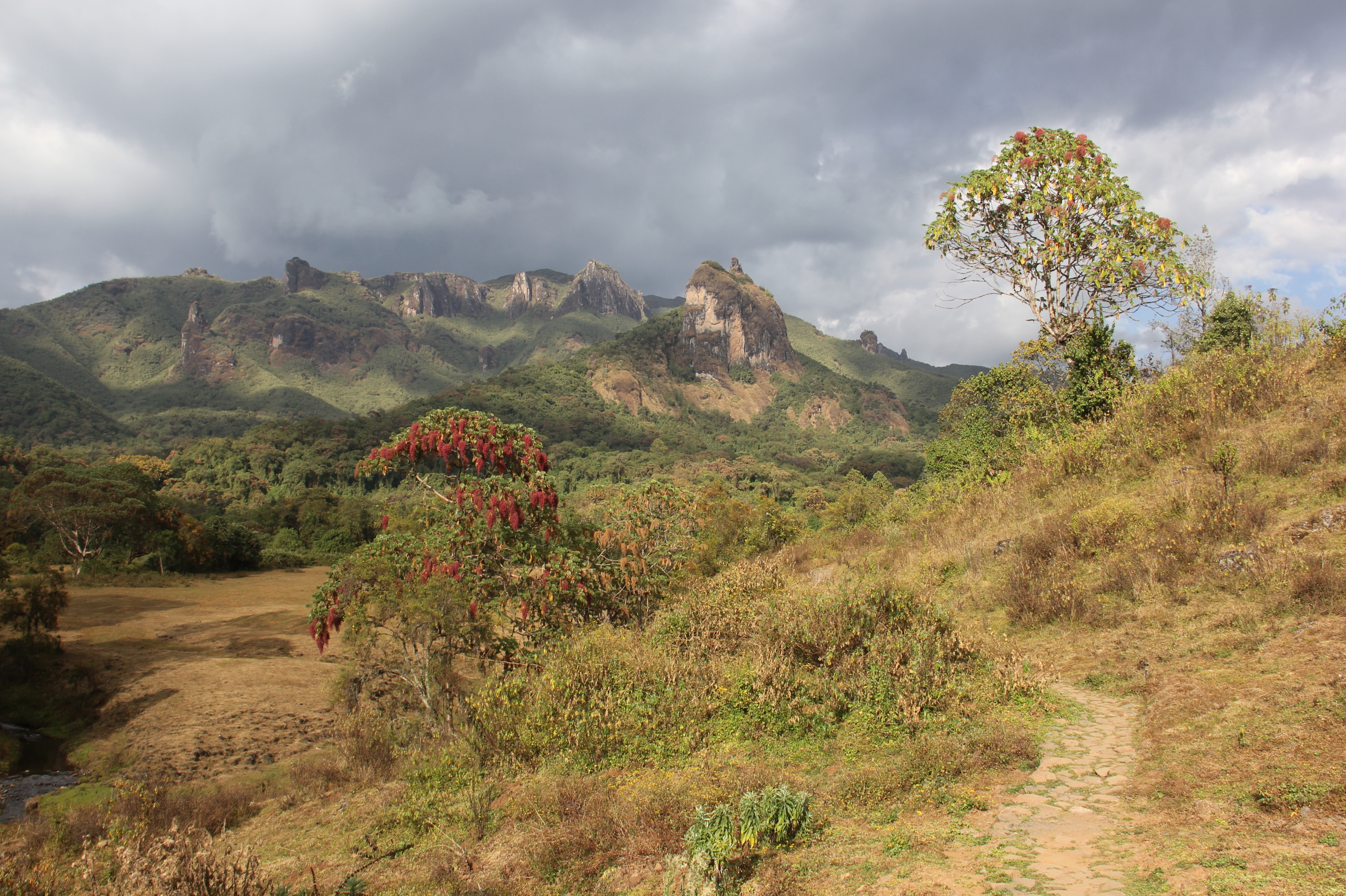
Bale Mountains National Park
Fewer than 500 Ethiopian wolves survive on Earth, and more than half of them live here. The Bale Mountains National Park, spread across the highlands of southeastern Ethiopia, is the last stronghold of the world's rarest canid -- a rust-colored predator that hunts giant mole-rats on Afro-alpine plateaus above 3,000 meters. But the wolves are only the beginning. This park, nominated for World Heritage status in 2009, holds one of the highest concentrations of endemic animals of any terrestrial habitat on the planet, a wild genetic reservoir for Coffea arabica, and a cloud forest so dense and unexplored that new species are still being discovered within it.
The Roof of Africa's Horn
The park encompasses the Bale Mountains and the Sanetti Plateau in the Ethiopian Highlands, southeast of Addis Ababa in the Oromia Region. The landscape shifts dramatically with elevation. On the Sanetti Plateau, daytime temperatures hover around 10 degrees Celsius with fierce winds and night frosts above 3,000 meters. Drop into the Gaysay Valley and the temperature climbs to 20 degrees. Descend further into the Harenna Forest and it reaches 25 degrees beneath a dense canopy where leopards, lions, and giant forest hogs move through undergrowth that feels more equatorial than highland. The rainy season runs from May through November, and the weather can change with a violence that catches even experienced trekkers off guard. This is not gentle mountain terrain. It is a vertical ecosystem compressed into a few thousand meters of elevation gain.
The Wolf and the Mole-Rat
The Ethiopian wolf -- Canis simensis -- is the park's most famous resident and the world's most endangered canid. Slender, long-legged, and fox-like in appearance, the wolves hunt in the Afro-alpine grasslands of the Sanetti Plateau, where their primary prey is the big-headed African mole-rat. Almost one-third of the 47 mammal species recorded in the park are rodents, and this rodent community is a keystone of the entire ecosystem -- supporting not just the wolves but also servals, spotted hyenas, and raptors. The mountain nyala, another species found nowhere else, shares the highlands alongside Menelik's bushbuck, klipspringer, Bohor reedbuck, and the rare Bale Mountains vervet. In the lower Harenna Forest, a different assemblage emerges: African golden wolves, mantled guerezas, African leopards, and African wild dogs. The park holds 47 mammal species in total, distributed across elevation bands like residents of a vertical city.
Wings, Songs, and Ancient Coffee
With 282 bird species recorded -- including nine of Ethiopia's sixteen endemic species -- the Bale Mountains are among the most important birding destinations in Africa. The blue-winged goose, spot-breasted lapwing, Abyssinian longclaw, and Abyssinian catbird all breed here, along with over 170 migratory species passing through each year. At least seven endemic amphibian species have been discovered in the park's forested swamps and high plateaus, several of them endangered by habitat loss. The forests hold another kind of treasure: wild populations of Coffea arabica, the genetic ancestor of the coffee that fuels much of the modern world. Three medicinal plant hotspots have been identified in the Gaysay and Angesu areas, and the hagenia trees produce flowers containing anthelmintic compounds that local communities have used for generations to treat tapeworms. The biodiversity here is not just scenic -- it is pharmacological and agricultural, a living library of genetic material.
The People of Bale
The Bale Mountains are not empty wilderness. The surrounding region is home to approximately 1.5 million people, predominantly Oromo-speaking farmers and cattle herders. Afan Oromo, a Cushitic language, serves as both the official language of Oromia and a lingua franca for over 25 million Oromos across Ethiopia. Most people in the Bale area also speak some Amharic, the national language. The relationship between the park's conservation mission and the communities that have lived alongside these mountains for centuries remains one of Ethiopia's most important environmental negotiations. Livestock grazing, settlement expansion, and deforestation press against the park's boundaries, threatening the endemic species within. The Ethiopian wolf, in particular, faces pressure not just from habitat loss but from domestic dogs that carry rabies and canine distemper into the highlands. Protecting the world's rarest canid means protecting an entire landscape -- and finding ways for wolves and herders to share the roof of the Horn of Africa.
From the Air
Located at approximately 6.67N, 39.67E in the Ethiopian Highlands southeast of Addis Ababa. The Sanetti Plateau rises above 4,000 meters (13,100 feet), making it one of the highest driveable roads in Africa. Terrain is extreme -- mountain peaks, deep valleys, and cloud forest. Addis Ababa Bole International Airport (HAAB) is the nearest major field, approximately 400 km northwest. No significant airports nearby; expect high terrain, variable mountain weather, and limited diversion options. Visual identification of the park is aided by the distinctive flat-topped Sanetti Plateau and the dark Harenna Forest on the southern escarpment.