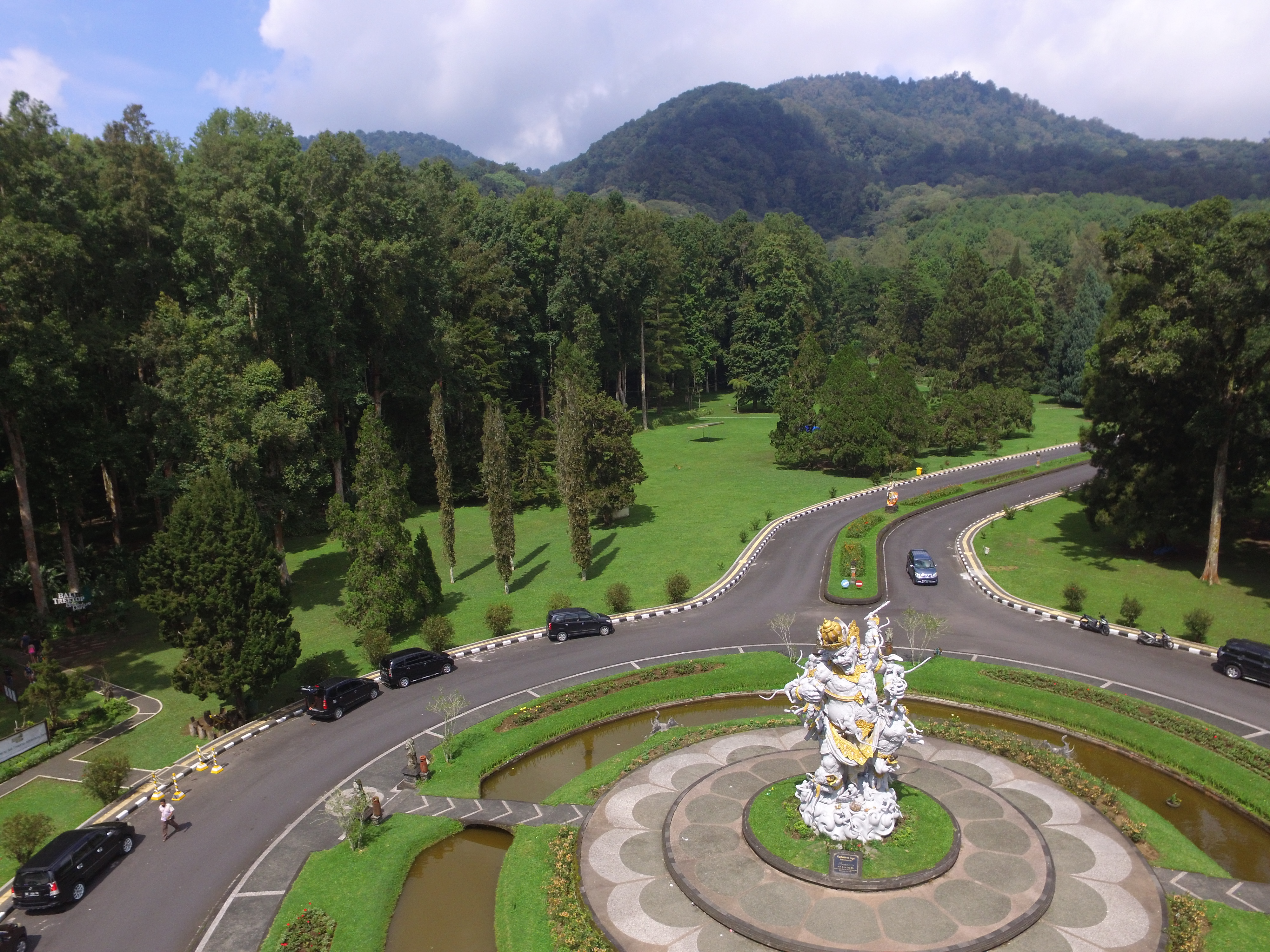
First Creation: Bali's Garden in the Clouds
The name tells you everything. Eka Karya -- "first creation" in Balinese -- is what they originally called this garden, and the ambition behind that name has never faded. Established on July 15, 1959, just fourteen years after Indonesian independence, the Bali Botanic Garden was the young nation's first attempt to build a botanical preserve entirely its own, free from colonial legacy. They chose a remarkable site for it: a 157.5-hectare sweep of highland forest on the slopes of Tapak Hill in Bedugul, 1,300 meters above sea level, where clouds drift through the canopy and daytime temperatures rarely climb above 25 degrees Celsius. Below, Lake Bratan shimmers beside the iconic Ulun Danu Temple. Above, the forest thickens into the Batukaru Nature Reserve. Between them, the garden holds more than 21,000 living specimens -- the largest botanical collection in Indonesia.
A Greenhouse Nation's Living Archive
Indonesia spans the world's largest archipelago, and its plant diversity is staggering. The Bali Botanic Garden was designed to capture a particular slice of that richness: the montane flora of eastern Indonesia. Its 2,400 species represent the highland ecosystems of Bali, Nusa Tenggara, Sulawesi, Maluku, and Papua -- islands whose mountain forests are among the least studied and most threatened in Southeast Asia. The collections range from orchids and ferns to cacti and carnivorous plants, each section arranged across the hillside's natural contours. A herbarium supplements the living collections with 10,000 preserved plant specimens, from algae to flowering plants. The garden was originally intended to specialize in gymnosperms -- the ancient conifers and their relatives -- but its mission expanded as Indonesia's conservation needs grew more urgent.
Interrupted by History
The garden's early years mirrored the turbulence of the nation that created it. Development halted abruptly in 1965 when political upheaval swept Indonesia, and the grounds fell silent for a decade. It was not until April 30, 1975, that the garden reopened, its area expanded to 129.2 hectares and its mission broadened to include ex-situ conservation -- the practice of protecting species by growing them outside their native habitat. This became the garden's quiet purpose: a refuge for plants whose mountain forests were shrinking. By 2001, the grounds had expanded again to their current 157.5 hectares, operated by the Indonesian Institute of Sciences. The garden had survived the political storms that could have ended it, and in doing so had become something more than a collection of plants -- it had become a statement of persistence.
Where the Wild Things Cross
The garden's location at the edge of the Batukaru Nature Reserve means that the boundary between cultivated collection and wild forest blurs in interesting ways. At least 79 species of birds inhabit the grounds, their calls threading through the canopy from dawn. Treeshrews -- small, alert mammals that look like a cross between a squirrel and a shrew -- are regularly spotted foraging among the garden paths. Occasionally, long-tailed macaques wander in from the reserve, treating the garden's carefully tended collections as their personal buffet. Three Hindu temples sit within the garden's boundaries, their stone walls softened by moss and fern, linking the botanical preserve to the spiritual landscape that defines Balinese life. On clear days, the giant ficus tree on the upper slopes of Tapak Hill frames a view down to Lake Bratan that has made it one of the most photographed trees on the island.
A Garden for the People
Unlike many botanical gardens that cater primarily to researchers and plant enthusiasts, Eka Karya has always balanced science with accessibility. A traditional Balinese-style guesthouse welcomes overnight visitors. The grounds accommodate scientific conferences -- including an international fern conference in 2013 -- alongside school groups and families on holiday. By 2011, the garden was drawing 350,000 visitors annually, including 10,000 international guests. Most arrive from the beaches and rice terraces of southern Bali, climbing ninety minutes through increasingly cool and misty highlands to reach a landscape that feels nothing like the tropical island below. The humidity hangs between 70 and 90 percent, and at night temperatures can drop to 10 degrees Celsius -- a shock for visitors accustomed to Bali's coastal warmth. But that coolness is the point. It is what allows montane species to thrive here, far from their threatened native ranges, preserved in a garden whose name still fits: a first creation, still growing.
From the Air
Located at 8.28S, 115.15E in the central highlands of Bali at approximately 1,300 meters elevation. The garden sits on the slopes above Lake Bratan, which is clearly visible from altitude as a dark body of water in the caldera. Ngurah Rai International Airport (WADD) is approximately 50 km to the south. The Bedugul highland area is identifiable by its dense forest cover and cooler cloud patterns compared to the coastal lowlands.