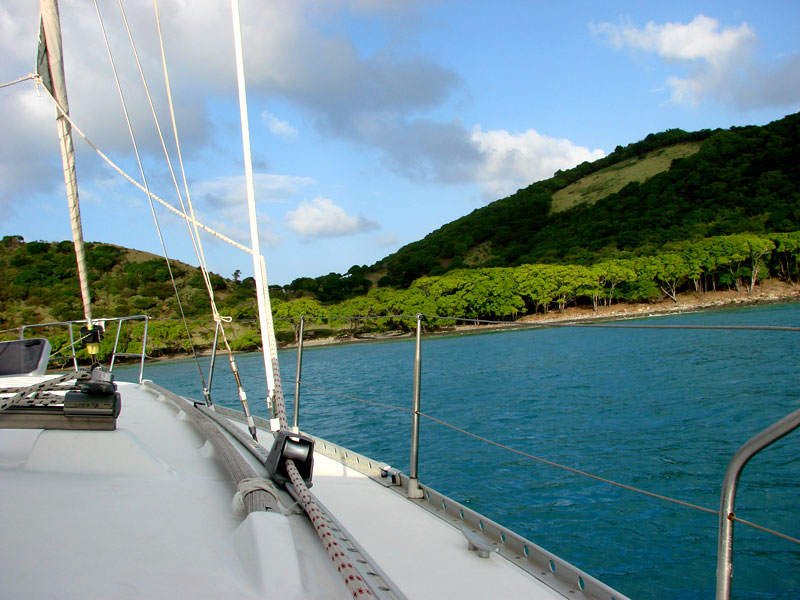
Baliceaux
From a distance, Baliceaux looks like any other small Caribbean island: green hills rising from turquoise water, part of the Grenadines chain strung between Saint Vincent and Grenada. Nothing about its appearance prepares you for what happened here. In 1797, British colonial authorities crowded nearly 5,000 Garifuna men, women, and children onto this island after defeating their resistance on Saint Vincent. There was no fresh water. There was no shelter. There was no food supply. Over seven months, roughly half of the prisoners died of starvation, disease, and exposure. Their remains lie in unmarked graves beneath the grass and scrub. Baliceaux is beautiful. It is also a graveyard.
Before the Horror
Spanish navigators encountered Baliceaux in the fifteenth century, but the island's recorded history is sparse until the late eighteenth century. Its highest point, Gun Hill, served as a military observation station during the conflicts that swept the Caribbean between 1772 and 1797. The island is small, privately held for most of its modern history, and has never supported a permanent settlement. It lies among the northern Grenadines, close enough to Saint Vincent to see the larger island's volcanic peaks on a clear day. For the Garifuna people who were brought here against their will in 1797, that proximity must have been its own form of cruelty: their homeland visible on the horizon, but impossibly out of reach.
The Valley of Dry Bones
After the Second Carib War ended with the defeat of the Garifuna resistance on Saint Vincent, the British did not simply claim victory. They carried out a systematic deportation. Nearly 5,000 Garifuna -- including elders, women, and children -- were removed from their homes and transported to Baliceaux. The island had none of the infrastructure needed to sustain a population of that size. There were no buildings, no water sources adequate for thousands, no cultivated food. The imprisoned Garifuna were left to die, and many did. Disease -- likely including yellow fever and dysentery -- tore through the crowded, starving population. Approximately 2,445 people perished during the seven months the survivors were held on the island. The British then loaded the remaining 2,026 Garifuna onto transport ships and sent them to Roatan, an island off Honduras, 1,700 miles from everything they had ever known.
Unmarked and Unexcavated
For more than two centuries, the graves of the Garifuna who died on Baliceaux received no official recognition. No monuments were erected. No archaeological excavation was conducted. The island passed through private hands, at one point listed for sale in 2023 with an asking price of thirty million dollars. The prospect of a sacred burial ground being sold as a luxury real estate listing galvanized Garifuna communities across the Caribbean and Central America. The Garifuna Heritage Foundation and diaspora organizations called for the island's acquisition as a cultural heritage site. Every March, on National Heroes Day in Saint Vincent, Garifuna descendants make a pilgrimage across the water to Baliceaux, walking the ground where their ancestors suffered and died, singing songs of remembrance in the Garifuna language.
Reclaimed
In March 2025, Prime Minister Ralph Gonsalves announced in the parliament of Saint Vincent and the Grenadines that the government had acquired Baliceaux. He cited the island's historical and cultural significance to the Garifuna people as the reason for the purchase, stating that the former owners would receive fair compensation. For the Garifuna diaspora -- communities now spread across Honduras, Belize, Guatemala, Nicaragua, and the United States, all tracing their ancestry to the survivors of Baliceaux -- the acquisition carried profound weight. The island where the British had tried to erase a people would now belong to the nation those people helped build. What happens next on Baliceaux remains to be determined: whether it becomes a memorial, a heritage site, or simply a place where the dead are finally acknowledged. But after 228 years, the ground beneath the grass is no longer for sale.
From the Air
Baliceaux is located at 12.95N, 61.13W among the northern Grenadines, between the islands of Saint Vincent and Bequia to the northwest and Mustique to the south. It is a small, hilly, uninhabited island visible as a distinct landmass from moderate altitude. Nearest airport: Argyle International Airport (TVSA/SVD) on Saint Vincent, approximately 15 nm to the northwest. Also near J.F. Mitchell Airport on Bequia (TVSB). The island's highest point, Gun Hill, is the most prominent feature. No landing facilities exist on Baliceaux. Approach the Grenadines chain with awareness of inter-island ferry and yacht traffic at lower altitudes.