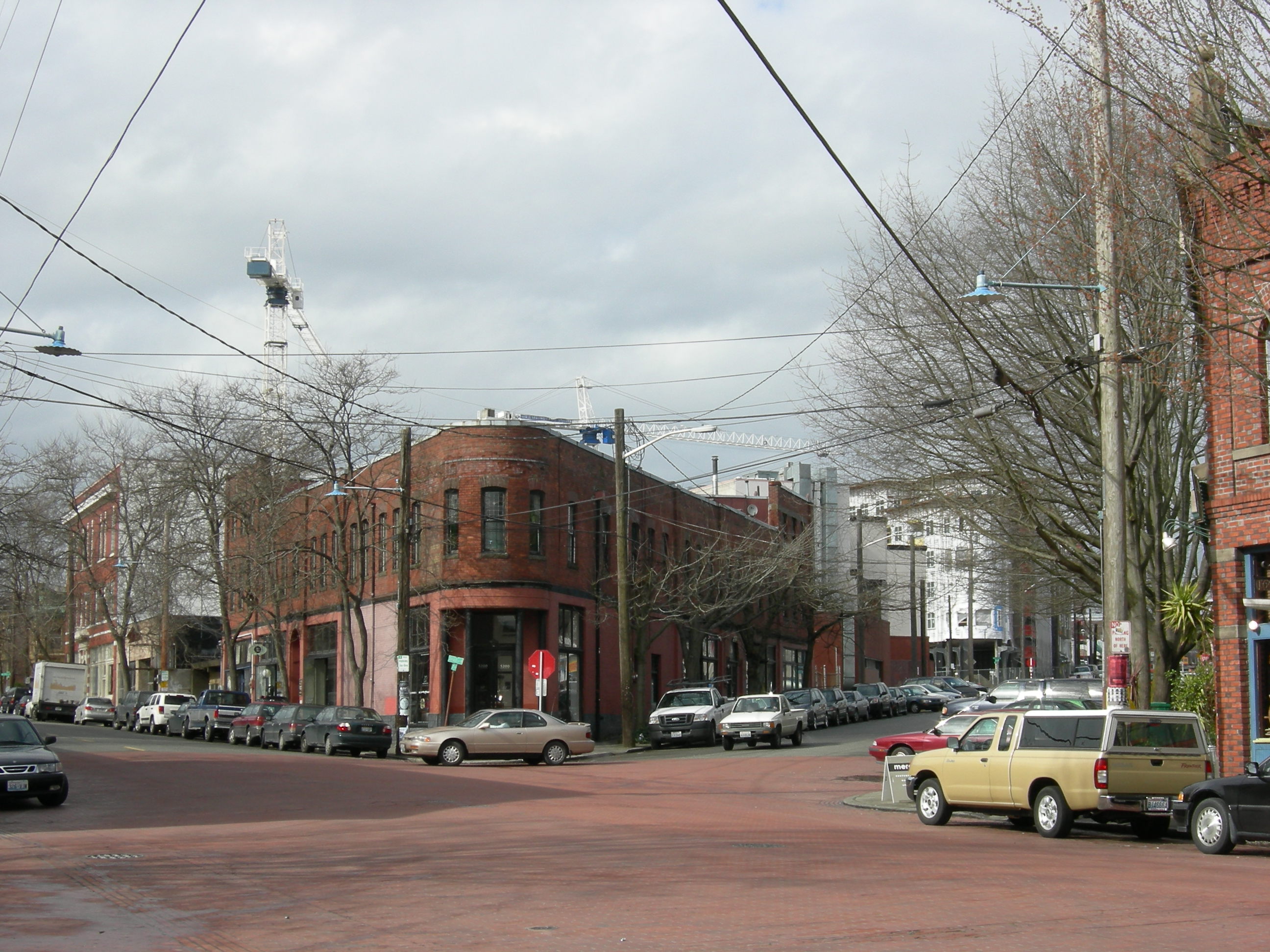
Ballard Avenue Historic District
On April 11, 1976, King Carl XVI Gustaf of Sweden stood in Seattle's Ballard neighborhood and read a proclamation that most Swedish monarchs would never have occasion to deliver: the formal induction of an American commercial street into the National Register of Historic Places. That a Scandinavian king was doing the honors made perfect sense. Ballard had been built by Swedes -- loggers and fishermen who arrived in the 1880s and '90s, drawn by the promise of salmon in Puget Sound and timber in the hills above it. The avenue they built still carries their architectural fingerprints.
A City Within a City
Before Seattle swallowed it through annexation in 1907, Ballard was its own incorporated city, and Ballard Avenue was its commercial heart. The district stretches from NW Market Street to NW Dock Place, running close to the shore of Salmon Bay. Its buildings -- 26 of which bear historic markers erected by the Ballard Historical Society -- face inward toward the avenue in the tight, purposeful arrangement of a small town's main street. These were the shops, saloons, and offices of a community that made its living from the water and the forest. The Swedish immigrants who dominated the neighborhood left behind not just buildings but a cultural imprint so deep that Stockholm sent its king to acknowledge it.
Saving the Street
By the 1970s, the district's original buildings were aging but still intact. The Ballard Avenue Association and Seattle's Urban Conservation Division began documenting the street's historical significance. Their work caught the attention of Mayor Wes Uhlman, who signed the ordinances leading to national recognition. When King Gustaf arrived to make the formal proclamation in 1976, he also dedicated a new bell tower at Marvin's Garden Park. Inside hung the original bell from Ballard's old city hall -- a small artifact linking the independent city's past to its preserved future. The designation as a National Register district (ID #76001885) ensured that Ballard Avenue's character would be protected even as Seattle's development pressures intensified.
Ballard's Broader Landmarks
The Historic District anchors a broader constellation of preserved sites in Ballard. The old Ballard Carnegie Library sits on nearby NW Market Street, built with Andrew Carnegie's money in 1904, back when Ballard still governed itself. The Ballard Bridge crosses Salmon Bay to the south. Fire Station No. 18 still stands as a reminder of the independent city's civic infrastructure. And to the west, the Hiram M. Chittenden Locks connect Puget Sound to the Lake Washington Ship Canal, a feat of early twentieth-century engineering that transformed Seattle's waterways. Together, these landmarks trace the story of a fiercely independent community that joined a larger city but never quite lost its identity.
Nordic Roots, Modern Life
Walk Ballard Avenue today and the old storefronts house breweries, restaurants, and boutiques. The transformation from working waterfront to nightlife destination has been the subject of much hand-wringing -- headlines about condos threatening Ballard's spirit go back decades. But the historic district's protections have kept the physical streetscape largely intact. The brick facades and wooden storefronts still read as a late nineteenth-century commercial row, even if what is sold behind them has changed. The Swedish heritage endures less in the businesses than in the neighborhood's sense of itself: stubborn, self-reliant, and slightly apart from the rest of Seattle.
From the Air
Located at 47.667N, 122.383W, Ballard Avenue runs parallel to Salmon Bay in northwest Seattle. The district is best spotted at 2,000-3,000 feet AGL when approaching from the west, with Salmon Bay and the Hiram M. Chittenden Locks as visual references. The Ballard Bridge is immediately south. Nearest airports: Boeing Field/King County International (KBFI), 8 nm south-southeast; Kenmore Air Harbor (S60), 8 nm northeast.