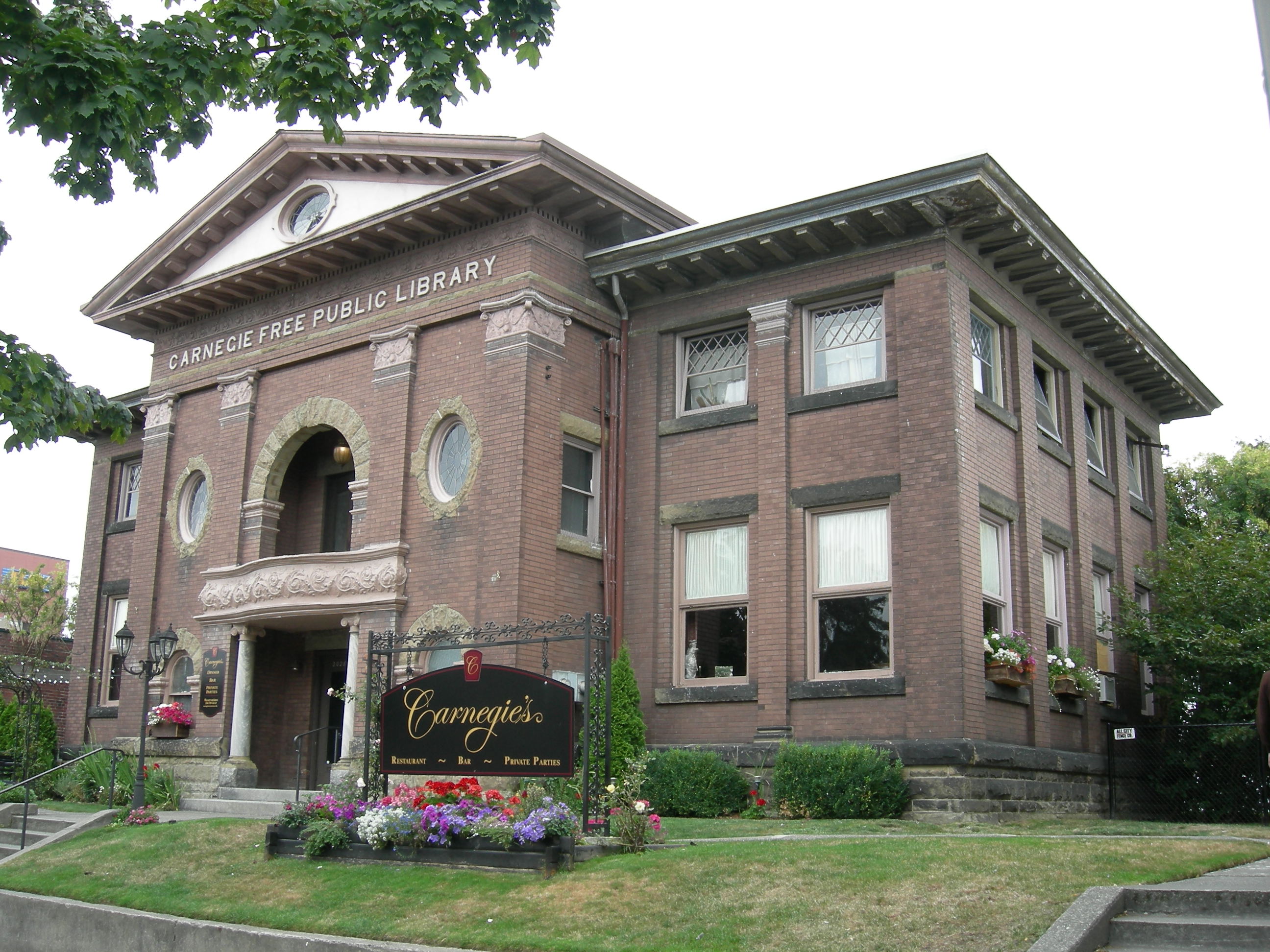
Ballard Carnegie Library
The building had a 500-seat auditorium and a men's smoking room. It was built partly by a chain gang. It opened to the public on June 24, 1904, three years before the city that built it ceased to exist. The Ballard Carnegie Library was not just a place to borrow books -- it was the civic pride of an independent city that would soon be swallowed by Seattle, a monument to what a small waterfront community could accomplish with Andrew Carnegie's money and its own determination.
From Homestead Shelf to Grand Hall
Ballard's relationship with the written word started modestly. In the late 1860s, when the settlement along Salmon Bay consisted of little more than homesteads and timber claims, a man named Ira Wilcox Utter helped establish a freeholders' library -- essentially a shared collection of books among neighbors. By 1901, a women's group had organized a proper reading room and raised funds to support it. But the city council had bigger ambitions. In 1903, they applied to Andrew Carnegie, the steel magnate turned philanthropist who was distributing his fortune in the form of library buildings across the English-speaking world. Carnegie approved a $15,000 grant. Combined with local funds, it was enough to build something genuinely impressive for a town of Ballard's size.
A Building That Did Everything
When the library opened in 1904, it was far more than a repository for books. Its 500-seat auditorium made it Ballard's largest public gathering space. The men's smoking room -- later converted into an additional reading room -- reflected the social customs of the era. The building served as a community center in all but name. After Ballard was annexed by Seattle in 1907, the Carnegie Library became the first major branch of the Seattle Public Library system. It also employed one of Seattle's first African American librarians, a quiet landmark in the city's civil rights history. When World War I began, the library became a distribution point for war information, hosting Red Cross meetings and English language classes for the immigrant population that defined the neighborhood.
Second Lives
The library served Ballard for nearly six decades before closing in 1963, replaced by a newer and larger facility nearby. What followed was an architectural afterlife that might have amused Carnegie: the stately building that once housed his vision of democratic knowledge became, in succession, an antique shop, a restaurant, and a kilt manufacturer. The building survived these reinventions with its essential character intact. On November 7, 2012, Seattle's Landmarks Preservation Board voted to designate the Ballard Carnegie Free Public Library as an official Seattle Landmark, ensuring that whatever business occupies the space next, the building itself will endure -- a relic of the brief, ambitious era when Ballard governed itself.
From the Air
Located at 47.669N, 122.383W on NW Market Street in the Ballard neighborhood of Seattle. The building sits just north of Salmon Bay. Best viewed at 2,000-3,000 feet AGL with the Ballard Avenue Historic District and Hiram M. Chittenden Locks as reference points. Nearest airports: Boeing Field/King County International (KBFI), 8 nm south-southeast; Kenmore Air Harbor (S60), 8 nm northeast.