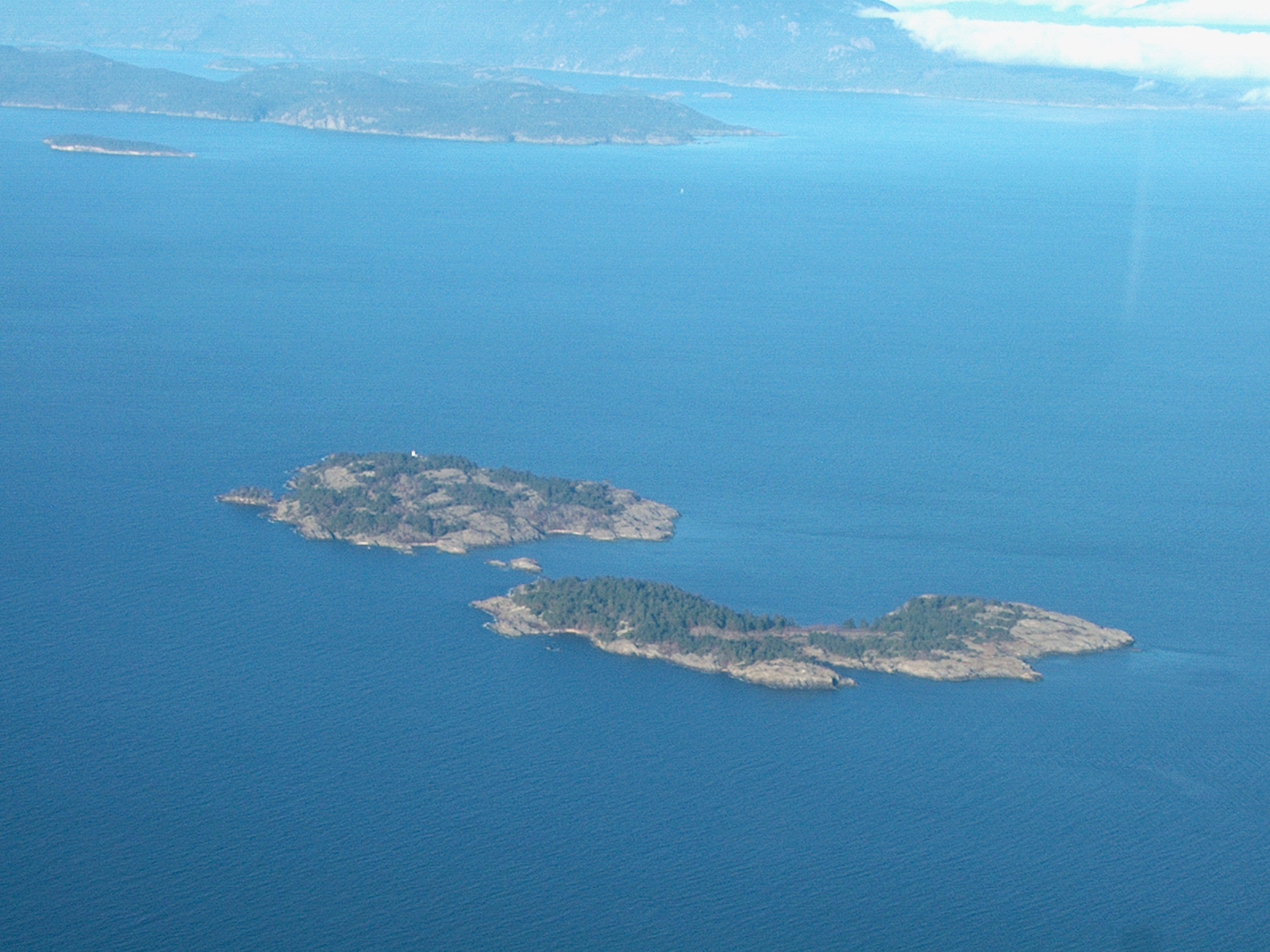
Ballenas Island Light
The name gives it away. Ballenas is Spanish for whales, and the islands earned it from the Spanish explorers who sailed these waters in the late eighteenth century, when humpbacks and grays still moved through the Strait of Georgia in numbers large enough to name a place after. The lighthouse that stands on West Ballenas Island today is a white octagonal concrete tower topped with a red lantern, 27 meters tall, built in 1900 and moved to its current position in 1912. It is not open to the public. The island is privately owned, and the light keeps its own company.
A Light Between Two Shores
West Ballenas Island sits in the Strait of Georgia between Vancouver Island and the British Columbia mainland, in waters where commercial shipping, fishing boats, and pleasure craft all converge. The lighthouse was established in 1900 to mark the passage, and from the beginning it was a posting that demanded self-reliance. Keepers lived on the island with their families, maintaining the light and the fog signal, watching weather roll in from the Pacific and funnel through the strait. The first keeper, William Henry Brown, served from 1901 to 1911, beginning a succession of lightkeepers that would continue for nearly a century.
The Keepers' Roster
The list of keepers reads like a compressed history of a century on the BC coast. Wilhelm Betiat served for a single year in 1911. Arthur Broughton Gurney kept the light from 1912 to 1916, then again from 1920 to 1921, with his wife, Mrs. A.B. Gurney, taking over the post from 1917 to 1919 while he was likely away during the First World War. Frederick Pratt held the position for 19 years, from 1970 to 1989, the longest single tenure in the lighthouse's history. Richard Wood was the last listed keeper, serving from 1994 to 1996, as automation gradually made human tenders unnecessary at stations across British Columbia.
Concrete Against the Strait
The tower itself is a study in pragmatic coastal engineering. Octagonal in plan, built from reinforced concrete, and painted white for maximum visibility against the dark conifers and grey rock of the island, it was designed to withstand the winds that channel through the strait. The red lantern at the top is a standard Canadian Coast Guard aid to navigation, still operational, still sweeping its beam across waters where freighters bound for Vancouver share lanes with kayakers exploring the Gulf Islands. The move from the lighthouse's original position to its current site in 1912 suggests the builders learned something about exposure or visibility in those first dozen years.
Private Island, Public Light
West Ballenas Island is privately owned, which makes this lighthouse unusual among British Columbia's coastal stations. There is no public dock, no visitor center, no interpretive trail. The light serves mariners, not tourists. From the water, the white tower and red cap are visible for miles. From the air, the island is a dark forested shape in the strait, the lighthouse a bright point on its western edge. It is one of dozens of lights along the BC coast, each marking a hazard or a passage, each with its own roster of keepers who lived in isolation so that others could navigate safely. The whales the Spanish named it for have returned to these waters in recent decades, a quiet vindication of the name that has outlasted every keeper on the roster.
From the Air
Ballenas Island Light is located at 49.35°N, 124.16°W on West Ballenas Island in the Strait of Georgia. The white octagonal tower with red lantern is visible from altitude against the dark forested island. The island sits between Vancouver Island and the BC mainland, roughly midway between Nanaimo (CYCD) to the southwest and the Sunshine Coast to the northeast. Parksville and Qualicum Beach are the nearest mainland settlements on Vancouver Island. Approach from the east or west for the best view of the lighthouse against the strait.