Ballintubber Abbey
For over three hundred years, the congregation at Ballintubber Abbey worshipped under open sky. Cromwell's soldiers destroyed the roof in 1653, and no one replaced it. Not because the parish died -- quite the opposite. Through the Penal Laws, when Catholic worship was suppressed across Ireland, the people of County Mayo continued to celebrate Mass in their roofless abbey. Rain fell on the altar. Wind scattered the prayers. The faithful kept coming. When the roof was finally restored in 1966, it was not a resurrection but a renovation. The church had never stopped.
A King's Foundation
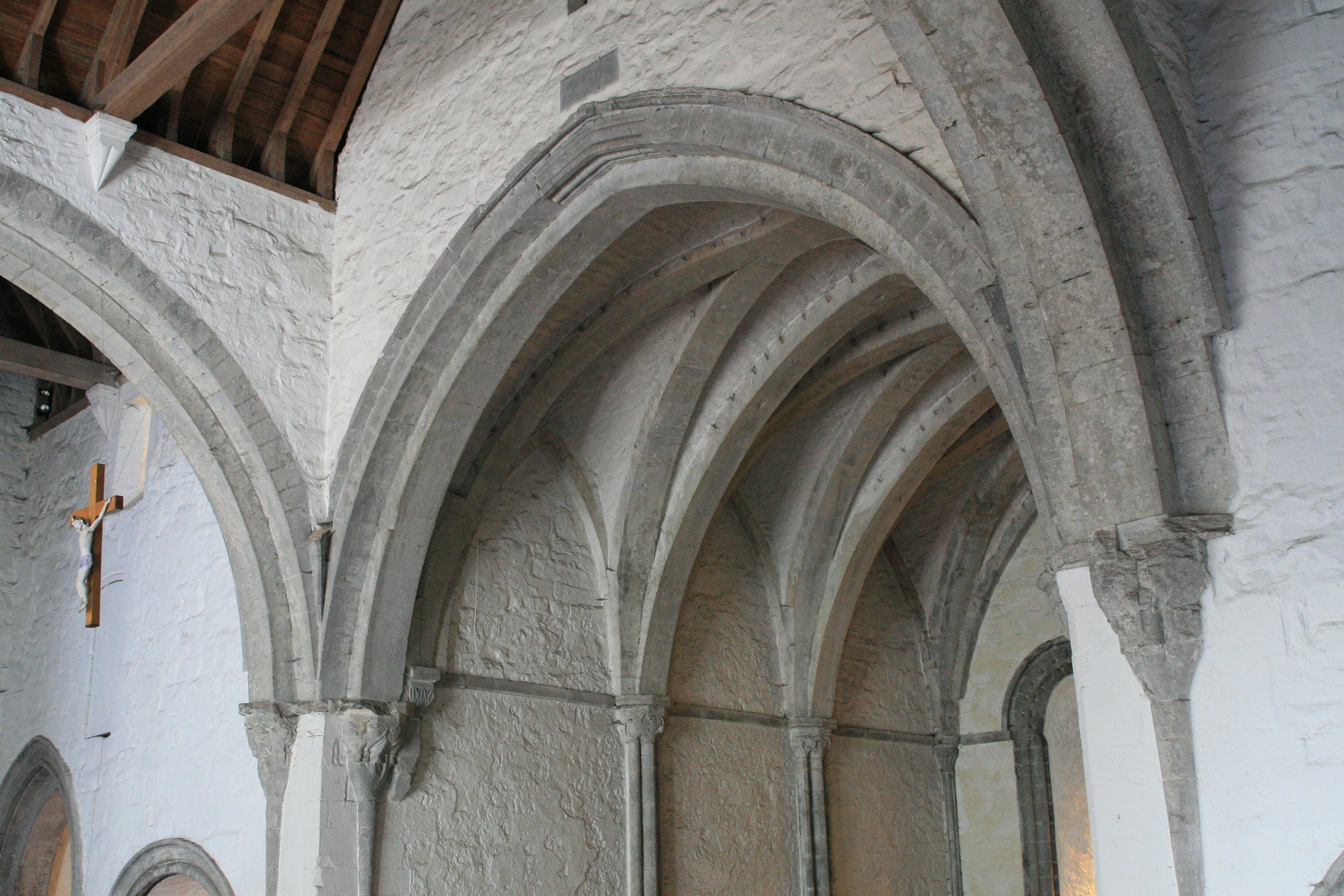
Ballintubber Abbey was founded in 1216 by King Cathal Crobdearg Ua Conchobair, one of the last kings of Connacht. Built in the Hiberno-Romanesque style, the abbey features chevron archivolts and foliate capitals on its three east-facing windows -- architectural details that place it firmly in the transition between Romanesque and Gothic traditions. The design is a Latin cross with a nave, crossing transepts, and a rib-vaulted chancel flanked by chapels. It was, from the beginning, both a working monastery and a place of pilgrimage. The abbey marks the starting point of Tochar Phadraig, the ancient pilgrimage route to Croagh Patrick, Ireland's holy mountain. That path, reopened in modern times by Pilgrim Paths of Ireland, has connected Ballintubber to the broader landscape of Irish faith for eight centuries.
Fire, Sword, and Stubborn Stone
The abbey's history reads like a catalog of catastrophe survived. In 1265, fire destroyed the timber and oak-shingle roof of the nave, though the stone east end stood firm. Gothic pointed arches appeared in the 1270 restoration, layering a new style over the Romanesque bones. Then came Cromwell. The assault of 1653 demolished the monastic buildings, dormitories, cloisters, and domestic quarters. Every timber structure was torn down. Only the stone-vaulted roofs of the chancel, the chapel walls, and the old sacristy survived. For the next three centuries, the abbey endured as a ruin in continuous use -- a contradiction that captures something essential about Irish Catholicism's relationship to persecution.
Three Restorations
Bringing Ballintubber back took more than a century of effort. Archbishop John MacHale led the first attempt in 1846, re-roofing the nave and transepts. George Coppinger Ashlin supervised a more thorough restoration from 1881 to 1890, reinforcing walls, glazing the transept openings, and installing stained glass from Mayer and Company of Munich. The third and most extensive restoration, led by Reverend Thomas A. Egan and Percy le Clerc, Inspector of National Monuments, stretched from 1909 to 1979. The nave received its roof, and the interior was restored to its thirteenth-century appearance: tessellated quarry tile floors, clear glass, and an exposed oak roof. The rib-vaulted chancel, with its carved capitals of animals and birds entwined with leaves, survived all three centuries of exposure and was preserved. In 1997, the Chapter House and Dorter were re-roofed, and a section of the arcaded cloister received a glass roof for visitor comfort.
The Priest Hunter's Grave
Among Ballintubber's more unsettling features is its connection to John O'Mullowny of Ballyhean, one of Ireland's most infamous priest hunters. During the Penal era, men like O'Mullowny tracked down Catholic clergy for bounties -- a grim occupation in a country where saying Mass could be a capital offense. According to local tradition and the abbey's own accounts, O'Mullowny is buried in the cemetery, his grave marked by a large tree. That a priest hunter lies in the graveyard of a church that never stopped celebrating Mass is an irony that Ballintubber wears without comment. The abbey today has modern outdoor attractions, including abstract Stations of the Cross and an underground permanent crib, but it is the unbroken continuity of worship -- eight centuries and counting -- that gives Ballintubber its particular gravity.
From the Air
Located at 53.76°N, 9.28°W, approximately 2 km northeast of the village of Ballintubber in County Mayo. The abbey is visible from low altitude as a stone church with surrounding ruins in a rural setting. Croagh Patrick, Ireland's holy mountain, is visible approximately 20 km to the west. Nearest airports: Knock Airport (EIKN), approximately 40 km northeast; Galway Airport (EICM), approximately 50 km south.