Ballona Wetlands
Standing at the edge of the Ballona Wetlands on a winter afternoon, watching great blue herons pick through the salt marsh while the sound of the 90 freeway drones from the east, it's possible to understand why the woman who wrote about it in 1976 said she would always be amazed that birds could find a patch of wilderness amid the concrete sprawl. The wetlands are not wilderness — they're a 577-acre fragment of what was once 1,800 acres of marsh, cut in half by a flood-control channel, bordered by freeways, and owned by the state of California. But the birds are still there, and so are the coyotes, and a rare population of Southern Pacific rattlesnakes.
What Was Lost and What Remains
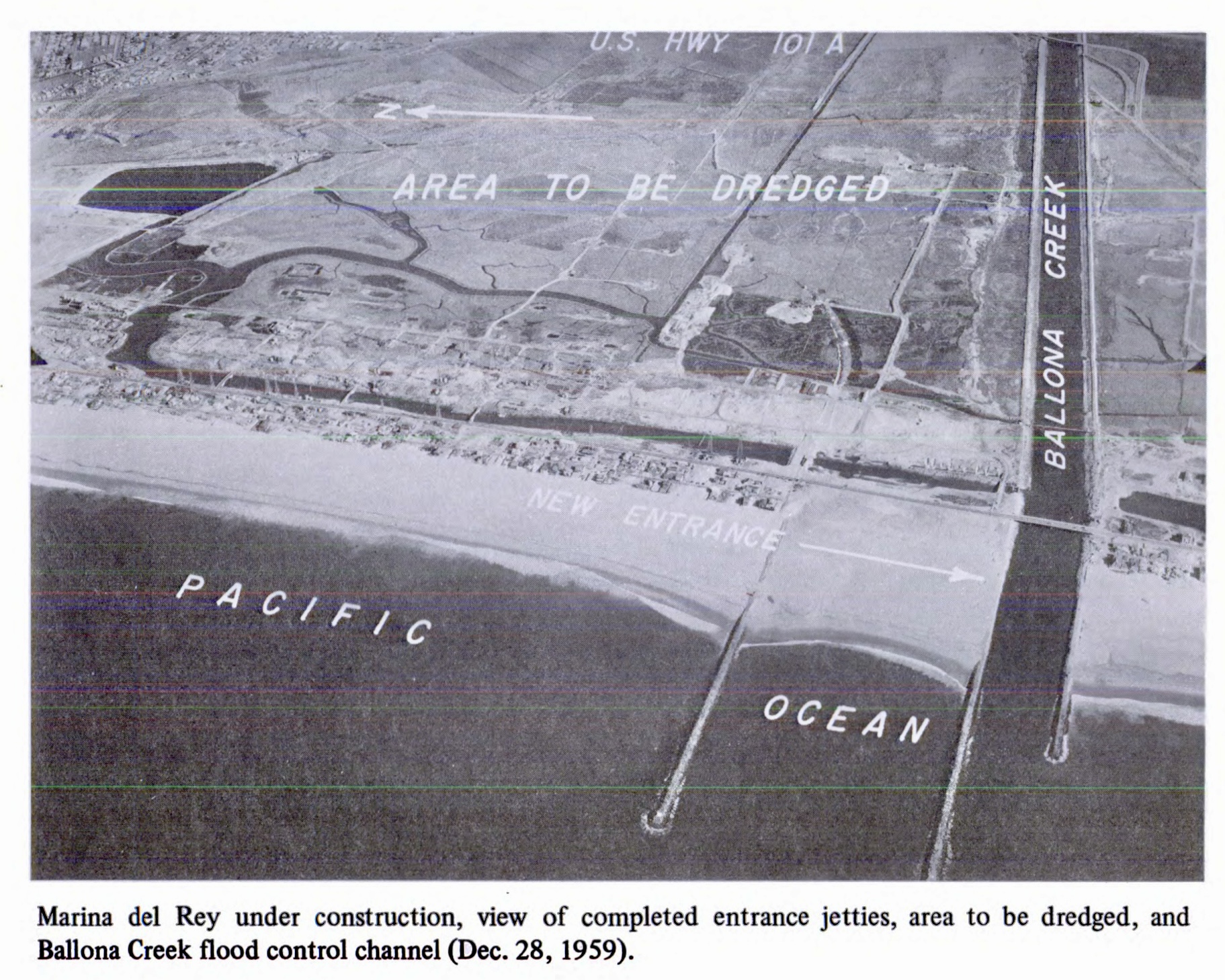
The original Ballona Wetlands — the full extent of Rancho la Ballona as the Tongva people and then Spanish settlers knew it — ranged between 1,500 and 2,100 acres, a mosaic of saltwater marsh, freshwater marsh, riparian corridor, sand dunes, and coastal prairie stretching from Venice south to the bluffs at Playa del Rey. Construction of the Ballona Creek flood-control channel in the 1930s began the degradation; construction of Marina del Rey in the 1960s nearly completed it. What remains today is the second-largest open space within the Los Angeles city limits, behind only Griffith Park — a distinction that speaks to the value of what was saved and the scale of what was lost.
The Tongva and the Cattle and Howard Hughes
Tongva artifacts and human remains were found during excavation of the adjacent Playa Vista development, reminders that the Ballona wetlands were sacred to the 2,000 or so remaining Gabrieleño people, who made their homes near the water, ate fish hatched in its estuaries, and buried their dead in the soil. Augustin Machado grazed cattle on the land in the 1820s. By the early 20th century, hunters came for the green-winged teals that crowded the marsh. In 1940, Howard Hughes bought the land below the Westchester bluffs for his airport — the property that would become, after Hughes's death in 1976, the site of the Playa Vista development that consumed the last farm fields in the Los Angeles basin.
Ecology in the City
Nearly 260 bird species have been observed at the Ballona freshwater marsh alone; the total count for the broader area — including nearby bluffs, parks, and neighborhoods — reaches 320 species. The Audubon Society recognizes the wetlands as an Important Birding Area. Nesting pairs of Belding's Savannah sparrow find habitat here, as do foraging California least terns, both species of conservation concern. The wetlands also support a dozen species of dragonfly, five species of bumblebee (including the imperiled Crotch's bumblebee), and the San Diego legless lizard. Flora includes native pickleweed, saltgrass, and alkali heath alongside extensive introduced species.
The Long Fight Over Restoration
An extensive planning process for the restoration of the Ballona Reserve began in 2004. The California Department of Fish and Wildlife certified a final environmental impact report in December 2020, selecting a preferred alternative that would add 200 acres of coastal wetlands, replace levees with transitional zones to accommodate sea-level rise, and realign Ballona Creek in a more natural meander. In May 2023, a Los Angeles Superior Court judge ordered the environmental impact report decertified. CDFW decertified it in September 2023. Target dates for a revised EIR — spring 2024, then spring 2025 — came and went without publication. The restoration remains pending.
Two Ways of Seeing It
UCLA sustainability professor Jon Christensen described the Ballona debate in 2020 as 'a perfect microcosm of debates about nature on a planetary scale — two opposite ways of thinking about the human relationship with nature: one is that we've meddled enough, and we should leave it well enough alone, and the other viewpoint is that we are the dominant force on Earth, and we should use our knowledge and our skills and methods to restore nature.' One writer who visited the freshwater marsh found that despite the constant sound of traffic just feet away, 'another world filled with plants, wildlife and the song of birds' waited just inside the boundary. The tension between those two realities defines the place.
From the Air
The Ballona Wetlands are located at approximately 33.9750°N, 118.4350°W just south of Marina del Rey, between Lincoln Boulevard and the Pacific Ocean. From the air, the wetlands appear as a green irregular patch amid the coastal urban development west of the 405 freeway. Ballona Creek's concrete channel bisects the reserve. Los Angeles International Airport (KLAX) is 3 miles south; Santa Monica Airport (KSMO) was 3 miles north. The area lies under the Class B airspace shelf.