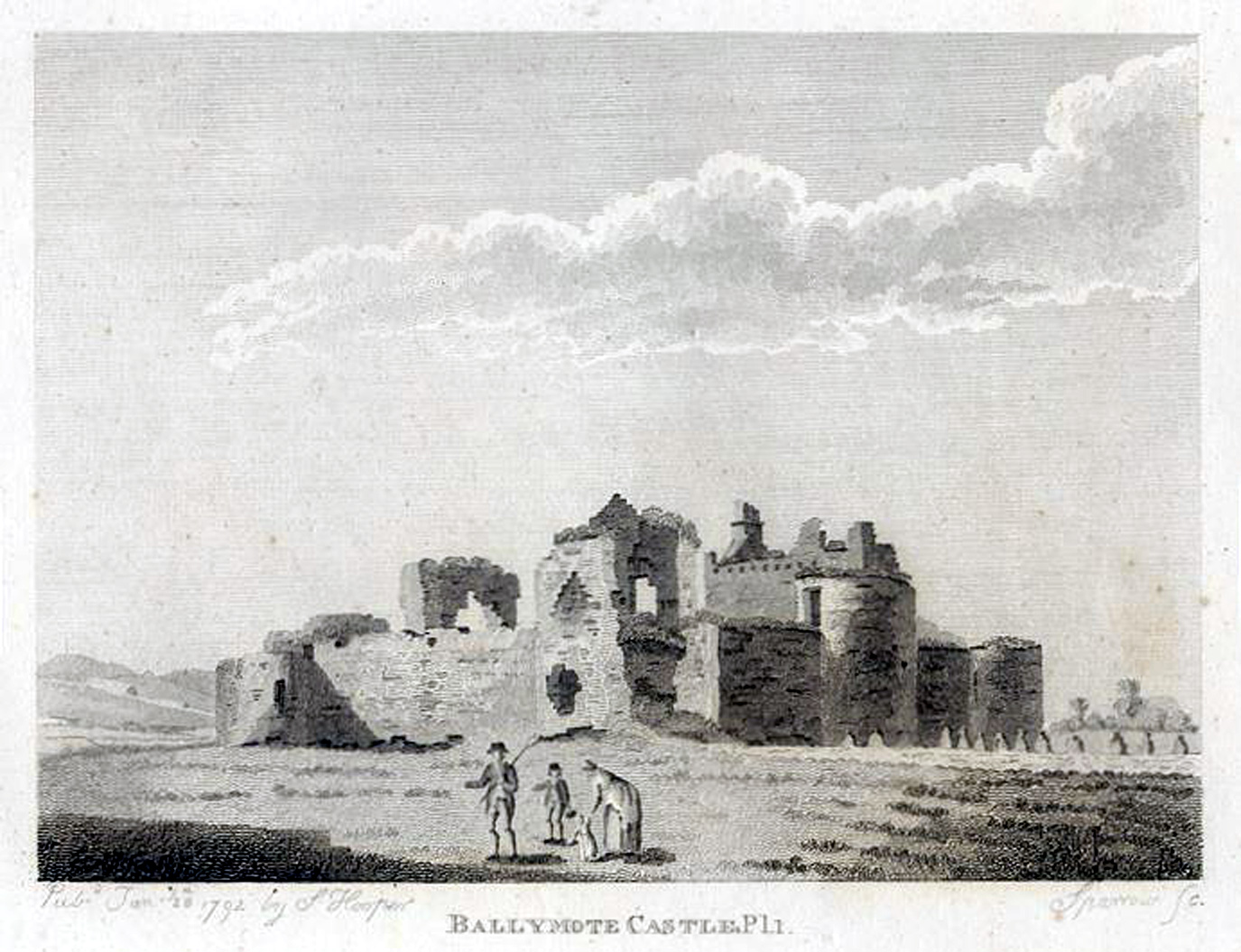
Ballymote Castle
Red Hugh O'Donnell paid four hundred pounds and three hundred cows for Ballymote Castle in 1598. It was, by the standards of late medieval Ireland, a reasonable price for a fortress that controlled the southern approaches to County Sligo. From Ballymote, O'Donnell would march south to the Battle of Kinsale in 1601 -- a defeat that broke Gaelic Ireland. The castle, like so much else, would pass to English hands. But before that, it had already changed owners more than a dozen times in three centuries, its walls absorbing the ambitions and failures of every faction in Connacht.
The Red Earl's Fortress
Ballymote Castle was built around 1300, the last Norman castle constructed in Connacht. Its builder was Richard Og de Burgh, 2nd Earl of Ulster, known as the Red Earl, who needed a stronghold to protect his newly won possessions in County Sligo. The design was formidable: a large rectangular enclosure castle, the most symmetrical of all the Irish 'keepless' castles, with similarities to Beaumaris Castle in Anglesey, built by Edward I of England. Walls ten feet thick enclosed an interior of roughly 300 square meters, with three-quarter-round towers at all four corners and in the middle of the east and west walls. Passages three feet wide ran through the center of the walls, giving access to the towers and curtain walls at different heights. A postern gate planned for the south wall was never completed, likely because of the events of 1317, when the O'Connors seized the castle before the builders could finish.
A Castle of Constant Exchange
The catalogue of ownership reads like a who's-who of medieval and early modern Ireland. The O'Connors of Sligo took it in 1317. The Mac Diarmada seized it during local power struggles in 1347. By 1381, the McDonaghs had it. It passed to Tadhg MacDermot, one of the last Kings of Moylurg, by 1561. The O'Connor Sligo had it again by 1571, surrendering it to the English crown under the policy of surrender and regrant, then receiving it back from James I. The English held it from 1584, taken by Richard Bingham, Governor of Connacht. The O'Connors, O'Hartes, and O'Dowds sacked it in 1588. The English gave it up to the MacDonaghs in 1598, who promptly sold it to Red Hugh O'Donnell for his famous price of four hundred pounds and three hundred cows.
From Kinsale to Ruin
It was from Ballymote that Red Hugh O'Donnell departed for the Battle of Kinsale in 1601, the climactic confrontation between the Gaelic lords and the English crown. The battle was a catastrophe for the Irish. When the O'Donnells surrendered Ballymote to the English in 1602, the castle was already in poor repair. The Taaffes briefly held it in 1633 before surrendering to Cromwellian parliamentary forces in 1652. During the Williamite wars, Captain Terence MacDonagh held it for King James II, but Lord Granard brought artillery to bear in 1690 and MacDonagh had no choice but to surrender. After that final military engagement, the fortifications were deliberately neutralized: the moat was filled, the defensive capabilities destroyed. Ballymote Castle fell into the ruin that visitors see today.
Walls That Remember
The Office of Public Works has carried out preservation work on Ballymote, but it remains a ruin -- and a powerful one. The massive walls still stand to considerable height, the corner towers still visible, the gatehouse foundations still marking where the double-towered entrance once regulated who entered and who was turned away. Local folklore insists that underground passages connected the castle to Emlaghfad church and a nearby Franciscan abbey, though such stories are common throughout Ireland and are almost certainly legend. From the air, the castle is visible on the outskirts of Ballymote town, on the R296 road to Tubbercurry, opposite the railway station. The Red Earl also built the ancient road from Boyle to Collooney, known as Bothar an Corann, linking his castle to the broader infrastructure of Norman Connacht. Seven centuries later, the road outlasts the empire that built it.
From the Air
Located at 54.09°N, 8.52°W on the outskirts of Ballymote in southern County Sligo. The castle ruins are visible from low altitude as a large rectangular fortification with prominent corner towers. The town of Ballymote and its railway station are immediately adjacent. Nearest airports: Knock Airport (EIKN), approximately 40 km southwest; Sligo Airport (EISG), approximately 30 km north. The castle is alongside the R296 road.