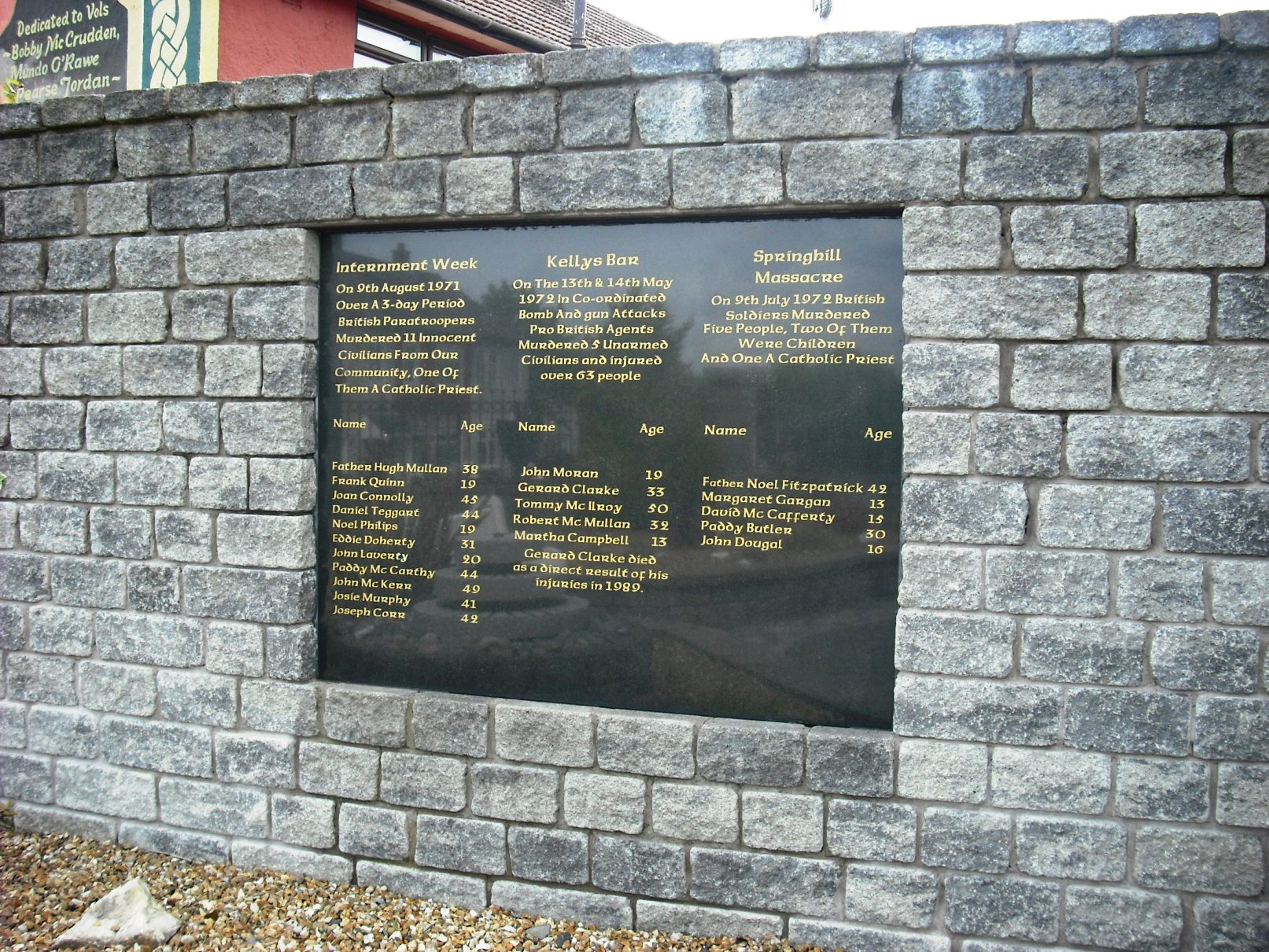
Ballymurphy Massacre
Francis Quinn was nineteen years old. He was shot while going to the aid of a wounded man. Father Hugh Mullan was a Catholic priest; he was shot while waving a white cloth and trying to reach an injured person. Daniel Teggart, forty-four, was shot fourteen times. Most of the bullets entered his back, apparently as he lay on the ground already wounded. Between the evening of August 9 and the morning of August 11, 1971, soldiers of the 1st Battalion, Parachute Regiment killed eleven civilians in the Ballymurphy district of west Belfast. It would take half a century for a court to say what their families had always known: every one of them was innocent.
Operation Demetrius
The killings occurred during Operation Demetrius, the British Army's mass arrest of suspected IRA members launched on the morning of August 9, 1971. The operation was chaotic and driven by poor intelligence. Many of those arrested had no paramilitary connections at all. By focusing exclusively on republican suspects, it ignored loyalist violence entirely, deepening the sense of injustice in nationalist communities. The Parachute Regiment was selected to carry out the operation. As internment raids swept through Belfast, some nationalist neighborhoods threw up barricades, and sporadic shooting broke out. In Ballymurphy, a working-class Catholic housing estate in west Belfast, residents found themselves in the path of some of the most aggressive soldiers in the British Army.
Thirty-Six Hours
Six civilians were killed on August 9 alone. Joseph Murphy, forty-one, was shot as he stood opposite the army base. Joan Connolly, a mother of eight, was also killed that evening. On August 10, Edward Doherty, twenty-eight, was shot while walking along Whiterock Road. On August 11, John Laverty, twenty, was shot twice -- once in the back and once in the back of the leg. Joseph Corr, forty-three, was shot several times and died of his injuries on August 27. John McKerr, forty-nine, was shot in the head while standing outside a Catholic church and died on August 20. Patrick McCarthy, forty-four, died of a heart attack after soldiers allegedly put an empty gun in his mouth and pulled the trigger. None of the dead were armed. None were involved in paramilitary activity. Several were shot while trying to help others who had already been hit.
Decades of Denial
The initial 1972 inquests returned open verdicts on all the killings, effectively leaving the question of responsibility unanswered. For decades, the British Army maintained that soldiers had come under fire from the IRA and returned fire at identified targets. The families of the dead rejected this account completely and consistently. They campaigned for a new inquest throughout the 1990s and 2000s, facing institutional resistance at nearly every turn. Funding for legacy inquests covering Troubles-era killings was repeatedly delayed. First Minister Arlene Foster of the Democratic Unionist Party used her influence in the power-sharing executive to hold back finance for the inquest -- a decision condemned by Amnesty International. The families persisted for fifty years.
Vindication
On May 11, 2021, the coroner delivered findings that the families had waited a lifetime to hear: all ten people shot dead were entirely innocent, and the use of lethal force by the British Army was 'not justified.' The coroner noted that the investigation had been hampered by an 'abject failing by the authorities to properly inquire into the deaths' at the time they occurred. The same battalion -- the 1st Parachute Regiment -- would go on to kill fourteen civilians in Derry on Bloody Sunday just five months after Ballymurphy. The families believe that if the killings in Ballymurphy had been properly investigated in 1971, Bloody Sunday might never have happened. They call Ballymurphy 'the precedent.' The 2018 documentary of that name, directed by Callum Macrae, tells the story through the voices of families who refused to let the names of their dead be forgotten.
From the Air
The Ballymurphy area is at approximately 54.58N, 5.97W in west Belfast, Northern Ireland. It is a residential area in the foothills of the Black Mountain, west of Belfast city center. Nearest airports: Belfast International (EGAA) about 10 nm northwest, Belfast City (EGAC) about 4 nm east. Best viewed below 3,000 ft AGL.