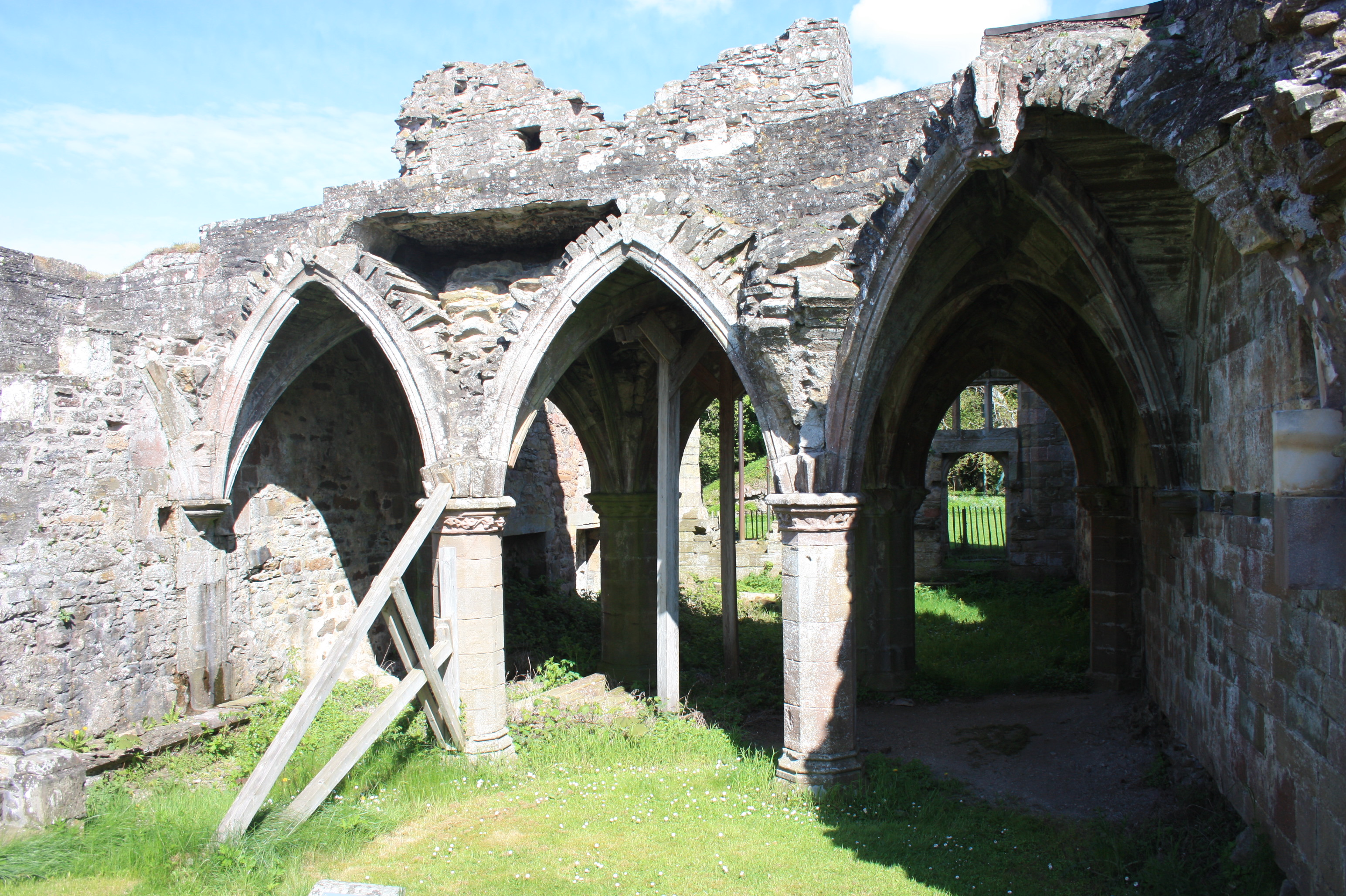
Balmerino Abbey
Ermengarde de Beaumont, widowed Queen of Scotland, was buried in the church of Balmerino Abbey in 1233, four years after she helped found it. She had chosen the site with care -- or perhaps the site had been chosen long before her. Local tradition held that the settlement here, known as Balmerinach or 'St Merinac's Place,' took its name from one of the monks who accompanied Saint Regulus when he reportedly brought the bones of Saint Andrew to Scotland in the fourth century. If the tradition is true, Ermengarde built her abbey on ground that had been considered holy for nearly nine hundred years.
A Queen's Foundation
The abbey was founded between 1227 and 1229 by Cistercian monks from Melrose Abbey, with the patronage of Ermengarde and her son, King Alexander II of Scotland. Ermengarde had been queen consort to William the Lion and had outlived her husband by nearly two decades. The decision to found a Cistercian house at Balmerino was both a spiritual investment and a personal one -- the queen clearly intended the abbey as her final resting place, and the church was sufficiently complete by 1233 to receive her burial. The abbey remained a daughter house of Melrose throughout its existence, maintaining the chain of affiliation that linked Fife to the Scottish Borders and, through Melrose's own mother house at Rievaulx, back to the Cistercian heartlands of England and France.
Twenty Monks and a Chestnut Tree
At its height in the early sixteenth century, Balmerino housed approximately twenty monks -- a modest community by European standards but a typical size for Scottish Cistercian houses. The abbey's grounds claim to include the oldest tree in Fife: a Spanish chestnut estimated at four hundred years old, its trunk gnarled and hollowed by centuries of Fife weather. Whether the tree was planted by the monks themselves or arrived later, it has become part of the abbey's identity, a living counterpart to the stone ruins around it. The monks would have worked the surrounding land, managed fisheries on the Tay, and maintained the daily round of prayer -- Matins, Lauds, Prime, Terce, Sext, None, Vespers, Compline -- that structured Cistercian life from dawn to darkness.
Burned Twice, Then Quarried
The abbey survived three centuries before war and ideology tore it apart. In December 1547, an English force burned it during the rough wooing -- Henry VIII's campaign to force a marriage between his son Edward and the infant Mary, Queen of Scots. The damage was repaired, but in 1559 Scottish Protestants, in the iconoclastic fervor of the Reformation, reportedly damaged it again. The community died out shortly afterward. In 1561, John Hay became the lay commendator and converted some of the abbey buildings into a private house. By 1603, the estate had been erected into a temporal lordship for Sir James Elphinstone, who became the 1st Lord Balmerino. The conversion and subsequent modifications destroyed much of the medieval fabric, including the high vaulting of a fifteenth-century chapter house that had featured four bays around a central pier -- an architectural design paralleled at Glasgow Cathedral and Glenluce Abbey.
Vaults and Ruins
What survives at Balmerino is fragmentary but revealing. The north wall of the sixty-six-metre-long cruciform abbey church still stands, along with parts of the original thirteenth-century chapter house, where the eastern three of six bays of quadripartite vaulting remain intact. The day stair -- the passage monks used to descend from their dormitory to the cloister for morning prayers -- rises through the thickness of the chapter house's north wall, a piece of domestic medieval architecture that speaks to the daily reality of monastic life more eloquently than any grand facade. The misalignment of piers in the south arcade with shafts in the north wall tells archaeologists that a nave aisle was added after the original construction, the building growing as the community's needs changed. The ruins are designated as a scheduled monument and are in the care of the National Trust for Scotland. They stand on the south bank of the Tay, looking across the water toward Dundee, quiet now in a way the monks who built them would have recognized.
From the Air
Balmerino Abbey ruins are at approximately 56.41N, 3.04W, on the south bank of the River Tay in northern Fife, with views across the water toward Dundee. The ruins sit in a rural setting near the village of Balmerino. Perth/Scone airfield (EGPT) is approximately 18 nm west. Best viewed at 1,500-2,500 ft AGL. The Tay estuary provides clear navigational context, with Dundee visible on the opposite bank.