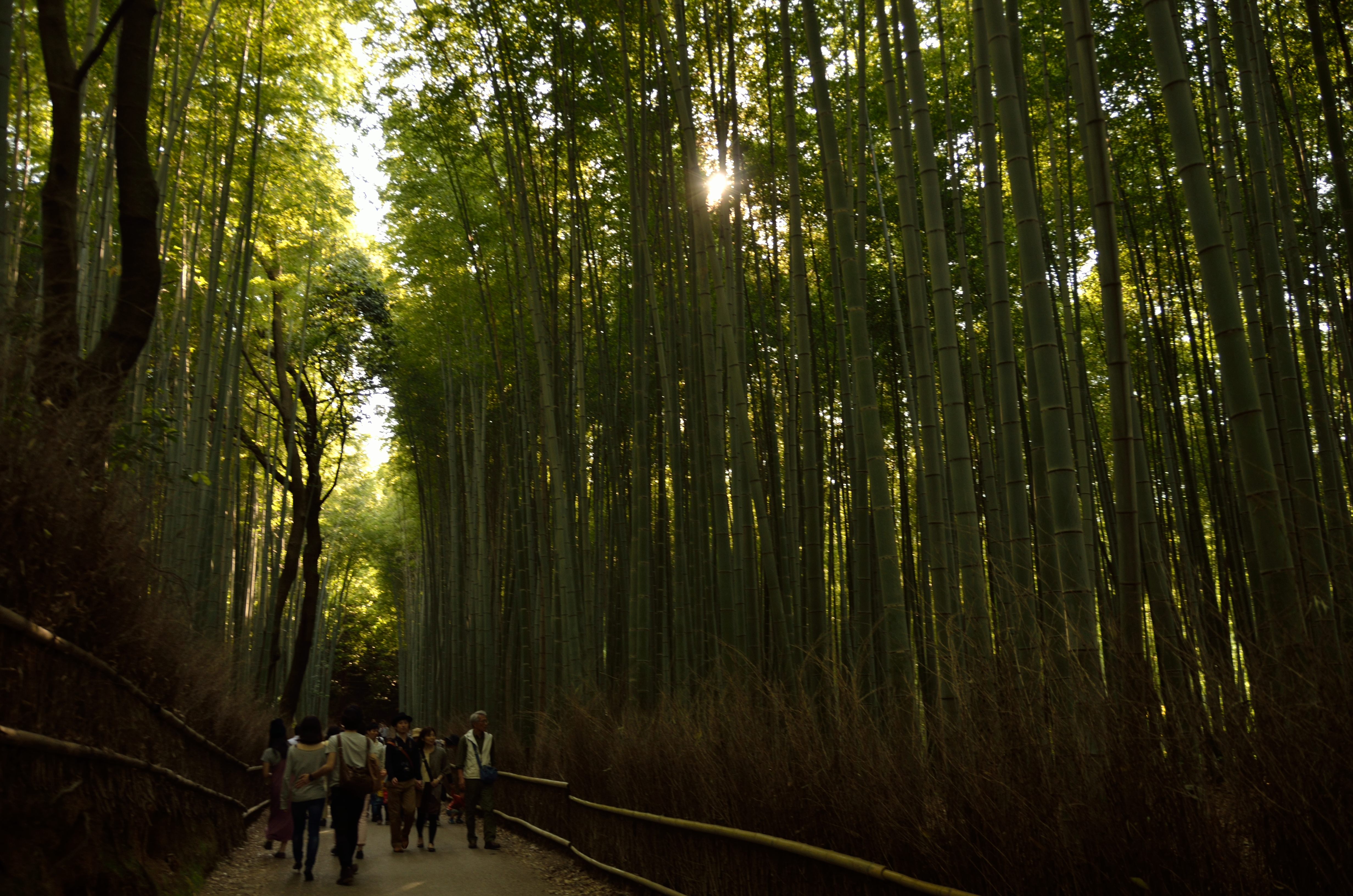
The Sagano Bamboo Forest: Where Japan Comes to Listen
The sound arrives before the sight. Walking into the Sagano Bamboo Forest from the streets of Arashiyama, you hear it first -- a hollow, resonant clicking as bamboo stalks knock against each other in the breeze, layered over a deeper creaking as the tall culms sway, underscored by the constant soft rustle of leaves high overhead. Japan's Ministry of the Environment recognized this acoustic experience as one of the nation's "100 Soundscapes of Japan," an official designation meant to identify and preserve the country's most important auditory landscapes. In a nation that builds gardens for contemplation and rakes gravel into patterns that represent water, it makes perfect sense that a forest would be treasured not for what it looks like but for what it sounds like.
The Physics of That Sound
The forest consists mostly of moso bamboo -- Phyllostachys edulis -- the largest temperate bamboo species, capable of reaching heights of twenty meters or more. Moso bamboo stalks are hollow and rigid, which gives them acoustic properties unlike any other tree. When wind moves through the grove, the stalks sway independently, and where they meet, they produce a resonant, percussive knock -- not unlike wooden wind chimes, but on a scale that surrounds you completely. The creaking comes from the stalks flexing under wind pressure, their hollow interiors amplifying the sound. Above, the dense canopy of narrow leaves creates a continuous whisper that shifts in pitch and intensity with each gust. The combined effect is a layered, three-dimensional soundscape that changes constantly. On a still day, the forest falls nearly silent. On a windy afternoon, it becomes an orchestra.
Growing at the Speed of Sound
Moso bamboo is among the fastest-growing plants on Earth. During peak growing season, a new shoot can add up to three feet of height in a single day -- growth you could almost watch in real time. A stalk reaches its full height in just two to three months, then spends the next three to five years hardening and maturing as its cell walls thicken and strengthen. The forest is not old growth in the way a redwood grove is old growth; it is constantly regenerating, with new shoots pushing up through the soil each spring while mature stalks complete their cycle. The pathways that thread through the grove pass between stalks of varying ages -- some bright green and smooth, others weathered to a pale yellow-gray, their surfaces marked with the dark spots that come with maturity. The effect is of walking through a living structure that is perpetually rebuilding itself.
Between the Temple and the Shrine
The bamboo forest sits in a remarkable spiritual neighborhood. To the south lies Tenryuji, the fourteenth-century Zen temple that ranks first among Kyoto's Five Great Zen Temples and holds UNESCO World Heritage status. To the north stands Nonomiya Shrine, a small Shinto site with its own deep literary connection -- it appears in The Tale of Genji, the eleventh-century novel often considered the world's first. The forest path connects these two religious sites, creating a walk that moves between Buddhist contemplation and Shinto nature reverence with the bamboo grove as a kind of natural cathedral between them. This layering of the sacred and the natural is characteristic of Arashiyama, where temples, shrines, and landscape have been intertwined since the Heian aristocracy first chose these western hills for retreat.
A Forest Under Pressure
Prior to 2015, there was a charge to access the bamboo forest. When the fee was removed, visitor numbers surged, and the grove became one of the most photographed sites in Japan. The popularity brought problems. News reports in 2018 documented tourists defacing bamboo stalks by carving names and messages into the bark -- vandalism that scars the smooth green surface permanently, since bamboo does not heal the way a hardwood tree does. The narrow pathways that once offered a meditative walk through the green corridor became crowded corridors of selfie sticks and tour groups. The irony is sharp: the soundscape that earned the forest its official recognition -- that clicking, creaking, rustling voice of bamboo in wind -- is increasingly drowned out by the noise of the crowds who come to experience it.
The Green Cathedral from Above
Seen from altitude, the Sagano Bamboo Forest appears as a dense, vivid green patch on the lower slopes of the Arashiyama mountains, its canopy distinct from the mixed deciduous and coniferous forest surrounding it. The bamboo's uniform height and tight clustering create a texture visible even from several thousand feet -- a smooth, bright carpet that stands out against the darker greens of the hillside. The forest is compact, covering only a modest area, but its visual impact from above is unmistakable. The pathways are invisible beneath the canopy; from the air, you see only the green roof. The Katsura River curves past to the south, and the white line of the Togetsukyo Bridge marks where the Arashiyama district begins. The bamboo grove sits between river and mountain, temple and shrine, silence and sound.
From the Air
Located at 35.009°N, 135.667°E on the lower slopes of Arashiyama mountain in western Kyoto. From altitude, the bamboo forest is identifiable as a distinctly bright green, uniform-textured patch contrasting with the surrounding mixed forest on the hillside. The Togetsukyo Bridge and Katsura River curve to the south, providing easy visual reference. Best viewed at 2,000-3,000 feet AGL. Osaka Itami Airport (RJOO) lies approximately 25 nautical miles southwest. Kansai International Airport (RJBB) is roughly 55 nautical miles south. Tenryuji temple grounds are visible immediately south of the bamboo grove.