Bamburgh Castle
Thomas Malory believed this was Joyous Gard, the castle of Sir Lancelot. Bernard Cornwell made it the ancestral seat of his Saxon warrior Uhtred of Bebbanburg. The real Bamburgh Castle needs no fictional enhancement. Built atop a thrust of dark volcanic dolerite that rises abruptly from the Northumberland coastline, it commands views that stretch from the Farne Islands to Lindisfarne and across miles of flat, pale sand. People have fortified this rock for at least 1,600 years, and some claim far longer.
Din Guarie and Bebbanburh
The crag is part of the Whin Sill, a sheet of volcanic rock that surfaces dramatically across northern England -- at Hadrian's Wall, at the Farne Islands, and here. The indigenous Celtic Britons knew the fortress as Din Guarie, and it may have been the capital of the kingdom of Bernicia from around 420 CE. In 547, the Anglo-Saxon ruler Ida seized the citadel and made it his seat. The fortress changed hands between Britons and Anglo-Saxons three times before settling into English control around 590. Its current name descends from Bebba, wife of the Northumbrian king Aethelfrith, who gave the stronghold the name Bebbanburh around 600 CE. Under the Anglo-Saxon kings of Northumbria, Bamburgh became the capital of the most powerful kingdom in early medieval Britain -- the same realm that fostered the monastic culture of Lindisfarne, just five miles to the north.
Besieged, Bombarded, Broken
The Normans built the castle that forms the core of the present structure, raising a stone keep that was completed by 1164 under Henry II. From that point, Bamburgh's story is one of siege after siege. William II besieged it unsuccessfully in 1095 during a revolt by Robert de Mowbray, Earl of Northumbria. After Robert's capture, his wife held the castle until the king threatened to blind her husband before her eyes -- she surrendered. Following the Battle of Neville's Cross in 1346, the captured Scottish King David II was imprisoned here. During the Wars of the Roses, Bamburgh endured a nine-month siege in 1464 by the Earl of Warwick, 'the Kingmaker,' who deployed heavy artillery against its walls. It is believed to have been the first castle in England to be destroyed by cannon fire. By the seventeenth century, the battered fortress had fallen into decay, its owners bankrupt and its walls crumbling.
Armstrong's Restoration
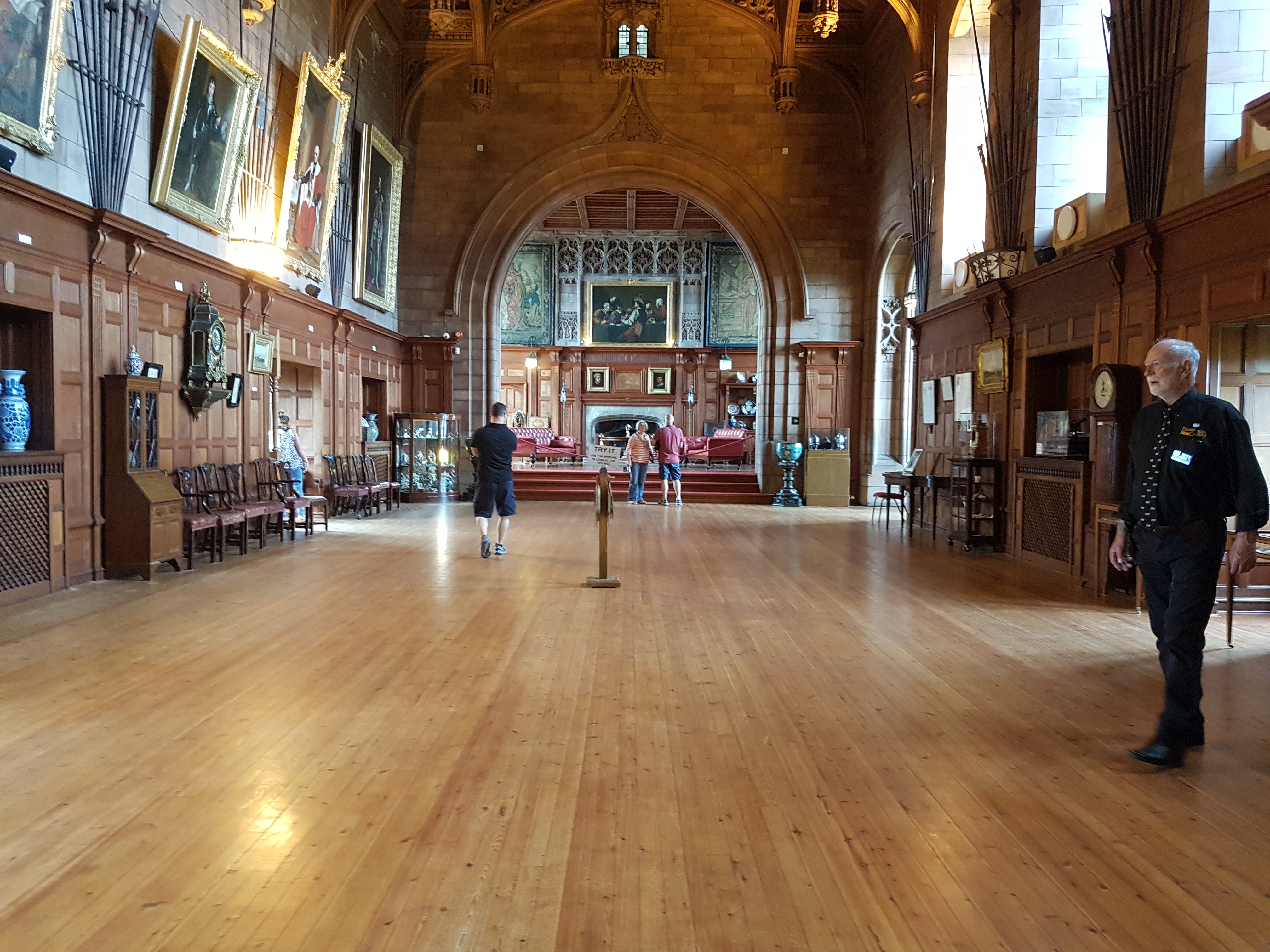
The castle's savior was an unlikely figure: William Armstrong, the Victorian industrialist and arms manufacturer whose hydraulic machinery and artillery transformed modern warfare. Armstrong purchased Bamburgh in 1894 and commissioned the architect C. J. Ferguson to carry out an extensive restoration that continued until 1904. Armstrong poured money into the project, rebuilding sections in high-quality squared sandstone and ashlar while preserving the medieval keep and curtain walls. The result is a castle that looks dramatically medieval from a distance but contains Victorian engineering throughout. The Armstrong family still owns Bamburgh today. The castle's laundry rooms house the Armstrong and Aviation Artefacts Museum, displaying engines, artillery, and aviation relics from two world wars -- a fitting tribute to the man who rebuilt the fortress and whose company, Armstrong Whitworth, helped arm Britain through the industrial age.
Beneath the Sand
Bamburgh's secrets extend well beyond its walls. Archaeological excavations begun in the 1960s by Brian Hope-Taylor uncovered a gold plaque known as the Bamburgh Beast, an intricate piece of Anglo-Saxon metalwork, along with a remarkable early medieval sword now known as the Bamburgh Sword. Since 1996, the Bamburgh Research Project has investigated the fortress site and the Bowl Hole, an early medieval burial ground in the sand dunes south of the castle. Between 1998 and 2007, the remains of 120 individuals from the seventh and eighth centuries were excavated there -- people who lived in the shadow of the Anglo-Saxon capital. The Northumberland coast around Bamburgh teems with wildlife as well as history. The nearby Farne Islands host breeding colonies of Arctic and common terns, Atlantic puffins, European shags, and razorbills. During World War II, pillboxes were built in the dunes to guard against German invasion, their concrete hulks occasionally revealed by tidal surges.
The View from the Crag
From the castle's battlements, the entire Northumberland coast arranges itself in a sweeping panorama. To the north, Lindisfarne sits low on the horizon, its priory ruins just visible. To the south, the ruined towers of Dunstanburgh Castle stand on their own coastal promontory nine miles away. Inland, Alnwick Castle -- seat of the Duke of Northumberland and a filming location for the Harry Potter films -- lies sixteen miles to the south. Bamburgh itself is a small village, its population measured in dozens rather than hundreds. The castle dominates everything, its massive silhouette visible for miles along the coast. Film crews have recognized the location's power repeatedly: Bamburgh has appeared in Elizabeth, Macbeth, Robin of Sherwood, The Last Kingdom, and Indiana Jones and the Dial of Destiny. But no camera can fully capture the experience of standing on that volcanic rock with the North Sea wind in your face and fifteen centuries of history beneath your feet.
From the Air
Bamburgh Castle sits at 55.61°N, 1.71°W on a prominent volcanic crag on the Northumberland coast. The castle is unmistakable from the air, rising sharply above flat beaches. Lindisfarne (Holy Island) is visible 5 nm to the north; the Farne Islands lie to the southeast. Nearest airports: Newcastle (EGNT) approximately 50 nm south, or RAF Boulmer (military) much closer along the coast.