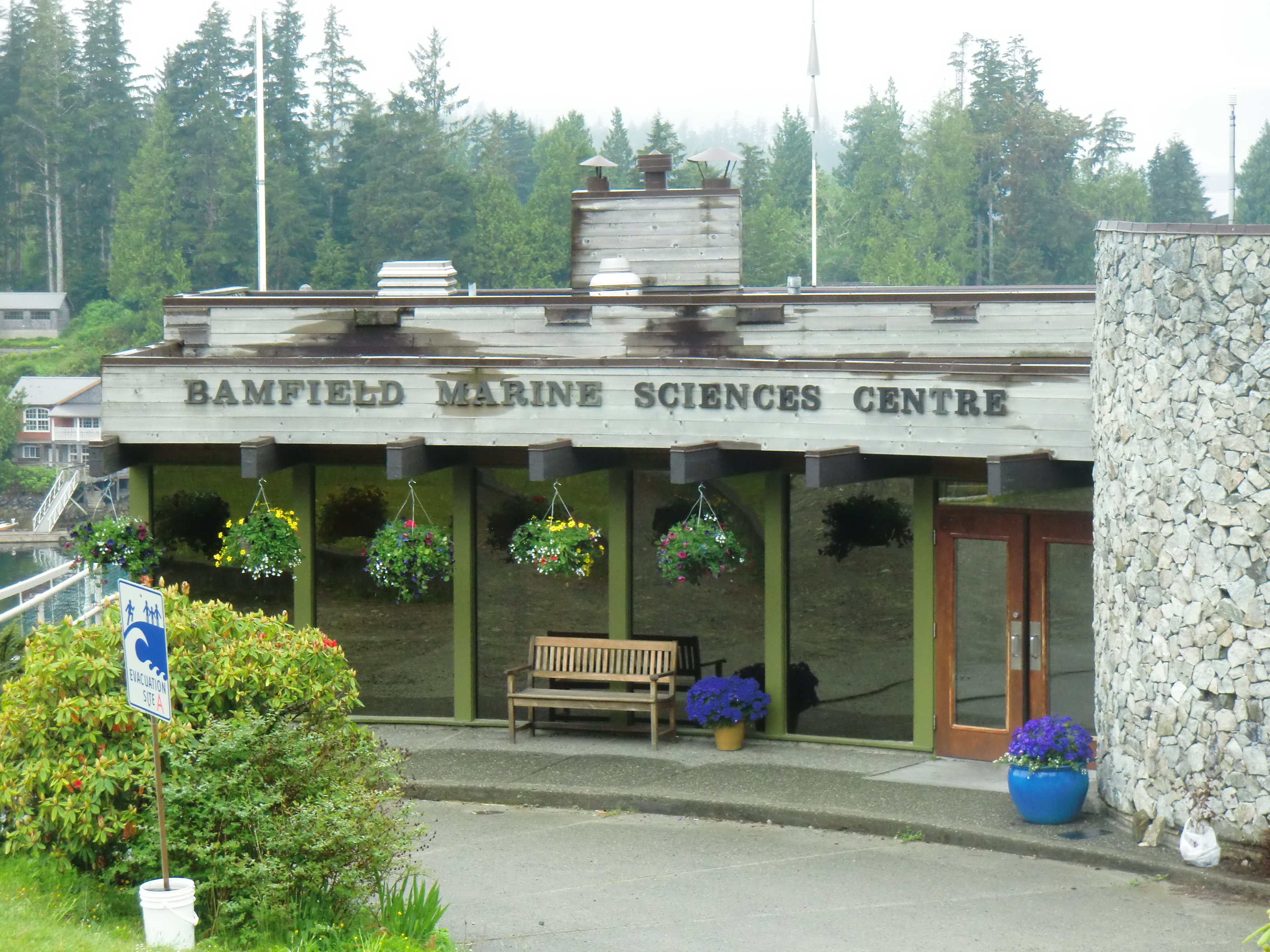
Bamfield Marine Sciences Centre
The building where scientists now study sea urchins and nudibranchs once hummed with Morse code transmissions spanning half the planet. The Bamfield Marine Sciences Centre occupies the concrete shell of the Pacific Cable Board station, the North American terminus of the All Red Line -- a submarine telegraph cable that connected Canada to Fanning Island, Fiji, New Zealand, and Australia through exclusively British Empire territory. The cable operated from 1901 to 1959. The science started in 1972. Between those dates lies one of the more improbable reinventions on the BC coast.
Wires Beneath the Pacific
When the Pacific Cable Board chose Bamfield as the landing point for its trans-Pacific telegraph cable in 1901, the tiny fishing village on Barkley Sound became a node in a global communications network overnight. The cable ran 1,600 kilometers south to Fanning Island, a coral atoll below Hawaii, then continued westward in stages to Australia. The original wooden station was replaced by a reinforced concrete building in 1926 -- a structure solid enough to survive a shelling by an Imperial Japanese Navy submarine during World War II without major damage. The Canadian government stationed troops at Bamfield for the remainder of the war. When the cable was rerouted to Port Alberni in 1953, the station closed in 1959, and most of the surrounding buildings were demolished. Only the concrete building, two cable storage tanks, and one adjacent structure survived.
From Cable Station to Research Station
In 1968, the National Research Council asked five western Canadian universities to propose the best location for a marine biology station on the Pacific Coast. Victoria seemed the natural choice, but a 1969 feasibility study pointed to Bamfield -- remote, yes, but surrounded by the extraordinary biodiversity of Barkley Sound. The five universities (University of British Columbia, University of Victoria, University of Calgary, University of Alberta, and Simon Fraser University) purchased the former cable station property and ratified a constitution for the Western Canadian Universities Marine Biological Society in 1970. By the end of 1972, the Bamfield Marine Sciences Centre was operational, immediately becoming the largest employer in a community of fewer than two hundred people.
Living Laboratory
The centre runs university courses from May through December and hosts researchers year-round. From 1969 to 1980, the station was part of the British Columbia Shore Station Oceanographic Program, collecting daily coastal water temperature and salinity data for the Department of Fisheries and Oceans. That tradition of patient, long-term observation continues through partnerships with Ocean Networks Canada, which monitors Barkley Sound and Folger Passage through internet-connected undersea cables. In 2016, the centre partnered with the Huu-ay-aht First Nations and the Hakai Institute to launch a drone-mapping program over Barkley Sound, combining Indigenous knowledge with aerial technology to chart the complex coastline. School groups, college students, and adult learners cycle through field immersion programs that bring thousands of visitors annually to a village with a permanent population barely in the triple digits.
Where the Empire's Wire Meets the Tide
Something fitting persists in the transformation. The All Red Line carried information across oceans; the marine sciences centre collects it from them. The concrete walls that once insulated telegraph operators from Pacific storms now shelter marine biologists cataloguing the life those storms churn up. Barkley Sound remains what it always was -- a meeting point of deep ocean upwelling, temperate rainforest runoff, and tidal complexity that makes the waters here some of the most biologically productive on the Pacific Coast. The cable is long gone, but the building endures, repurposed for a different kind of listening.
From the Air
Located on the east side of Bamfield Inlet at 48.84°N, 125.14°W on Vancouver Island's Barkley Sound. Visible as a cluster of buildings on the waterfront. Best viewed at 1,500-2,500 feet. Nearest airport: Port Alberni (CBS8). Barkley Sound is a complex waterway with many islands; the centre sits at the head of the inlet. Expect marine fog and low cloud frequently.