Ban Chiang
In August 1966, a Harvard student named Steve Young was walking down a dirt path in a quiet Thai village when the root of a red kapok tree sent him sprawling. He landed face-down in the dust, and when he looked up, the exposed rims of pottery jars stared back at him. Young knew enough about Southeast Asian archaeology to suspect something significant. He was right. Those jars, and the thousands of artifacts buried beneath the village of Ban Chiang, would eventually upend assumptions about where and when Bronze Age civilization emerged in Asia.
A Village Built on Buried Worlds
Ban Chiang sits in the rolling farmland of Udon Thani province in northeastern Thailand, about 560 kilometers from Bangkok. The village itself is unremarkable - rice paddies, modest homes, a temple called Wat Pho Si Nai. But beneath its paths and houses lie layers of occupation stretching back millennia. The oldest graves found at the site contain no metal at all, belonging to a Neolithic culture. The most recent date to about 200 CE, well into the Iron Age. Between those bookends lies the evidence that made Ban Chiang famous: bronze artifacts, crucibles, and molds demonstrating that villagers here were casting metal nearly four thousand years ago. Unlike other ancient bronze-working societies in Mesopotamia or China, this metallurgy flourished without a centralized state, military hierarchy, or urban core. The people of Ban Chiang were farmers and hunters who buried their dead beneath their own homes in a practice archaeologists call residential burial.
The Red Spirals That Launched a Frenzy
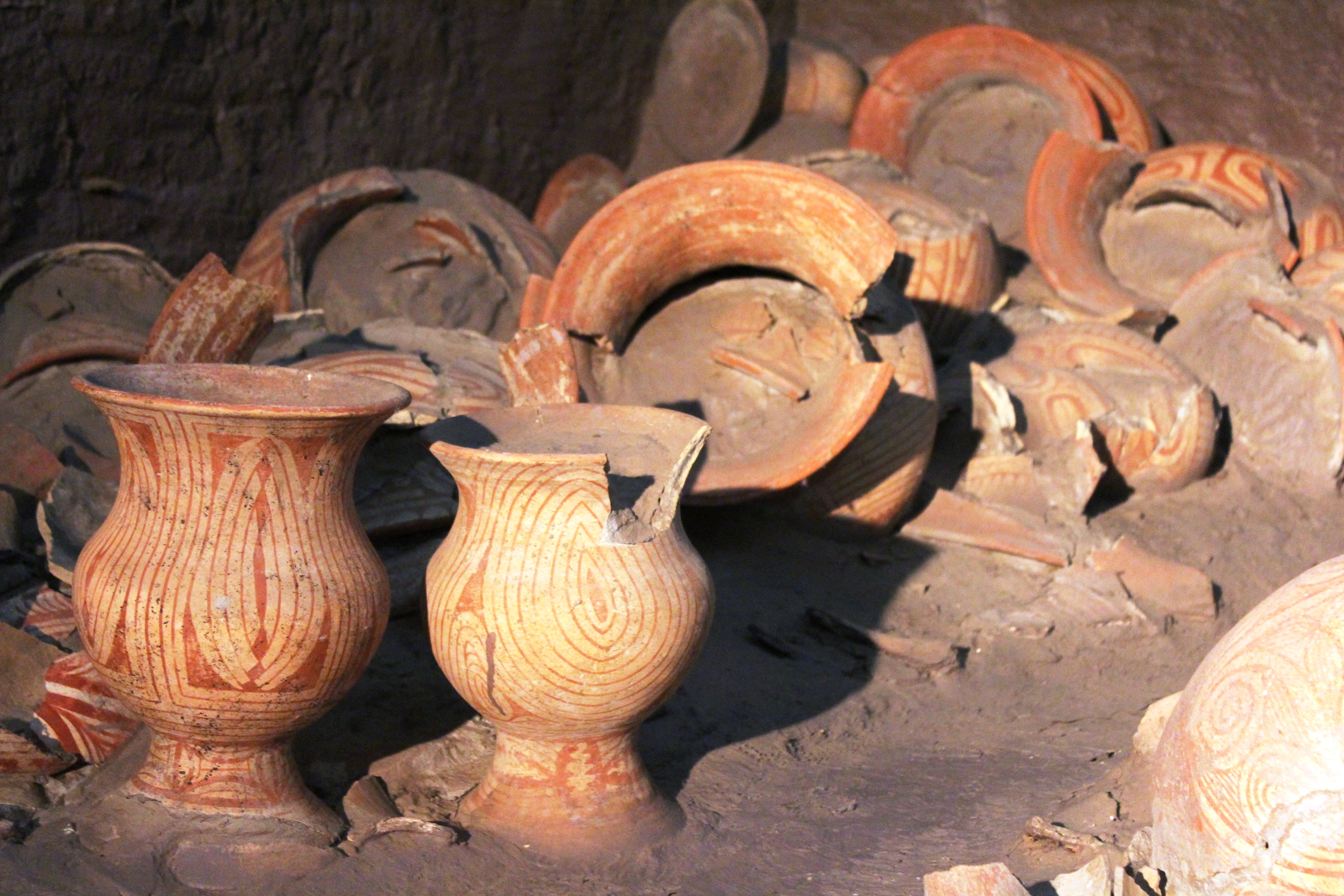
What first caught the world's attention was the pottery. Ban Chiang's distinctive vessels - buff-colored jars painted with swirling red designs - are unlike anything else in Southeast Asian archaeology. The patterns are bold and confident: spirals, fingerprints, and flowing organic lines applied with iron oxide pigment. Early thermoluminescence dating suggested the oldest pieces might reach back to 4420 BCE, which would have made Ban Chiang the earliest Bronze Age culture on Earth. The claim electrified the archaeological world. It also triggered a disaster. Villagers, suddenly aware they were living on treasure, began digging up and selling pottery. Art dealers and collectors descended. The beautiful jars, some intact after thousands of years underground, entered a black market pipeline that stretched from Thai middlemen to galleries in California. By the time proper excavation resumed in the 1974-1975 season, led by Chester Gorman and Pisit Charoenwongsa through the University of Pennsylvania Museum, significant damage had already been done.
A Timeline Under Dispute
Subsequent radiocarbon dating brought Ban Chiang's chronology back to earth. The earliest metallurgy at the site now dates to roughly 2000-1700 BCE - still ancient, but no longer the world's oldest. Charles Higham of the University of Otago pushed the timeline further, using Bayesian statistical analysis of human and animal bones to argue that initial settlement began around 1500 BCE, with bronze working starting about 1000 BCE. The debate remains unresolved. What is settled is that at least 142 burials from the 1974-1975 excavations reveal a population that lived vigorously, with little evidence of warfare or interpersonal violence. Metal weapons are almost entirely absent. These were people who invested their metallurgical skill in bangles, bells, adzes, and tools - the implements of daily life rather than conquest. Research by Joyce White and Elizabeth Hamilton, published across a four-volume monograph series, showed that most copper alloy products were cast in local villages rather than centralized workshops, suggesting a decentralized network of skilled metalworkers.
The Buffalo and the Cost of Progress
Faunal analysis tells a subtler story about life at Ban Chiang. Bones of wild gaur and banteng suggest the earliest inhabitants were hunters. Over time, the remains shift. Domesticated water buffalo appear, their phalanges matching modern breeds whose DNA traces back to domestication events in southern China around 2000 BCE. The buffalo enabled wet rice paddy agriculture, which transformed the settlement. But progress carried a price. Analysis of skeletal remains shows that life expectancy actually declined after the introduction of intensive agriculture and animal husbandry - from 30.4 years in the pre-buffalo period to 28.1 years afterward. Closer contact with domesticated animals likely introduced new diseases to a population with no immunity. It is a pattern repeated across human history: the innovations that build civilizations also exact their toll on the bodies of the people who adopt them.
Stolen Heritage, Slow Justice
In January 2008, federal agents conducted thirteen simultaneous raids across California and Chicago, seizing thousands of Ban Chiang artifacts from museums, galleries, warehouses, and private homes. The operation, code-named Operation Antiquity, was the culmination of five years of undercover work by a National Park Service agent who posed as a collector. The trail led to at least five major museums, including the Los Angeles County Museum of Art and the Bowers Museum. At one point, more Ban Chiang artifacts sat in American collections than at the site itself. Jonathan and Cari Markell, owners of a gallery called Silk Roads, pleaded guilty to trafficking charges in 2015. The Bowers Museum returned 542 objects; the Mingei International Museum repatriated 68. Today, the Ban Chiang National Museum houses a recreated excavation pit at Wat Pho Si Nai, displaying artifacts and simulated skeletons exactly as they appeared during the dig. UNESCO inscribed the site in 1992, recognizing it as bearing exceptional testimony to a disappeared civilization - one whose story, even now, is still being pieced back together.
From the Air
Located at 17.55°N, 103.36°E in the flat agricultural landscape of Udon Thani province, northeastern Thailand. The site is not visible from altitude - it lies beneath the modern village. Nearest significant airport is Udon Thani International (VTUD), approximately 50 km to the southwest. The terrain is gently undulating farmland typical of the Khorat Plateau, with rice paddies dominating the landscape at lower altitudes.