Ban Kao
Hendrik Robert van Heekeren was not supposed to be an archaeologist. He was a Dutch prisoner of war, one of hundreds held at Camp Ban Khao on the Burma Railway during World War II. But van Heekeren had an amateur's eye for old things, and when he noticed worked stone tools near the camp, he recognized them for what they were: artifacts from a civilization that predated anything the modern inhabitants of this river valley knew about. He managed to keep the stones when his captors transferred him to Japan in June 1944, hiding them beneath a wooden floor. After Japan's surrender, he passed them to an American professor in Manila. Those stones now sit in Harvard's Peabody Museum of Archaeology and Ethnology, thousands of kilometers from the riverbank where a prisoner's curiosity cracked open a window into Southeast Asia's deep past.
The Old Village on the River
Ban Kao means "old village" in Thai, a name that turned out to be more literal than anyone guessed. The sub-district sits in Kanchanaburi Province, in the mountainous terrain of the Tenasserim Hills near Myanmar's border. The Khwae Noi River - the same waterway made infamous by the Burma Railway - curves past the settlement, and it was along the river's southern bank, roughly 400 meters from the water, that the most significant discoveries would be made.
Today, Ban Kao is a modest community of about 16,000 people, its administrative territory divided into 15 villages. The Phu Nam Ron border crossing at the sub-district's western edge may grow in importance if the planned Dawei Port Project connects Bangkok to Myanmar's coast by highway and rail. But Ban Kao's significance lies underground. Beneath the fields and village paths, layers of human occupation stretch back more than three thousand years, waiting for the questions that van Heekeren was the first to ask.
Three Thousand Years in the Dirt
Van Heekeren's wartime discovery sparked a formal expedition. In 1960, he returned to Thailand as part of a Danish-led team, and the following year, Per Sorensen of Denmark led the Thai-Danish Prehistoric Expedition in systematic excavations at the Ban Kao site. What they found in a large mound 400 meters from the Khwae Noi reshaped understanding of mainland Southeast Asian prehistory.
Sorensen's team identified three distinct cultural phases: an Early Neolithic period, a Late Neolithic period, and an Iron Age phase. The burial site yielded twenty-six human skeletons and artifacts dating between 1300 and 200 BCE. The skeletons had short ovoid skulls with medium to broad faces - physical characteristics that researchers noted bore similarities to present-day Thai populations. Most of these ancient people died young; the majority lived fewer than thirty years, and only two individuals survived past forty. Alongside the human remains, the team recovered bones of Javan rhinoceros and Sumatran rhinoceros, evidence that the site's Neolithic inhabitants hunted these now-endangered animals in a landscape very different from today's.
Pots That Rewrote History
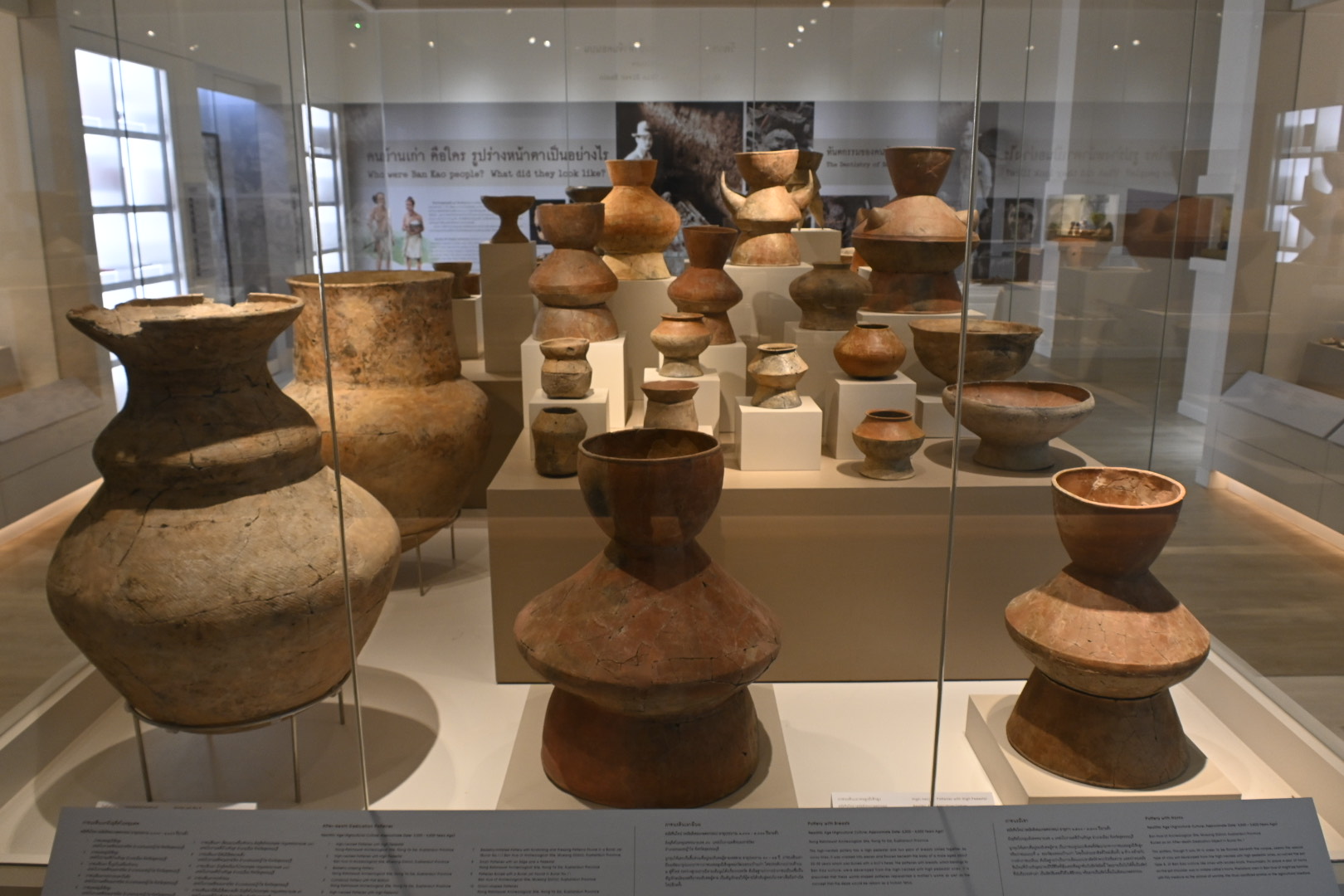
The pottery found at Ban Kao became the expedition's most consequential discovery, because it challenged the prevailing theory about how technology spread through ancient Southeast Asia. The dominant academic view held that China introduced bronze and iron working to the region, a cultural diffusion model that positioned mainland Southeast Asian societies as recipients rather than innovators.
Ban Kao's evidence complicated that story. Iron tools found buried with forty-five bodies at the site were carbon-dated from the first century BCE onward, and the ceramic and bowl fragments suggested indigenous traditions of craftsmanship that did not depend on Chinese influence. Early interpretations had connected Ban Kao's pottery to the Longshan culture of China, noting similarities that seemed to support a migration model. But as more evidence accumulated, the picture shifted. The tripod pottery and ceramic fragments preserved in the Ban Kao National Museum represent not just beautiful objects but an argument - that the people who lived along the Khwae Noi developed their own metallurgical and ceramic traditions, shaped by local need and local knowledge rather than imported wholesale from the north.
The Railway and the Reckoning
Ban Kao's archaeological story is inseparable from its wartime one. Camp Ban Khao was a prisoner of war work camp on the Burma Railway, the 415-kilometer line that the Japanese military forced into existence between Thailand and Burma using Allied prisoners and Asian laborers. In January 1943, the first 700 British prisoners arrived. Four hundred Dutch prisoners followed on 13 March 1943. Conditions at Ban Khao were, by the railway's appalling standards, tolerable - there was even a shop selling bami, nasi, and coffee, and no deaths were reported through April 1943.
But the railway itself was a massive exercise in human suffering. Roughly 12,000 Allied prisoners and as many as 90,000 Asian laborers died during its construction. Van Heekeren's archaeological eye was sharpened by circumstance - a man with time to observe and nowhere to go, noticing worked stones that local people had walked past for generations. His discovery connected two very different kinds of human endurance: the prisoners surviving the railway, and the Neolithic families surviving along the same river three thousand years earlier. Both left their bones in this soil. The Ban Kao National Museum now preserves artifacts from both eras, a quiet reminder that the same landscape can hold very different kinds of history.
From the Air
Located at 13.98N, 99.31E in Kanchanaburi Province, western Thailand, in the mountainous Tenasserim Hills near the Myanmar border. The site sits along the Khwae Noi River (River Kwai), roughly 130 km west-northwest of Bangkok. From altitude, the river valley is visible cutting through forested hills. The Phu Nam Ron border crossing lies at the western end of the sub-district. Nearest major airport: Bangkok Suvarnabhumi (VTBS) approximately 180 km east, or Don Mueang (VTBD) approximately 160 km east. Kanchanaburi town, with its famous Bridge over the River Kwai, lies downstream to the east. The terrain is mountainous with the Tenasserim Hills forming the Thai-Myanmar border. Expect tropical conditions with monsoon rains May-November.