
Banco Palmas
The neighborhood of Conjunto Palmeiras, on the outer edge of Fortaleza in Brazil's northeast, was not supposed to exist. In the 1970s, fishing families and other coastal residents were forced inland by municipal redevelopment along the beaches - moved to raw land without water, roads, or electricity, cut off from the sea that had fed them. By the 1990s, Conjunto Palmeiras had grown into a neighborhood of roughly 32,000 people, still poor, still underserved by formal banks, and still living with the consequences of being uprooted. On a January afternoon in 1998, the residents' association opened a bank of their own.
A Bank by and for the Neighborhood
Banco Palmas was not a traditional bank. It issued microcredit without demanding proof of income, guarantors, or financial collateral - the neighbors guaranteed the borrower's reliability. Interest rates on small production loans ranged from 0.5 to 3.5 percent monthly, far below the rates charged by informal lenders. The bank was run by the Associação dos Moradores do Conjunto Palmeira (ASMOCONP), the residents' association founded in 1981 to fight for basic infrastructure. Most of the staff were volunteers from the neighborhood itself. The animating conviction, refined over years of work by ASMOCONP president Joaquim de Melo and his collaborators, was simple: a community does not become poor because it lacks money. It becomes poor because its savings keep leaking out - to distant banks, distant shops, distant landlords. Plug the leaks, keep the wealth circulating locally, and development follows.
The Palmas
In 2000, Banco Palmas launched the 'palmas' - a local social currency, indexed one-to-one with the Brazilian real and freely exchangeable with it. The palma existed for one purpose: to keep money inside the neighborhood. Shops that accepted palmas offered discounts of 5 to 10 percent to customers using the local currency. The more people used it, the more each unit of value cycled through local hands before returning to the bank. By 2010, 240 businesses in Conjunto Palmeiras were accepting palmas, and about 42,000 palmas were circulating. The currency was legal. The Brazilian Central Bank, after some initial scrutiny, entered into cooperation agreements with Banco Palmas in the late 2000s, effectively granting official recognition to local circulating monies - a quiet but significant development in Brazilian financial history.
A Network, Not a Branch System
In September 2004, a second community bank opened in Paracuru, Ceará - Banco Par - modeled on Palmas but independent. By 2005, two more had opened in Espírito Santo. By 2008, there were 34. By March 2011, the Brazilian Network of Community Banks counted 52 banks across 12 states, and by the mid-2020s the network has continued to expand. Crucially, these are not branches. Each community decides to create its own bank, designs its own social currency (Bem, Tupinambá, União, and dozens of others), and runs its own operations. Banco Palmas's role, through its Instituto Palmas (founded 2003), became one of support rather than control: sharing methodology, negotiating partnerships with national banks like Caixa Econômica Federal and BNDES, training community credit agents, and publishing research on what was working and what wasn't.
More Than Credit
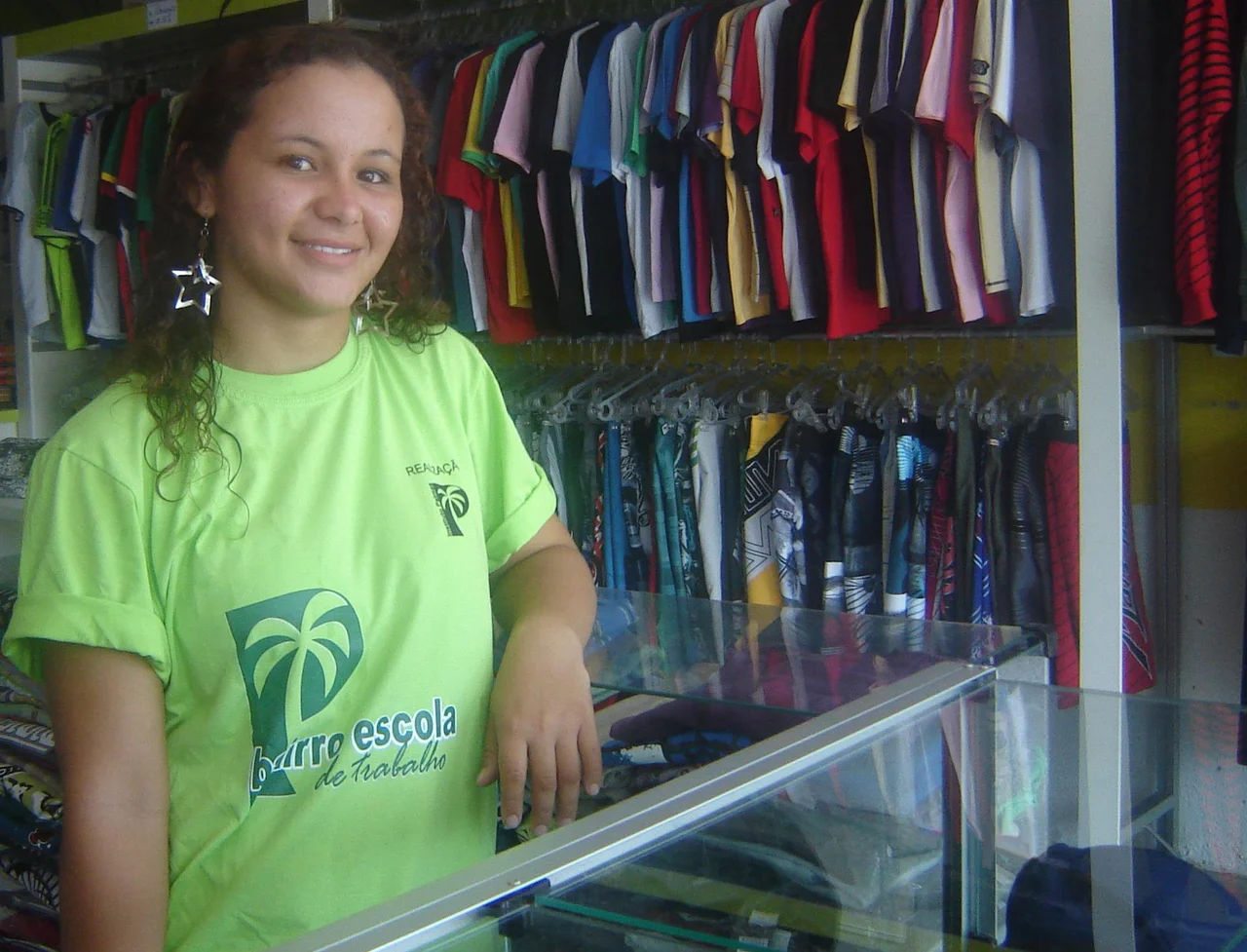
Over the years, Banco Palmas grew far beyond microcredit. The Bairro Escola de Trabalho trained over a thousand local youth aged 16 to 24 in neighborhood businesses in its first three years. The Incubadora Feminina, started in 2001, taught women - many of them single mothers - the skills to build self-managed enterprises, with a 60 percent rate of labor market integration. Palma Fashion supported women recovering from addiction and domestic violence. PalmaTur promoted the neighborhood as an alternative tourist destination beyond the beachfront hotels of Fortaleza's Beira Mar. PalmaLimpe produced cleaning products. PalmaNatus made herbal soaps. The Bate Palmas musical group, led by singer-songwriter Parahyba, performed traditional northeastern rhythms across the country. Each of these was, in its way, a bank product - a way of circulating wealth, skills, and pride inside a community that the formal economy had been content to ignore.
A Model That Travels
Banco Palmas has been studied by researchers, foundations, and development agencies from Asia, Africa, and Europe. Its ideas have traveled far further than its currency. The core principle - that a poor neighborhood's biggest asset is the money already inside it, if only that money can be kept cycling - has influenced community currency experiments from Greece to Kenya to the United States. In Conjunto Palmeiras itself, the transformation has been slower and less dramatic than any single headline could capture. Streets are still unpaved in places. Public services are still thin. But the neighborhood has sewage infrastructure it did not have in 1998. It has squares that have been remodeled and art spaces that did not exist. It has a generation of young people who were trained in local businesses rather than losing their twenties to unemployment. And on every Wednesday at 7 p.m., at the bank's headquarters, the Fórum Socioeconômico Local still meets - the neighborhood still deciding, out loud and together, what it wants next.
From the Air
Located at 3.84°S, 38.53°W, Banco Palmas occupies the Conjunto Palmeiras neighborhood on the southwestern outskirts of Fortaleza, Ceará - about 12 kilometers inland from the Atlantic coast. The nearest commercial airport is Fortaleza's Pinto Martins International (SBFZ), roughly 8 kilometers east. From cruising altitude, Conjunto Palmeiras appears as a dense grid of low buildings in the urban fabric of greater Fortaleza, with the beaches of Praia do Futuro and Beira Mar visible along the northeastern coast. The neighborhood lies on the Pacatuba-Fortaleza urban expansion corridor.
Nearby Stories
- Prainha do Canto Verde Extractive Reserve 28 km away
- Redenção, Ceará 33 km away
- Guajiru 39 km away
- Canindé, Ceará 48 km away
- Emboaca 71 km away
- Canoa Quebrada 89 km away
- German submarine U-164 (1941) 198 km away
- Nadir Crater 2724 km away