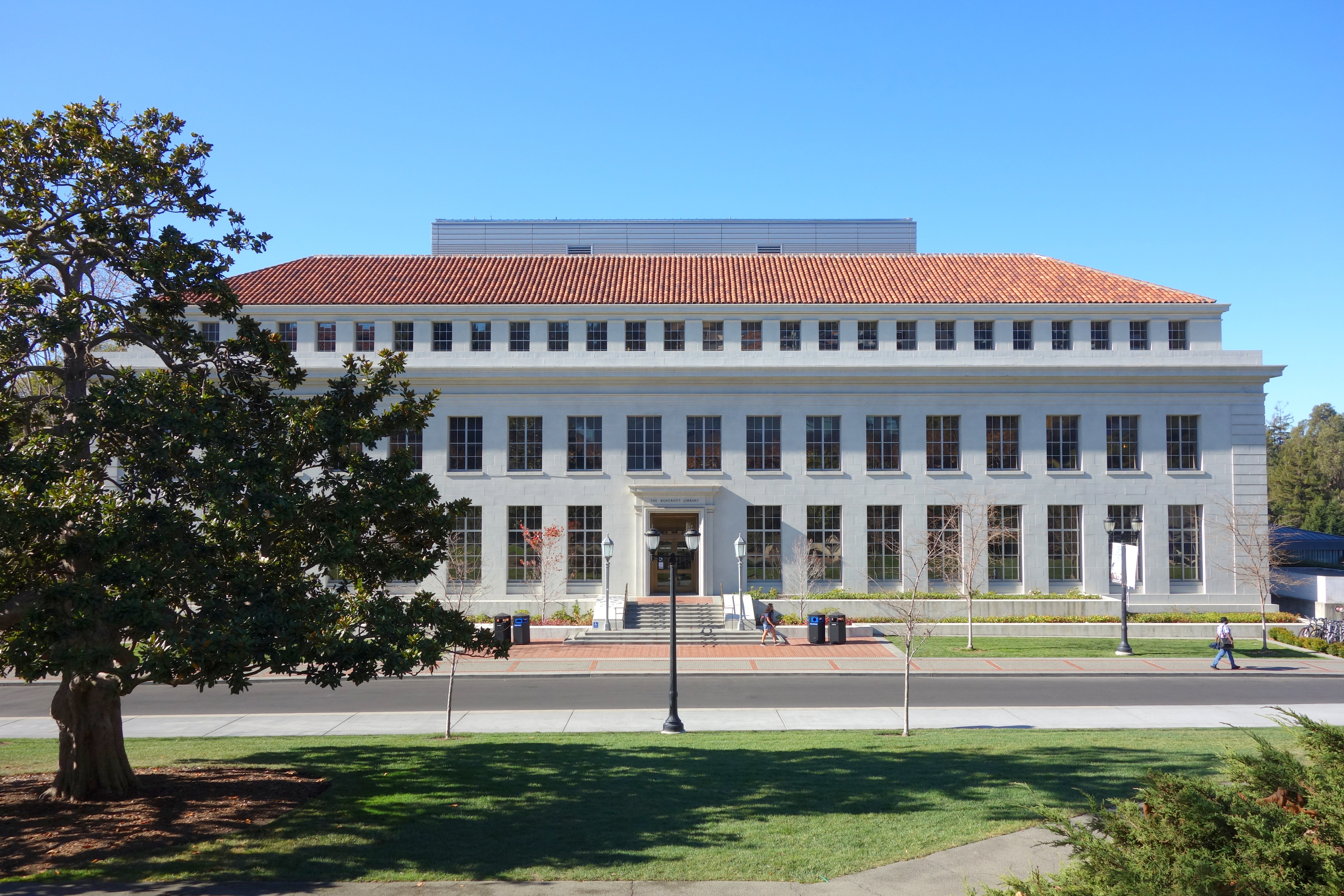
Bancroft Library
"When the collection had reached one thousand volumes, I fancied I had them all; when it had grown to 5,000, I saw it was but begun." Hubert Howe Bancroft wrote those words about his own creeping obsession, and anyone who has ever fallen down a research rabbit hole will recognize the feeling. What started in 1859 as a casual instruction to clear some shelves in Bancroft's San Francisco bookshop -- make room for anything about the Pacific coast -- became one of the great collecting compulsions of the nineteenth century. Bancroft did not set out to build a library. He set out to write a history. The library was a side effect that outlasted anything he actually wrote.
The Collector Who Could Not Stop
It began modestly enough. William H. Knight, working as an editor in Bancroft's employ, was asked to pull together every book in the shop that touched on the American West. He found fifty or seventy-five volumes. Bancroft bought a few old pamphlets from an antiquarian shop. Then a few more from stalls in Sacramento, Portland, and Victoria. A trip to the East Coast yielded finds in the secondhand stores of New York, Boston, and Philadelphia. Then London and Paris opened his eyes to the scale of what existed. Whole libraries were purchased when the opportunity arose. The scope kept expanding -- from California to the entire western half of North America, from Panama to Alaska, including the Rocky Mountain region, all of Central America, and Mexico. By the time Bancroft considered selling, the collection numbered between 40,000 and 60,000 volumes of books, pamphlets, maps, and manuscripts. He priced it at $250,000, a fraction of what he had spent. The California legislature rejected the purchase in 1887. The University of Chicago circled. California panicked at the thought of losing the collection and, in 1905, the University of California acquired it.
From Regional Archive to Literary Treasury
For its first six decades at Berkeley, the Bancroft Library focused narrowly on the American West, particularly the borderlands of northern Mexico and the southern United States from Florida to California. Directors Herbert Eugene Bolton and George P. Hammond kept the scope tight. Everything changed in 1970, when James D. Hart merged the university's entire Department of Rare Books and Special Collections into Bancroft. Overnight, the library's holdings expanded from Western Americana into the literary and cultural record of civilization itself. In came the Tebtunis Archive -- ancient Egyptian papyri excavated by an expedition funded by Phoebe Apperson Hearst in 1899, the largest such collection in the Western Hemisphere. In came the papers of Mark Twain, the centerpiece of the Mark Twain Project, which since 1965 has been editing everything the writer produced. In came manuscripts from Ina Coolbrith, California's first poet laureate, and from Jack London, Ambrose Bierce, and William Randolph Hearst.
The Beats and Beyond
The literary manuscripts tell a particular story about California as a place where writers came to reinvent American literature. Lawrence Ferlinghetti's papers sit in the same archive as those of Michael McClure, Philip Lamantia, Philip Whalen, and William Everson -- the core of the Beat Generation's San Francisco wing. Joan Didion's manuscripts are here, and Maxine Hong Kingston's. Rube Goldberg's cartoons share shelf space with C. S. Forester's Hornblower novels. The collection is less a library in the traditional sense than a portrait of the creative mind at work -- drafts, revisions, false starts, letters never sent. Today Bancroft holds more than 600,000 books, 55,000 linear feet of archival material, almost eight million photographic prints and negatives, and over 20,000 historical maps. The photographic morgues of the San Francisco Call-Bulletin and San Francisco Examiner alone constitute a visual history of the city across most of the twentieth century.
Reckoning with the Founder
Hubert Howe Bancroft was a visionary collector and a deeply flawed man. In 2023, the university considered renaming the library after concluding that Bancroft held what it called "abhorrent Anglocentric and white-supremacist views that run counter to the University of California's most deeply held principles." The university ultimately kept the name but formed the Bancroft Library Reckoning Committee to address the founder's legacy in other ways. It is a tension the library now carries openly: the collection is extraordinary, assembled with obsessive dedication, and the person who assembled it held views that the institution housing it explicitly rejects. The building itself, renovated and seismically retrofitted between 2005 and 2008, reopened in January 2009. The Bancroft Gallery offers rotating exhibitions drawn from the collections -- photographs, architectural drawings, oral histories, ephemera. The library is open to anyone who walks in. Access to the rarest materials requires demonstrated research need, but the catalog and many digital collections are freely available online.
From the Air
The Bancroft Library (37.8723N, -122.259W) sits on the UC Berkeley campus, east of the Campanile (Sather Tower), the most prominent visual landmark on campus visible from altitude. From 2,000-3,500 feet AGL, the campus is identifiable as the large green-and-building complex east of the Berkeley flatlands and west of the wooded hills. Oakland Metro (KOAK) is 6nm south. The library itself is not individually distinguishable, but the campus is unmistakable, bounded by Oxford Street to the west and Strawberry Creek to the south.