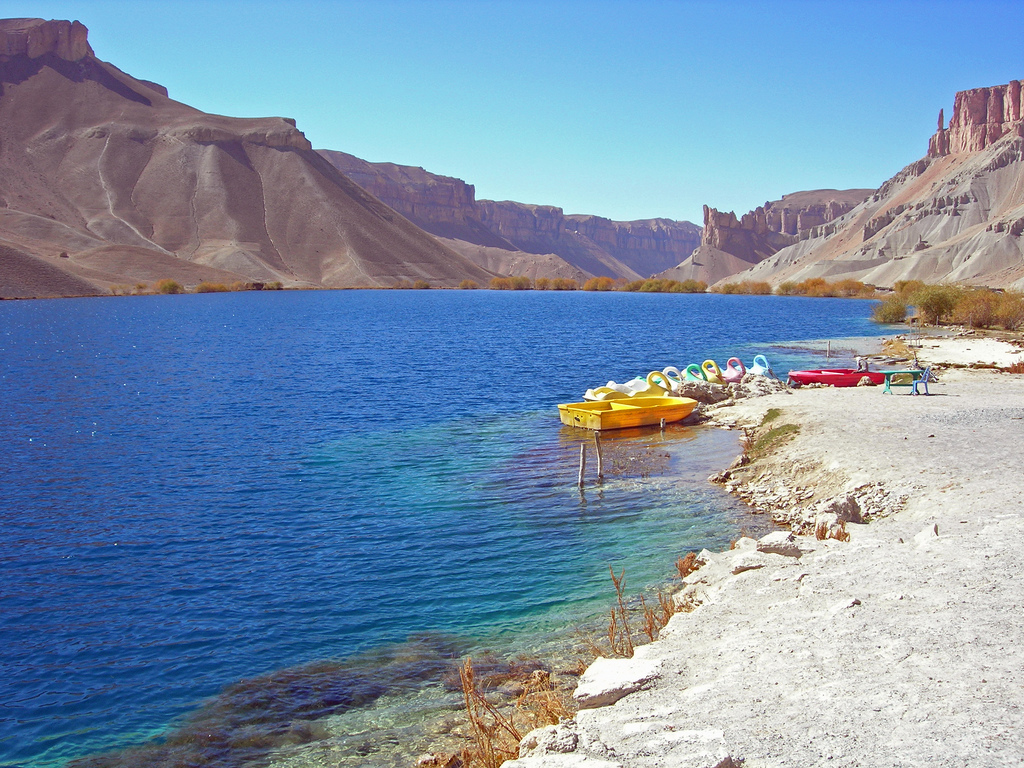
Band-e Amir National Park
The color is the first thing. Not the blue of a swimming pool or the blue-green of a tropical lagoon, but a dense, mineral turquoise that looks almost artificial, as if someone had filled basins in the mountains with tinted glass. Band-e Amir's six lakes sit at 2,900 meters in the Hindu Kush of central Afghanistan, dammed by natural travertine walls that the water itself has built over millennia. Calcium carbonate deposits from underground springs have hardened into barriers, creating a staircase of lakes where the surrounding rock is barren brown and the water is absurdly, almost aggressively blue. In 2009, this became Afghanistan's first national park. Getting here remains an undertaking.
A Geology of Patience
The lakes exist because of chemistry, not engineering. Carbon dioxide-rich water emerges from underground springs, and as the CO2 escapes into the air, dissolved calcium carbonate precipitates out and hardens into travertine dams. The process takes centuries. Each dam grows incrementally, building the walls that hold back each successive lake. The result is six pools arranged in stepped formation across a stark, treeless plateau. Band-e Haibat is the largest and most visited, its surface reflecting the surrounding cliffs in conditions calm enough to hold a mirror. Band-e Panir, Band-e Pudina, Band-e Gholaman, Band-e Zulfiqar, and Band-e Kanbul complete the chain. The colors shift through the day as the sun moves across the valley, from deep sapphire in early morning shadow to blazing aquamarine at midday. At sunrise, when the air is still and the water undisturbed, the reflections of surrounding mountains on Band-e Haibat's surface are so precise they become disorienting.
The Road In
Band-e Amir is most easily reached from Bamiyan, the town famous for the giant Buddha statues the Taliban destroyed in 2001. During high season, shared minivans make the journey on Thursday afternoons and Friday mornings. Otherwise, travelers take a minivan toward Yakawlang and get off at the turnoff, which leaves a three-hour walk across open, sun-exposed terrain. Private minivans can be hired for the full trip, though the price requires determined bargaining. The road itself passes through scenery that rivals the destination: layered rock formations in rust and cream, wide valleys with distant snow-capped peaks, and the occasional farmstead where the green of irrigated land interrupts the brown. All services at the lakes close in mid-November and reopen around March, when the ice releases its grip on the travertine walls and the turquoise reappears.
Life at the Edge
A teahouse at Band-e Haibat serves as the sole accommodation. Travelers sleep on mats on the floor for a modest fee, sharing the main room with local families on cold nights when communal warmth beats the chill of a private chamber. Next door, a building ambitiously named Hotel de Reves offers its own mats on the floor in slightly more private rooms. Food is basic. A few booths near the parking area sell biscuits, batteries, and mango juice packets. Fresh water comes from a spring. Green tea flows endlessly. The local economy around the park depends heavily on the land itself. Residents graze livestock, collect shrubs for fuel, and practice rain-fed farming within the park boundary. The Wildlife Conservation Society maintains the only non-governmental office here, working with park rangers on conservation and supporting ecotourism as an alternative livelihood.
Beneath the Surface
Band-e Amir's beauty exists alongside harder realities. Landmines from decades of conflict were prevalent along the road from Bamiyan, and though most have been cleared, travelers are still advised to stay on well-worn paths. The park's designation as an Important Bird Area by BirdLife International reflects genuine ecological richness: Himalayan snowcocks, Hume's larks, white-winged snowfinches, Afghan snowfinches, and Eurasian crimson-winged finches are among more than 170 bird species recorded here. But enforcement of hunting bans remains limited, and there is no current data to evaluate wildlife populations. In August 2023, the Taliban banned women from entering the park, further restricting access to a place that draws roughly 6,000 local tourists per year. The tomb of Amir overlooks Band-e Haibat from a small mosque-like structure, and behind it a women's bathing area with a hut built half into the water once offered privacy. Whether it still serves that purpose is uncertain.
The Color That Persists
Afghanistan's Grand Canyon, some call it, though the comparison misses the point. The Grand Canyon impresses with scale. Band-e Amir astonishes with color. The turquoise exists because of specific mineral conditions that cannot be replicated or faked, and it has been drawing travelers to this remote plateau for centuries. Pilgrims visit the tomb of Amir, attributing healing properties to the waters. Scientists come for the travertine formations. Birders come for species found nowhere else in such concentration. And ordinary Afghans come for a weekend at the lakes, a rare chance at leisure in a country where leisure is hard to find. The park sits roughly 75 kilometers west of Bamiyan, connected to the broader world by unpaved roads and the determination of those who use them. The lakes do not care about politics or access or the mined paths that once surrounded them. They go on building their travertine walls, molecule by molecule, in the same impossible blue.
From the Air
Located at 34.84N, 67.23E at 2,900 meters elevation in Bamyan Province, central Afghanistan. The five turquoise lakes are visible from altitude as distinctive blue spots in otherwise brown terrain. Approximately 75 km west of Bamiyan (no major airports nearby; nearest is Bamiyan Airport, OABN). Terrain is high-altitude plateau in the Hindu Kush with sparse vegetation. Best viewed in clear summer conditions when the turquoise color is most vivid.