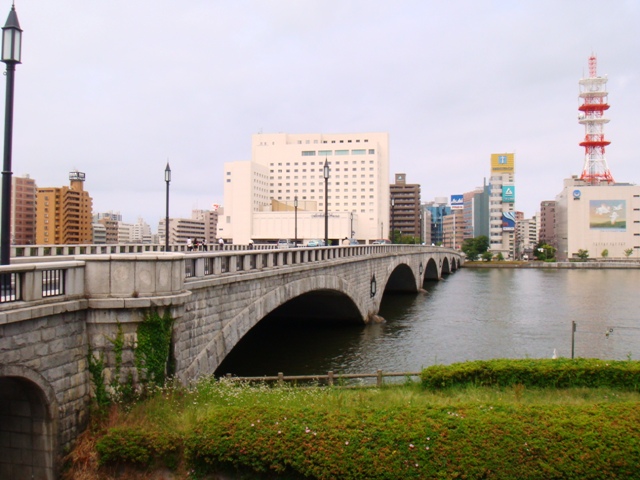
Bandai Bridge: Three Lives Over Japan's Longest River
When the magnitude 7.5 earthquake struck Niigata on June 16, 1964, every bridge on the Shinano River buckled or collapsed. Every bridge except one. The Bandai Bridge sank 1.2 meters on both ends but held firm, its six concrete arches refusing to break. For the desperate residents stranded on the north side of Japan's longest river, that single surviving crossing became the only lifeline for supplies and rescue. The bridge had already lived two previous lives -- first as a wooden toll crossing that was once the longest bridge in Japan, then as a fire-scarred replacement cobbled together from salvaged planks. Each time the river or the city tried to destroy it, the Bandai Bridge came back stronger. Niigata chose well when it named this stubborn span its symbol.
A Wooden Giant Across the Water
In 1886, during the Meiji era, crossing the Shinano River between Niigata and the neighboring community of Nuttari meant waiting for a boat. Two local power brokers -- the head of the Niigata Nippo newspaper and the president of Daishi Ginko bank -- decided the inconvenience had lasted long enough. They funded the construction of the first Bandai Bridge, a wooden structure that stretched 782 meters across the river, making it the longest bridge in Japan at the time. The Shinano River was enormously wide in those days, more than two and a half times its current breadth. The new bridge was privately owned, and its high tolls meant few people actually used it at first. In 1900, the prefectural government took over and made the crossing toll-free, finally delivering on its original promise to unite the two sides of the river. But the bridge's first life ended in March 1908, when a fire that destroyed 1,770 houses in Niigata consumed more than half the wooden span.
Salvaged from the Ashes
Niigata rebuilt quickly. By December 1909, a second Bandai Bridge stood across the Shinano, built using salvaged planks from the fire's wreckage as its foundation. It matched the dimensions of the original -- a practical choice driven by necessity rather than ambition. This second bridge became the transportation hub of a growing city, the main artery connecting Niigata's commercial districts. Fragments of both the first and second bridges survive today, displayed in an underground crossing beneath the Bandai shopping district -- wooden relics from an era when Japan's rivers were wider and its bridges were built to burn.
Concrete, Granite, and a River That Shrank
By the late 1920s, the second wooden bridge was deteriorating, but Niigata's river had transformed around it. Water diversion projects throughout the early twentieth century had narrowed the Shinano from 770 meters to just 270 meters at the bridge crossing. The third Bandai Bridge, completed in 1929, was built for this new reality: far shorter than its predecessors at 306.9 meters, but wider at 21.9 meters to accommodate automobiles with two lanes in each direction. Six reinforced concrete arches clad in granite gave the bridge a permanence its wooden ancestors never had. It became a prime example of Showa-era large-scale concrete arch construction -- elegant, solid, and built to endure what the river and the earth might deliver.
Fireworks and Fault Lines
The bridge's strength was tested by human error before geology had its turn. On August 28, 1948, during the annual Niigata Festival, a fireworks accident on the bridge sent over one hundred spectators tumbling into the Shinano River. Twenty-nine people died. The disaster led to a permanent ban: all bridges across the river are now closed to spectators during fireworks displays. Sixteen years later, the 1964 Niigata earthquake put every structure in the city to the test. The quake liquefied soil, toppled apartment buildings, and destroyed or severely damaged nearly every crossing on the Shinano. The Bandai Bridge absorbed the shock. Its foundations sank but its arches held, and it became the sole route for vehicles carrying emergency aid to the isolated north bank. That single act of structural defiance cemented the bridge's place in Niigata's identity.
Lanterns on the River
In 1985, Niigata celebrated the centennial of the first bridge by adding decorative lanterns that illuminate the granite arches after dark, turning the span into one of the city's most photographed scenes. Four years later, a folk-dance procession across the bridge became a signature event of the annual Niigata Festival -- dancers filing across the same crossing where fireworks once turned festive. In 2004, the bridge received designation as a national Important Cultural Property, seventy-five years after the current span was completed. That same year, much of the structure was reconstructed to more closely resemble its original 1929 appearance. Today the Bandai Bridge connects the Furumachi and Honcho shopping districts to the north with Niigata Station and the Bandai commercial district to the south, carrying National Route 7 over the river that made the city. Three incarnations in, the bridge has outlasted wood, fire, earthquake, and tragedy. The lanterns glow each evening as proof.
From the Air
Located at 37.92°N, 139.05°E spanning the Shinano River in central Niigata. The six-arched bridge is visible from altitude as a distinctive crossing point on the wide river near its mouth at the Sea of Japan. Best viewed from 2,000-4,000 feet AGL. The Shinano River and its parallel bridges provide strong visual orientation. Niigata Airport (RJSN) lies approximately 5 nautical miles northeast. The Bandai Bridge connects the Furumachi commercial area north of the river to Niigata Station and the Bandai district to the south.