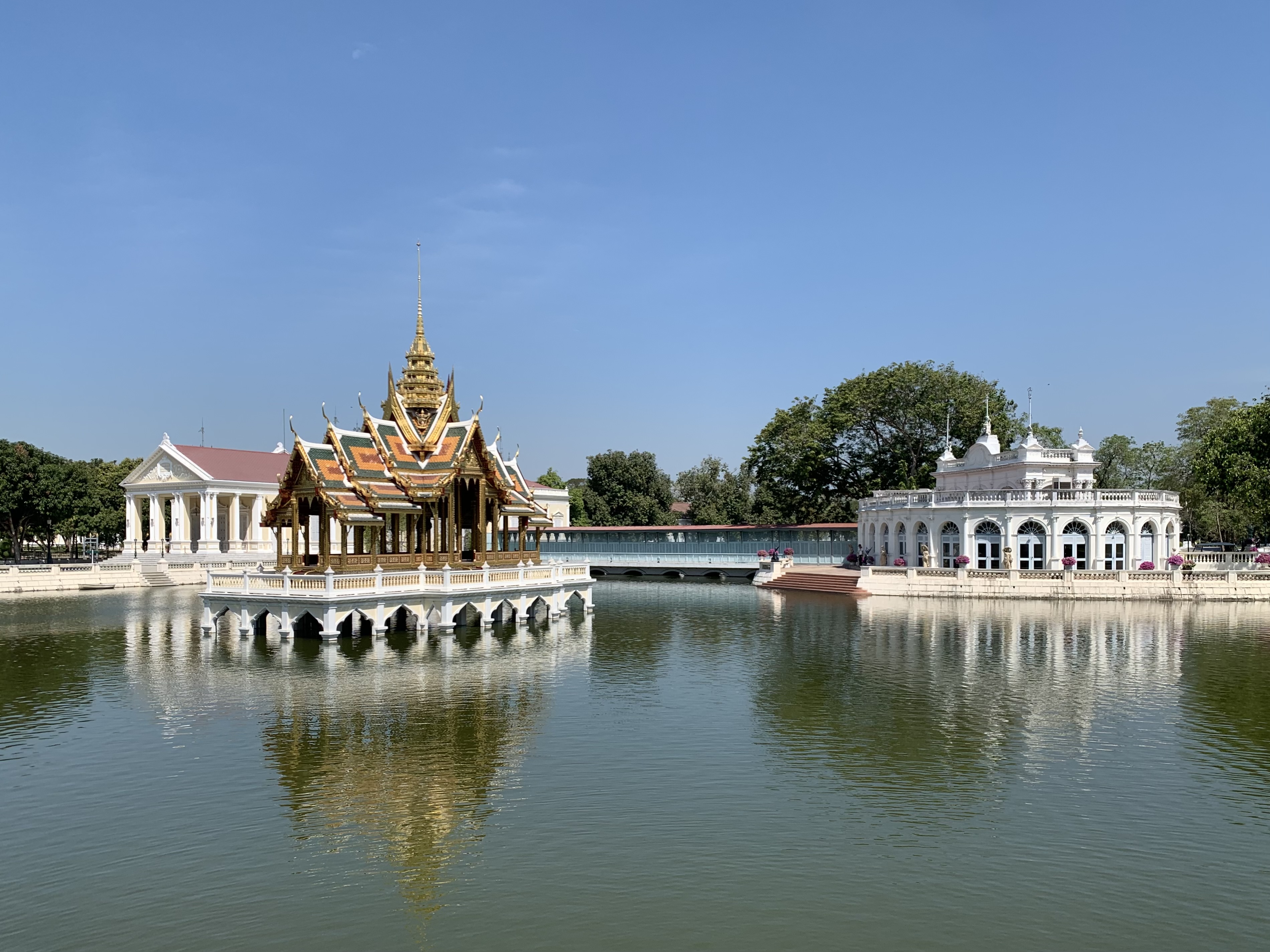
Bang Pa-In Royal Palace
Each building speaks a different language. The Chinese-style throne hall, red and gold under curving eaves, faces a Gothic chapel across the river that could pass for a parish church in the English countryside. Between them, a Thai pavilion floats on a pond like a golden crown resting on still water. Bang Pa-In Royal Palace is a place where architectural traditions from three continents somehow coexist without argument, set along the banks of the Chao Phraya River in Ayutthaya Province, about sixty kilometers north of Bangkok.
A Palace Born, Abandoned, and Reborn
King Prasat Thong built the original palace complex in 1632, during the height of the Ayutthaya Kingdom, choosing this island in the Chao Phraya River as a royal retreat. For over a century it served that purpose. Then came decline. After the Burmese sacked Ayutthaya in 1767, the palace fell into disuse, swallowed by tropical vegetation for nearly a hundred years. Vines crept over walls, trees pushed through floors, and the river slowly reclaimed its banks. It was King Mongkut, in the mid-nineteenth century, who saw something worth saving in the overgrown ruins and began restoration. But the palace as visitors see it today is largely the work of his son, King Chulalongkorn, who rebuilt and expanded the complex between 1872 and 1889. Chulalongkorn was a modernizer, fascinated by European culture after extensive travels abroad, and he poured that fascination into Bang Pa-In.
A World Tour in One Garden
The palace grounds read like an architectural anthology. Wehart Chamrun -- 'Heavenly Light' -- is a Chinese-style royal residence and throne room, its lacquered columns and intricate woodwork a gift of aesthetic diplomacy. The Warophat Phiman, or 'Excellent and Shining Heavenly Abode,' served as the main royal residence. Ho Withun Thasana, the 'Sages' Lookout,' is a brightly painted observation tower from which the king could survey his domain. Most photographed of all is the Aisawan Thiphya-Art -- the 'Divine Seat of Personal Freedom' -- a Thai-style pavilion set in the middle of a pond, its spire reflected perfectly in the water on calm days. Across the river sits Wat Niwet Thammaprawat, a royal temple built in a European Gothic style that startles visitors expecting the familiar forms of Thai Buddhist architecture. Stained glass windows filter tropical light into the interior, a surreal collision of traditions.
Tragedy on the River
On 31 May 1880, King Chulalongkorn arranged a Royal Barge Procession to travel to Bang Pa-In with his wives. During the journey, the steamboat Sarawan collided with the royal barge carrying Queen Sunanda Kumariratana and their daughter, Princess Kannabhorn Bejaratana. The barge capsized. Both the queen and the princess drowned. The tragedy was later retold with an embellishment — that palace law forbade commoners from touching royalty, paralyzing would-be rescuers. In fact, according to the king's own diary, boatmen did jump into the water and pulled the queen and princess free, but were unable to revive them. Chulalongkorn, devastated, erected a marble monument at the palace in their memory. The inscription reads, in part, as a lament for a beloved wife and child taken by the very river that made the palace so beautiful. The monument still stands in the gardens, a quiet reminder that grandeur and grief have always shared these grounds.
Ceremonies and State Guests
Bang Pa-In was not merely a summer retreat. In August 1918, King Rama VI presided over the royal wedding of Prince Prajadhipok and Princess Rambai Barni in the Warophat Phiman throne hall -- a ceremony that joined the future king to his queen. During Chulalongkorn's reign and continuing through that of King Bhumibol Adulyadej, the palace served as a venue for hosting foreign royalty. Queen Beatrix of the Netherlands, Queen Margrethe II of Denmark, Infanta Elena of Spain, and Queen Elizabeth II all visited these grounds. The palace remains open to visitors today, its gardens and buildings maintained as both a working royal site and a public monument to the kings who shaped it across nearly four centuries.
From the Air
Located at 14.2325N, 100.5792E along the Chao Phraya River. The palace complex and its distinctive ponds and gardens are visible from low altitude. The nearest airfield is Ayutthaya (VTBX), approximately 15 km to the north. Don Mueang International Airport (VTBD) lies about 50 km to the south, and Suvarnabhumi Airport (VTBS) is roughly 80 km southeast. Best viewed from 2,000-3,000 feet AGL heading north along the Chao Phraya River, where the palace island and its surrounding waterways are clearly distinguishable.