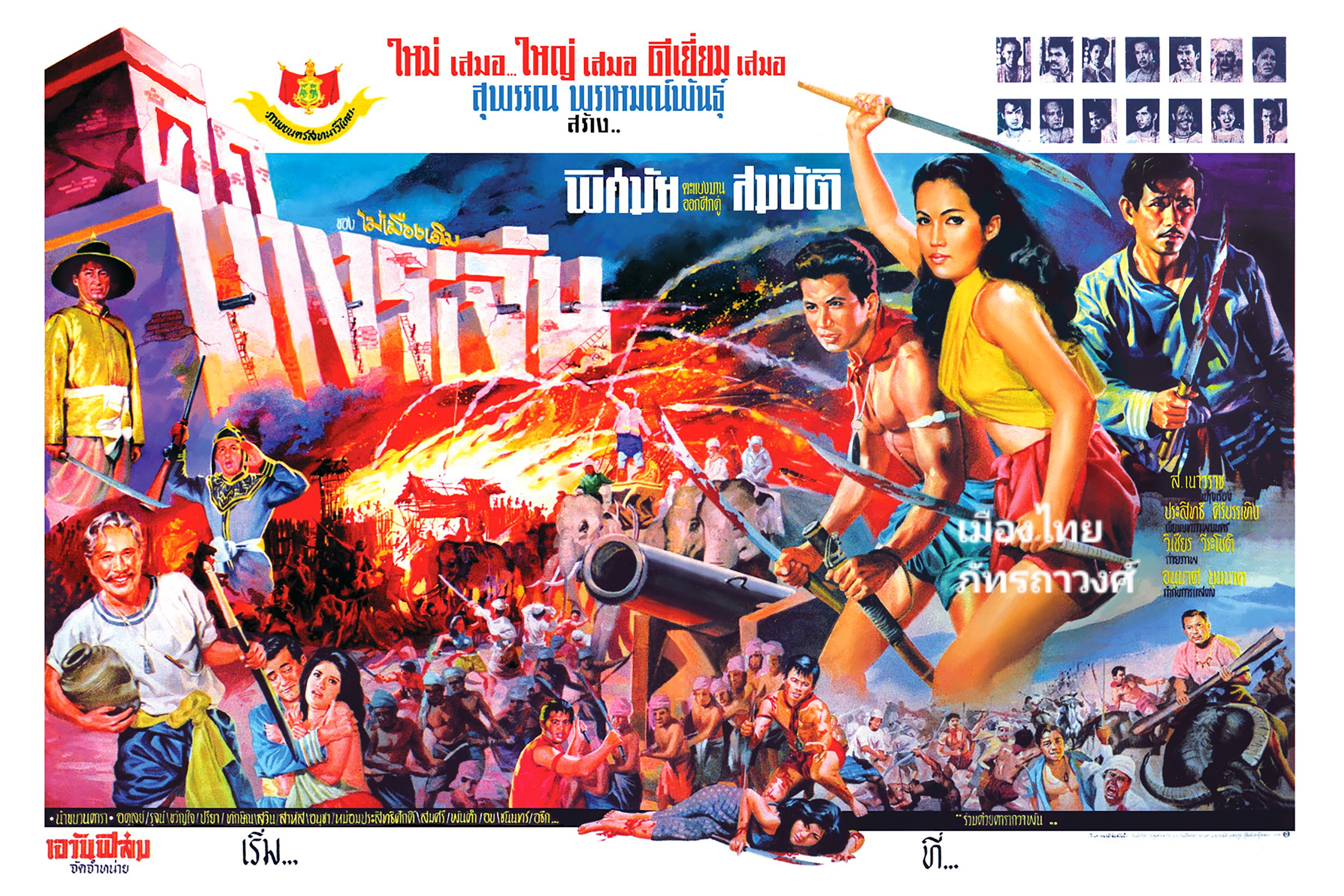
Bang Rachan
Nai Thong Min was drunk when he mounted the water buffalo. Burmese cannons were pounding his village, the walls were crumbling, and several of the eleven leaders who had held Bang Rachan together through seven impossible victories were already dead or wounded. So Thong Min climbed onto the biggest animal he could find and charged the Burmese fortifications with a handful of men behind him. He was killed. The charge failed. And three centuries later, his ride remains one of the most iconic images in Thai popular memory -- a moment of defiant, irrational courage that crystallizes everything the village of Bang Rachan means to the Thai national imagination.
The Provocation That Started a Resistance
In 1765, Burmese armies of the Konbaung dynasty entered Siam. The invaders advanced rapidly, meeting little organized resistance from the Siamese court or military. But the Burmese implemented a policy in the villages they occupied that would prove costly: they seized all rice paddies to feed their armies and demanded women from every settlement they raided. It was this policy -- the theft of food and the violation of families -- that provoked ordinary Siamese farmers into fighting back. In villages north of the old capital of Ayutthaya, small bands of warriors began ambushing Burmese soldiers. A group led by Nai Ten, Nai Chote, and others from the villages of Sibuathong, Pho Krap, and Pho Thale developed a tactic of luring Burmese soldiers into the forest with promises of rescuing captive women, then turning on them. When the Burmese began anticipating these ambushes, the guerrillas retreated to the village of Bang Rachan, in what is now Sing Buri Province, where refugees from surrounding districts had already gathered.
Eleven Leaders and Seven Victories
Bang Rachan was a natural fortress: set on high ground with plentiful food supplies and difficult to approach. About four hundred warriors assembled under eleven leaders, including Nai Thong Min, Nai Chan Nuad Keao -- famous for his ferocity and his bristling moustache -- and Nai Ten, who was elected overall commander. A Buddhist monk named Thammachote joined the village and was revered by the fighters, who believed he possessed knowledge of protective spells and incantations. The Burmese first sent a force of one hundred men. Nai Ten's warriors ambushed them while resting and nearly wiped them out. Word of the victory spread across the countryside, drawing more fighters until Bang Rachan's force swelled to a thousand warriors organized along military lines. The Burmese sent a second force of five hundred. Defeated. A third, larger force under a new commander: defeated again. Seven times the Burmese attacked; seven times they were repulsed, each failure making the villagers' reputation grow and the Burmese commanders increasingly reluctant to commit their men.
The Commander Who Did Not Underestimate Them
After seven defeats, a Mon commander who had lived in Siam as a spy volunteered to lead the eighth assault. Unlike his predecessors, he understood the terrain and his enemy's strengths. Instead of charging the village, he advanced slowly, building a chain of fortified positions along his route and refusing to engage Bang Rachan in open battle. From behind fortress walls, his artillery pounded the village with sustained cannon fire. This was the tactic that broke them. Bang Rachan had no artillery of its own. The villagers sent desperate pleas to Ayutthaya for cannons, but the capital -- itself preparing for the inevitable Burmese siege -- refused to send any. One official, Phraya Rattanathibet, was dispatched to help the village forge its own weapons, but the hastily cast cannons cracked and proved useless. Nai Ten succumbed to a knee wound sustained in an earlier battle. Nai Chan Nuad Keao and Nai Khun Sun died from injuries in failed raids on the Burmese forts.
Fallen but Never Forgotten
With four of their eleven leaders dead and the village under continuous bombardment, Bang Rachan finally fell. The timeline claimed by Thai tradition -- five months of resistance -- has been questioned by historians comparing Thai and Burmese sources; the full northern Burmese campaign lasted only slightly longer than five months, and the invading general associated with Bang Rachan in Thai accounts may have been elsewhere during the period described. Prince Damrong Rajanubhab, considered the father of Thai historiography, acknowledged elements of mythologization. But the emotional truth persists. A monument to the eleven leaders stands today on Highway 3032 in Khai Bang Rachan District, thirteen kilometers southwest of Sing Buri town. The 2000 Thai film Bang Rajan, directed by Thanit Jitnukul, dramatized the story and was presented internationally by Oliver Stone for its 2004 US cinema release. Thais compare Bang Rachan to the Battle of the Alamo in American memory: a defeat transformed by collective grief into a foundational story of national courage, where ordinary people fought to the last for a home their government had already given up on.
From the Air
Located at 14.90N, 100.32E in the flat central plains of Sing Buri Province, north of the Ayutthaya ruins. The memorial monument is located 13 km southwest of Sing Buri town on Highway 3032 in Khai Bang Rachan District. The terrain is flat agricultural land along river valleys. Nearest regional airports include Nakhon Sawan (VTPN) to the north and Don Mueang International Airport (VTBD) approximately 150 km to the south. Best viewed at 2,000-4,000 feet AGL as part of a flight along the central Thai plains following the Chao Phraya River valley northward from Ayutthaya.