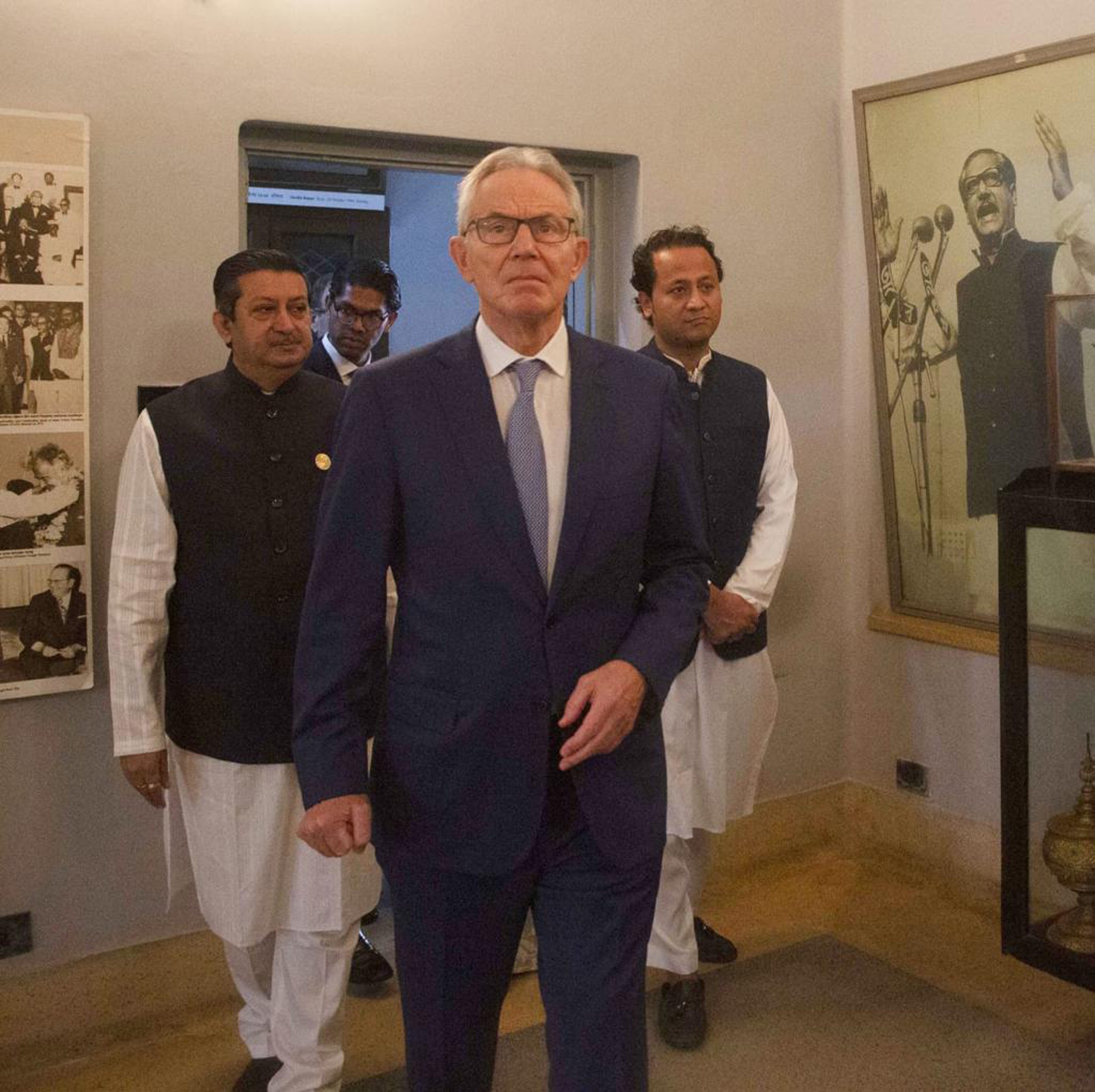
Bangabandhu Memorial Museum
Every nation has an address that carries the weight of its founding. For Bangladesh, it was 32 Dhanmondi, a modest two-story house in Dhaka where Sheikh Mujibur Rahman declared independence on the night of 25 March 1971, was assassinated with his family on 15 August 1975, and where the walls themselves became contested territory -- burned by protesters in August 2024 and demolished by an organized mob in February 2025. The building is largely gone now. The argument about what it meant has only intensified.
A House Built on a Loan
Sheikh Mujibur Rahman acquired the Dhanmondi plot in 1957, when he was a rising politician in East Pakistan and the neighborhood was a new residential project on the edges of Dhaka. He was arrested in 1958 under martial law before he could build on it. His family was evicted from their government housing and bounced between rented rooms until Mujib's release in 1960, when he took out a loan from the House Building Finance Corporation to construct a simple one-story home. He moved in on 1 August 1961 with his wife and children, the house still unfinished. Over the next decade, as Mujib's political stature grew -- through the Six Point Movement of 1966, the mass uprising of 1969, and the landslide election of 1970 -- the house grew with him, expanding to two stories. It was here that his youngest son, Sheikh Russel, was born in 1964. Here that the flag of Bangladesh was hoisted for the first time, on 23 March 1971.
Independence and Annihilation Under One Roof
On the night of 25-26 March 1971, Mujib proclaimed Bangladesh's independence from this house, moments before Pakistani soldiers arrived to arrest him. The house was damaged during the Liberation War, occupied by the Pakistani army, and restored after independence. For three and a half years -- from February 1972 to August 1975 -- it served as the de facto center of Bangladeshi politics. Then, in the predawn hours of 15 August 1975, disgruntled army officers stormed the house and killed Mujib, his wife Fazilatunnesa, sons Sheikh Kamal, Sheikh Jamal, and ten-year-old Sheikh Russel. The military government that followed seized the property. Sheikh Hasina, Mujib's surviving daughter, was barred from entering her childhood home when she returned from exile in 1981. She managed to reclaim ownership only by paying off a loan installment when the property was put up for auction.
From Residence to Shrine
In 1994, the Bangabandhu Memorial Trust converted the house into a museum, preserving the rooms where the family had lived and died. Visitors could walk through Mujib's drawing room, see Sheikh Russel's toys and aquariums, and stand on the staircase where the assassination took place. A six-story extension was added in 2011, housing galleries, a library, and an auditorium. The museum became a stop on every state visit -- Narendra Modi, Emmanuel Macron, John Kerry, and Angelina Jolie all signed its guest book. For supporters of the Awami League and the founding mythology of Bangladesh, the house was sacred ground. For the party's opponents, it was a symbol of dynastic politics and what they considered authoritarian rule under Sheikh Hasina. Both readings contained truth, and neither was complete.
Fire, Graffiti, and the Bulldozer March
On 5 August 2024, as Sheikh Hasina's government fell amid mass protests, crowds set the museum on fire. The interior was looted. The six-story extension -- library, auditorium, photo gallery -- was gutted. The next day, protesters spray-painted graffiti on the walls and posed for photographs among the ruins. On the anniversary of the assassination, 15 August 2024, mourners who tried to visit the site were attacked by mobs with sticks. Then, on 5 February 2025, activists from the Inqilab Moncho and allied organizations launched what they called a "bulldozer march," with demolition continuing into the following day. An excavator and a crane were brought to the site. Portraits were destroyed, and attackers chanted slogans demanding the banning of the Awami League. The demolition of Dhanmondi 32 was broadcast live on social media, and no security forces intervened. Subsequent attacks in November 2025 damaged what little debris remained.
What the Rubble Holds
The destruction of the Bangabandhu Memorial Museum is not the end of the story it tried to tell. If anything, the attacks have amplified the questions the museum raised. Bangladesh's independence was born in this house. Its founding father was murdered in this house. His daughter used this house to build a political dynasty that governed for decades, and her opponents reduced it to rubble as a statement about the kind of country they wanted instead. The physical structure can be demolished, but the address -- 32 Dhanmondi -- remains fixed in the political geography of Bangladesh, a coordinate where the nation's founding ideals and its unresolved contradictions meet. Whether it is ever rebuilt, and by whom, will say as much about Bangladesh's future as its past.
From the Air
Located at 23.7517N, 90.3764E in the Dhanmondi residential area of central Dhaka, identifiable by the grid of Dhanmondi's lakes and residential blocks. Approximately 8 km south of Hazrat Shahjalal International Airport (VGHS). Best viewed at 1,500-2,500 feet. The Buriganga River lies to the south, and the green expanse of Dhanmondi Lake is a nearby visual reference.