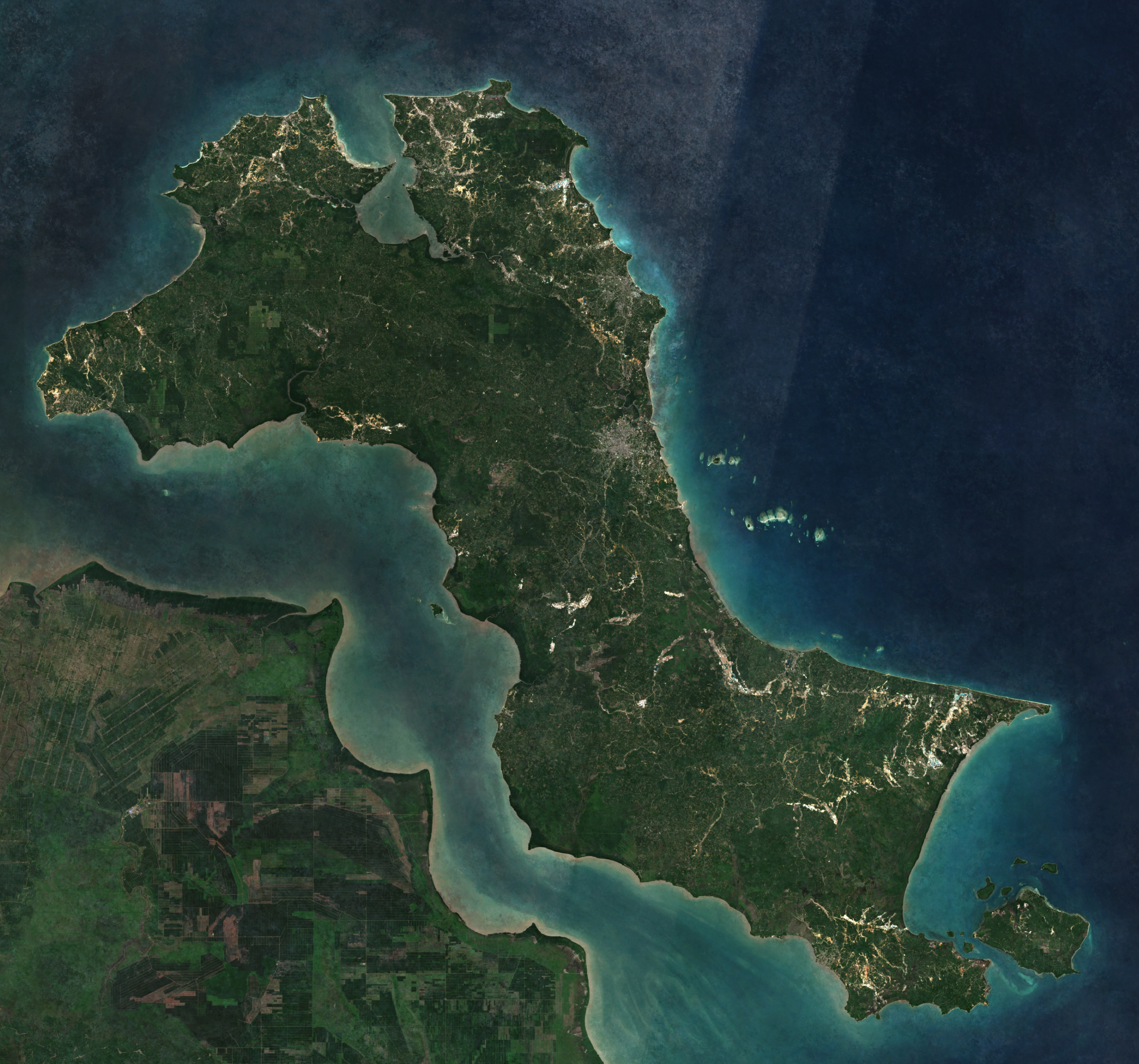
Bangka Island
The crocodiles moved into the mines. That detail alone captures the strange bargain Bangka Island has struck with its own geology. Since roughly 1710, this island off the southeastern coast of Sumatra has been one of the world's most productive sources of tin, and the open-pit mines that scar its lowlands fill with water when abandoned. Saltwater crocodiles, displaced from mangrove habitat destroyed by the same mining, have colonized these flooded pits, turning industrial scars into predator territory. It is a grim ecological feedback loop, and it defines modern Bangka -- an island where the consequences of extraction are never far from the surface.
Crossroads of Empires
Bangka's recorded history begins with a stone inscription. The Kota Kapur inscription, dated 686 CE and discovered on the island in 1920, documents Srivijayan influence over the region during the seventh century. The maritime empire prized Bangka for the same reason everyone after it would: position. Sitting between the South China Sea and the Java Sea, separated from Sumatra only by the narrow Bangka Strait, the island lay along trade routes connecting China, India, and the Malay world. The Majapahit empire later conquered Bangka under the legendary commander Gajah Mada, appointing local rulers and imposing social structures. Chinese traders arrived during the Ming dynasty treasure voyages -- the soldier Fei Xin recorded the island as Peng-ka hill in 1436. By the time European powers took interest, Bangka was already a place where cultures and commerce overlapped in complicated layers.
Traded Between Crowns
The British acquired Bangka in 1812 and promptly renamed it Duke of York Island, as colonial powers tended to do. The new name never stuck. Two years later, Britain exchanged Bangka with the Dutch for Cochin in India under the Anglo-Dutch Treaty of 1814 -- a swap that says something about how European empires valued territory, trading an entire island for a port city half a world away. Under Dutch control, Bangka's tin mines expanded dramatically, and by the late eighteenth century the island was producing around 1,250 tons annually. The Dutch brought in Chinese laborers, predominantly Hakka, to work the mines. A coolie rebellion in 1899 saw Chinese leaders captured by the Royal Netherlands East Indies Army, a reminder that the wealth extracted from Bangka was built on coerced labor and suppressed resistance.
War and Revolution
Japan occupied Bangka from February 1942 to August 1945. The occupation brought atrocity: the Bangka Island massacre saw Japanese soldiers kill Australian nurses along with British and Australian servicemen and civilians. After the war, Bangka became entangled in the Indonesian National Revolution. In the aftermath of Operation Kraai -- a Dutch military offensive in December 1948 -- republican leaders Sukarno and Mohammad Hatta were exiled to Bangka, the island effectively serving as a prison for the men who would become Indonesia's first president and vice president. Bangka joined independent Indonesia in 1949. For decades it was part of South Sumatra province, until 2000, when Bangka and neighboring Belitung were carved off as their own province. The island also carries a quieter legacy of political violence: a number of communist Indonesians have remained under house arrest on Bangka since the anti-communist purge of the mid-1960s, forbidden to leave.
The Price of Tin
Tin production on Bangka is a government monopoly, with a smelter operating at the port of Muntok on the western coast. Satellite imagery reveals the scale of the damage: pockmarked terrain where forest and farmland once stood, replaced by open pits and sediment-choked waterways. The mining extends offshore, dredging the seabed and destroying coral reefs. Environmental reporting from outlets like The Guardian and Mongabay has documented how illegal mining fuels social conflict across the island, pitting communities against each other and against corporations. Meanwhile, the displaced crocodiles keep finding new homes in flooded mine pits, and attacks on people have increased -- a consequence so absurd it almost obscures how serious it is. Yet tin remains central to Bangka's economy, even as production has declined in recent years. The island's population of roughly 1.19 million, a mix of Malay and Hakka Chinese residents, lives between the competing demands of livelihood and landscape.
Beyond the Mines
Bangka is not only tin. White pepper has been cultivated here for centuries -- Muntok white pepper remains a recognized variety in global spice markets. Palm oil and rubber plantations cover stretches of the interior, and the island's four seaports -- Muntok, Belinyu, Sadai, and Pangkal Balam -- handle fishing fleets and cargo traffic. The capital, Pangkal Pinang, is the province's largest city, while Belinyu in the north draws visitors for its seafood. The island's lowland geography of plains, swamps, and small hills gives way to beaches like Pasir Padi, where white sand meets turquoise water. From the air, Bangka reads as a study in contrasts: green canopy interrupted by the raw ochre scars of mining, fringed by pale coastline and the turquoise shallows of surrounding seas.
From the Air
Bangka Island sits at approximately 2.25S, 106.00E, east of Sumatra across the Bangka Strait. The island spans roughly 11,831 km2 and is clearly visible as a distinct landmass from cruising altitude. Depati Amir Airport (WIPK) at Pangkal Pinang serves as the main airport. The tin mining scars are visible from altitude as light-colored patches against the green canopy. The Gaspar Strait separating Bangka from Belitung to the east is a useful navigation reference. The port of Muntok on the western coast faces Sumatra across the narrows.