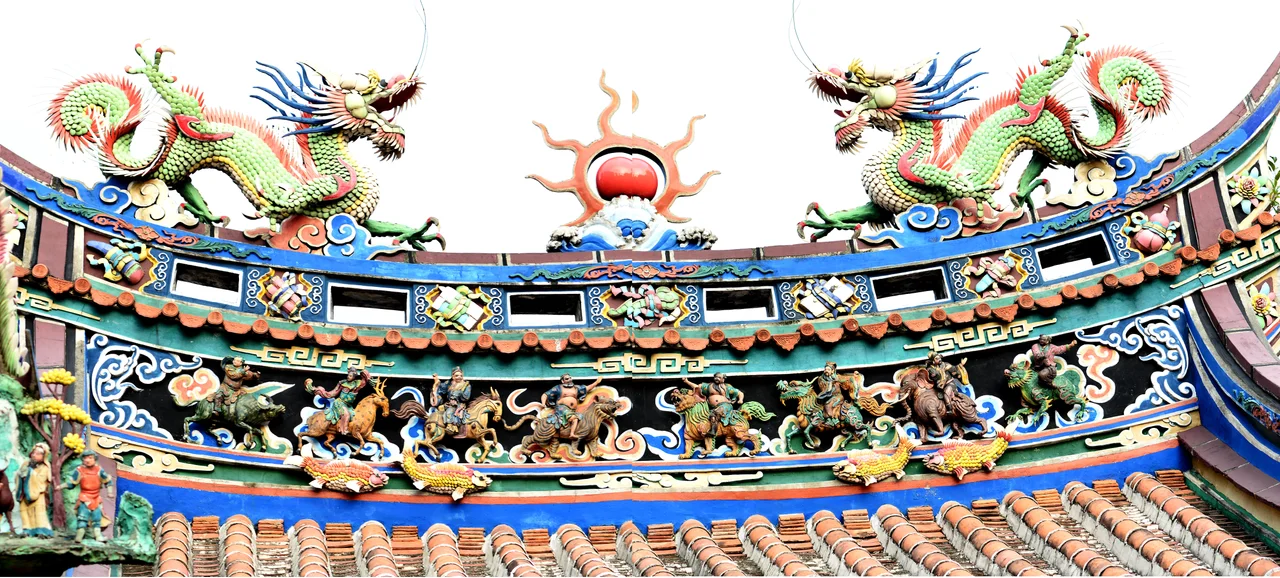

Bangka Qingshui Temple
Long before Taipei had a grid of boulevards or a metro system, the merchants and fishermen of Bangka — the settlement that would eventually grow into what is now Wanhua District — built a temple. It was 1787, and they dedicated it to a monk who had been dead for nearly seven centuries. His name was Master Qingshui, born Tan Chiau Eng in Anxi County, Fujian, in 1047. He was said to have prayed for rain during droughts and to have performed miracles. More importantly for those early settlers who had crossed the Taiwan Strait seeking a new life, he was their protector from home.
The Monk Behind the Deity
Master Qingshui (清水祖師) lived from 1047 to 1101, during the Northern Song dynasty. A Chan Buddhist monk from coastal Fujian province, he became revered among the Hokkien-speaking communities of southeastern China for his ability to bring rain during times of drought and his reputation for miraculous healings. After his death, local villagers built shrines in his honor, and over the centuries his veneration spread through the networks of Hokkien emigrants who carried their religious traditions wherever they settled.
When Fujian immigrants poured into Taiwan during the Qing dynasty — many of them from Anxi County, the monk's birthplace — they brought his cult with them. The Bangka temple, founded in 1787, became one of the most important centers of Qingshui worship on the island. The deity's dark complexion, one of his iconographic signatures, is said by tradition to be the mark left by fire — evidence of miracles tested and confirmed.
The Oldest Neighborhood in Taipei
Wanhua District is the oldest settled part of what became Taipei. The Bangka area was a trading hub from the early eighteenth century, its docks receiving goods carried down the Tamsui River from the interior highlands. By the time the temple was built, the neighborhood was already a generation old — with tea merchants, cloth traders, and the tight social networks of a community that had made its fortune and put down roots.
The temple sat at the heart of that community. Temples in this tradition are not quiet meditation spaces; they are civic institutions — places of commerce, dispute resolution, festival, and collective identity. The noise and incense and crowds of a busy Taiwanese temple are not distractions from devotion. They are devotion. The Bangka Qingshui Temple has been a neighborhood institution for over two centuries, surviving the administrative transitions from Qing to Japanese to Republic of China rule that reshaped every other institution around it.
Architecture of the Mid-Qing
Scholars of Taiwanese temple architecture consistently cite the Bangka Qingshui Temple as 'the most characteristic example of mid-Qing temple architecture.' What that phrase describes is a particular richness of ornament and structural logic. Mid-Qing temples are characterized by their layered roof lines, elaborate carved stone columns, and intricate wood carvings under the eaves — dragons, phoenixes, historical scenes, and auspicious symbols packed into every available surface.
The temple was renovated and restored in 1958, work that preserved its essential form while stabilizing fabric that had aged through a century of Japanese colonial rule and the disruptions of World War II. What visitors see today is the product of that 1958 restoration, which itself honored a design first realized in the late eighteenth century. The proportions, the courtyard structure, the carved guardian figures — all trace back to that original vision of what a prosperous immigrant community could build to honor a deity who had traveled with them across the sea.
Wanhua Today
The temple sits in Wanhua District, still one of the most atmospheric corners of Taipei — older and denser than the gleaming commercial boulevards to the east, with a character shaped by centuries of working-class life and street-level commerce. Snake Alley and the Longshan Temple are nearby landmarks; the neighborhood retains the texture of Old Bangka in ways that newer parts of Taipei do not.
The nearest MRT stop is Ximen Station on the Bannan Line, a short walk to the west. From there, the approach to the temple takes you through narrow lanes where incense sellers and temple goods merchants have operated for generations. The smell of sandalwood reaches you before the roofline does. It is a temple that rewards unhurried attention — the carvings alone can absorb a full afternoon.
From the Air
The Bangka Qingshui Temple is located at approximately 25.04°N, 121.50°E in Wanhua District, the southwestern corner of central Taipei. From the air, Wanhua is identifiable as the dense older fabric west of the elevated Zhongzheng bridge approaches, along the left bank of the Tamsui River tributary. The nearest in-city airport is Taipei Songshan (RCSS), approximately 7 km to the northeast; Taoyuan International Airport (RCTP) lies about 35 km to the southwest. Viewing altitude of 3,000–5,000 feet provides good orientation to the river network and street grid of historic Bangka.
Nearby Stories
- Dapu Incident 9.3 km away
- Shuanglianpi Wetland 18 km away
- Toufen 41 km away
- North Jiangsu Main Irrigation Canal 980 km away
- General Cliff Rock Paintings 1050 km away
- Sinking of MV Sewol 1061 km away
- Yellow Sea 1111 km away
- Twin Forts of Romblon 1358 km away