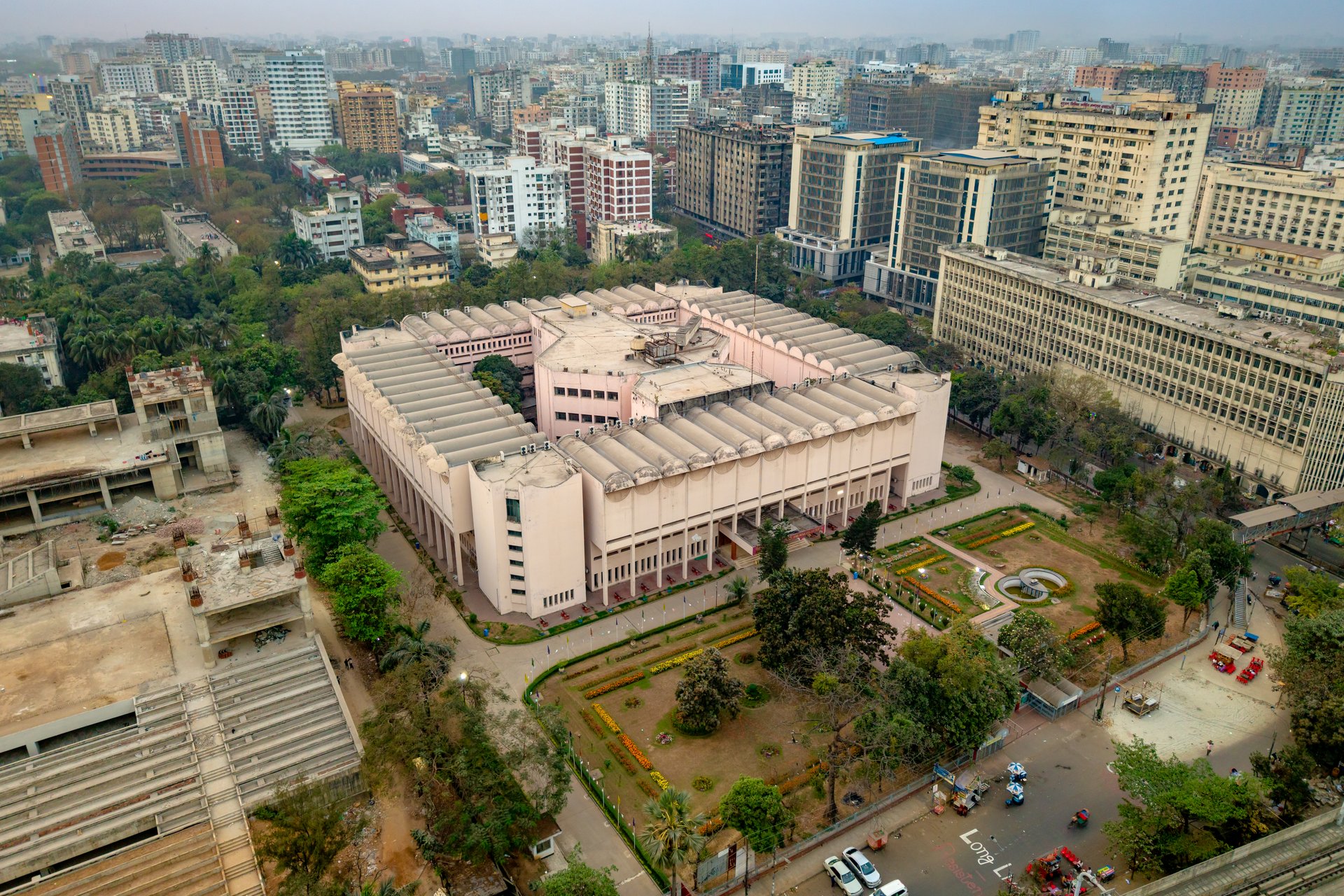
Bangladesh National Museum
The initial collection fit in a single room of the old Secretariat building in Dhaka: 379 objects -- coins, manuscripts, folk art -- assembled with 10,000 taka in public subscriptions and a 2,000-taka government grant. That was 1913, when the Dhaka Museum opened under British Bengal with the modest ambition of preserving regional antiquities. More than a century later, the institution occupies a purpose-built complex in the Shahbagh quarter, holds over 91,000 artifacts, and draws more than 2,000 visitors daily. Its collection spans Buddhist sculptures from the Gandhara period, over 50,000 ancient and medieval coins, and an entire floor dedicated to the war that created the nation it now serves.
A Museum in Search of a Home
The idea preceded the institution by decades. In 1855, the Asiatic Society of Bengal proposed a museum for Dhaka, but logistics killed the plan. The idea resurfaced in 1907 among Dhaka's educated elite, and on 20 March 1913, the government of undivided Bengal formally established the Dhaka Museum. Lieutenant Governor Lord Carmichael inaugurated it on 7 August 1913 in a room at Jagannath University College. As the collection outgrew its space, it moved to the Nimtali Baroduari building by 1915. The museum's first curator, Nalini Kanta Bhattasali, shaped its early identity, but after his death in 1947 -- the year of Partition -- the institution drifted without a permanent curator for four years. A press agency temporarily occupied its premises. The collection survived, but barely.
Independence Renamed It, War Filled It
When the Pakistan Army swept through East Pakistan in 1971, the destruction reached into cultural institutions. Artifacts from the damaged Dinajpur Rajbari and Baldha Museum were transferred to Dhaka for safekeeping, and the museum began actively collecting war-related documents and objects -- photographs, posters, personal effects of fighters and victims. After independence, the institution was renamed the Bangladesh National Museum in 1972, a change formalized by government order in 1974. A Trustee Board and a National Museum Commission were created to oversee its growth. In December 1975, a new site in Shahbagh was approved, and on 17 November 1983, the current building -- designed by architect Syed Mainul Hossain and equipped with modern exhibition facilities -- opened to the public.
Four Floors, Four Centuries
The museum is organized vertically, each floor a different register of time. The ground floor greets visitors with old artillery pieces and a grand staircase. The first floor spreads across 22 rooms: a large map of Bangladesh's 64 districts, a full-scale Royal Bengal tiger, showcases of the country's natural biodiversity including a whale's tongue, and historical relics spanning Bengali civilization through 1900, with an entire room devoted to the traditional boats of rural Bangladesh. The second floor pivots to the 20th century -- photographs of national figures, displays on the 1952 Language Movement that helped catalyze Bengali nationalism, and extensive galleries on the Liberation War, complete with wartime posters and instruments of torture. Two libraries anchor the floor. The third floor looks outward, housing portraits of international figures and four galleries dedicated to Chinese, Korean, Iranian, and Swiss collections.
Preserving What Remains
By 2017, the museum's collection had reached 91,287 catalogued artifacts, but exhibition space could display only a fraction. A digitization project launched in 2012 aimed to create a comprehensive database, and in April 2017 the museum introduced a 360-degree virtual gallery, making selected exhibits accessible online for the first time. UNESCO has collaborated with the institution since 2010 on intangible cultural heritage initiatives, connecting the museum's physical holdings to the broader tapestry of living Bengali traditions. With 330 officers and employees managing conservation, curation, and public education, the museum operates as an autonomous institution under a board of trustees and a government-appointed director general. It is the largest museum in Bangladesh and one of the most visited cultural institutions in South Asia.
From the Air
Located at 23.7376N, 90.3941E in the Shahbagh area of central Dhaka, adjacent to the University of Dhaka campus and near the Shahbagh intersection. Approximately 9 km south of Hazrat Shahjalal International Airport (VGHS). Best viewed at 2,000-3,000 feet. Ramna Park and Suhrawardy Udyan provide nearby green-space navigation references amid Dhaka's dense urban landscape.