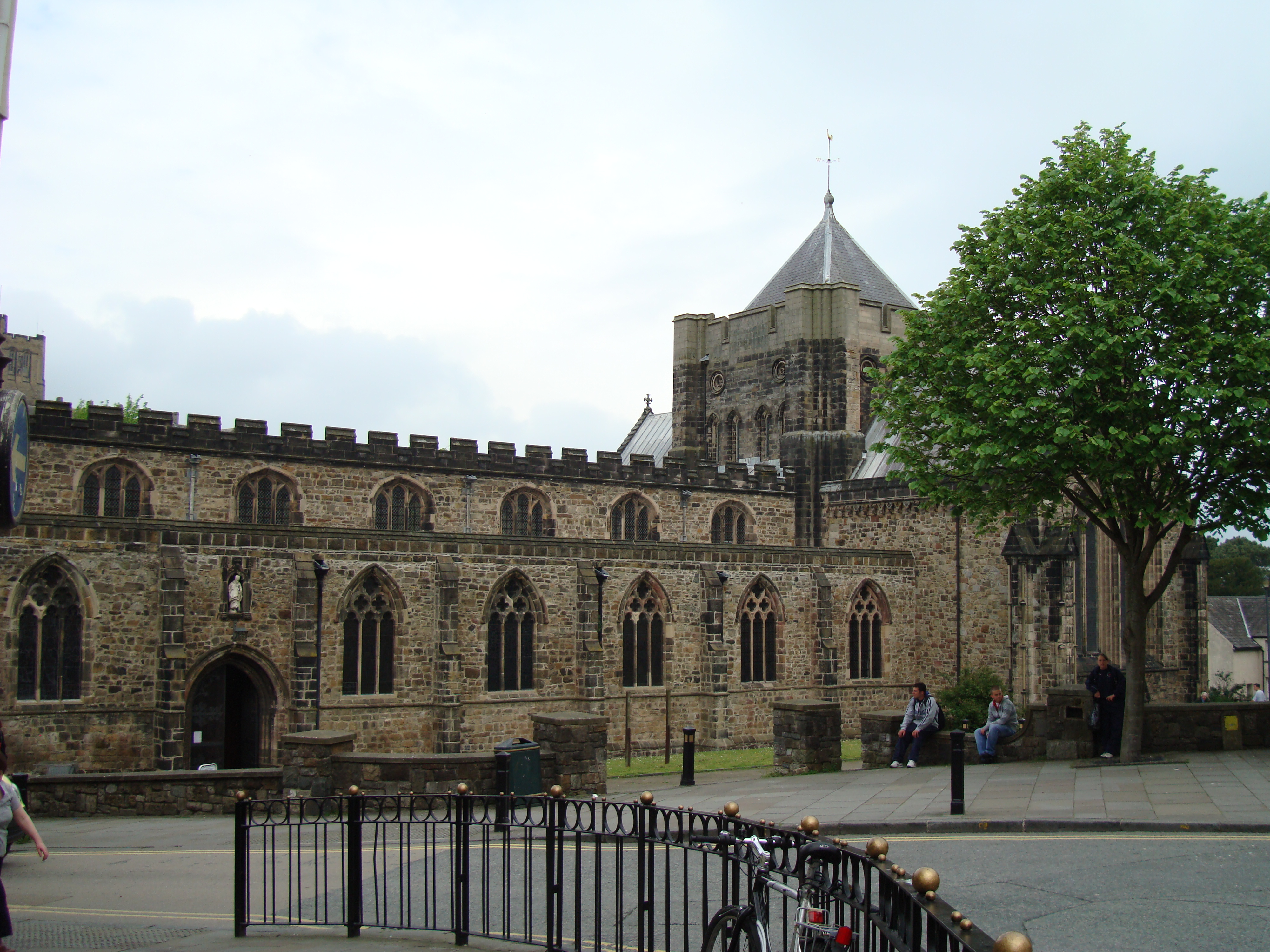
Bangor Cathedral
Five wooden mice hide in the woodwork of Bangor Cathedral. Carved by Robert Thompson, the Yorkshire craftsman who signed all his work with a mouse, they are among the most recent additions to a building whose foundations reach back to the age of saints. The cathedral sits low in the landscape, almost hidden -- a deliberate choice, it is said, made to keep Viking longships from spotting it as they prowled the Menai Strait. Whether or not that story is true, the instinct for survival has served the place well. Bangor Cathedral has endured for nearly fifteen hundred years.
The Saint and the King
Around 530, a monk named Deiniol established a monastery here on land granted by Maelgwn Gwynedd, the powerful king of Gwynedd. According to tradition, Saint David himself consecrated Deiniol as the first Bishop of Bangor, linking this quiet corner of North Wales to the patron saint of the nation. Nothing survives from Deiniol's era -- the monastery was sacked in 634 and again in 1073, each time rebuilt from whatever remained. The name Bangor itself may derive from the wattle fencing that enclosed the original monastic enclosure, a reminder that this was once a simple compound of timber and prayer.
Caught Between Crowns
The cathedral's history reads like a chronicle of Welsh resistance. King John's army destroyed it in 1211 during a punitive raid into Gwynedd. Edward I's invasion in 1282 left it badly damaged, and the dean and chapter received sixty pounds in compensation -- a gesture that probably felt inadequate given the scale of destruction. The rebuilding that followed, under Bishop Anian, reshaped the transepts and crossing. Then came Owain Glyndwr's rebellion in 1402, during which the cathedral was reportedly burned to the ground, though contemporary evidence for the total destruction is thin. What is certain is that extensive reconstruction followed, not completed until 1532, when Bishop Thomas Skevington raised the tower that stands today.
Kings Beneath the Altar
Gruffudd ap Cynan, the warrior king who reunited Gwynedd after decades of Norman encroachment, was buried by the high altar upon his death in 1137. His son Owain Gwynedd joined him there, though Owain's remains were later moved beneath the wall of the Lady Chapel. These royal burials made the cathedral more than a place of worship; they anchored it to Welsh identity at a time when that identity was under relentless pressure. Giraldus Cambrensis recorded a service here in 1188 when the Archbishop of Canterbury celebrated Mass, part of a recruiting drive for the Third Crusade that wound through Wales seeking soldiers and donations.
The Mostyn Christ and the Biblical Garden
The cathedral's treasures include the Mostyn Christ, a fifteenth-century oak carving of Christ seated on a rock, wearing the crown of thorns, his expression one of sorrowful contemplation before the crucifixion. It is a quietly powerful piece, small enough to miss if you are not looking for it. Outside, the Biblical Garden contains an example of every plant mentioned in the Bible, a living encyclopedia of scriptural botany that blooms and fades with the seasons. The combination of ancient carving and living garden captures something essential about the place: it is both museum and sanctuary, tending simultaneously to the past and to the present.
Scott's Unfinished Vision
George Gilbert Scott, the prolific Victorian architect who restored so many of England's great churches, turned his attention to Bangor in 1868. His design called for a high central tower and spire that would have given the cathedral a dramatically different silhouette against the mountains. But cracks appeared in the stonework, suggesting the foundations could not bear the load, and the tower was left as a low, modest structure. Lord Penrhyn, whose vast wealth came from the nearby slate quarries, contributed two thousand pounds toward the nave restoration in 1879. The result is a building that wears its many centuries openly -- Norman arches beside Victorian stonework, medieval burial slabs alongside modern woodcraft -- a place that has never stopped being rebuilt.
From the Air
Bangor Cathedral sits at 53.2266N, 4.1274W, on low ground near the center of Bangor, close to the southern shore of the Menai Strait. From the air, look for the university city between the Menai Suspension Bridge and the Britannia Bridge. The cathedral is difficult to spot from altitude due to its deliberately low profile. Nearest major airports: RAF Valley (EGOV) on Anglesey, Caernarfon (EGCK). Recommended viewing altitude: 1,500-2,500 ft AGL for best context of the city and strait.