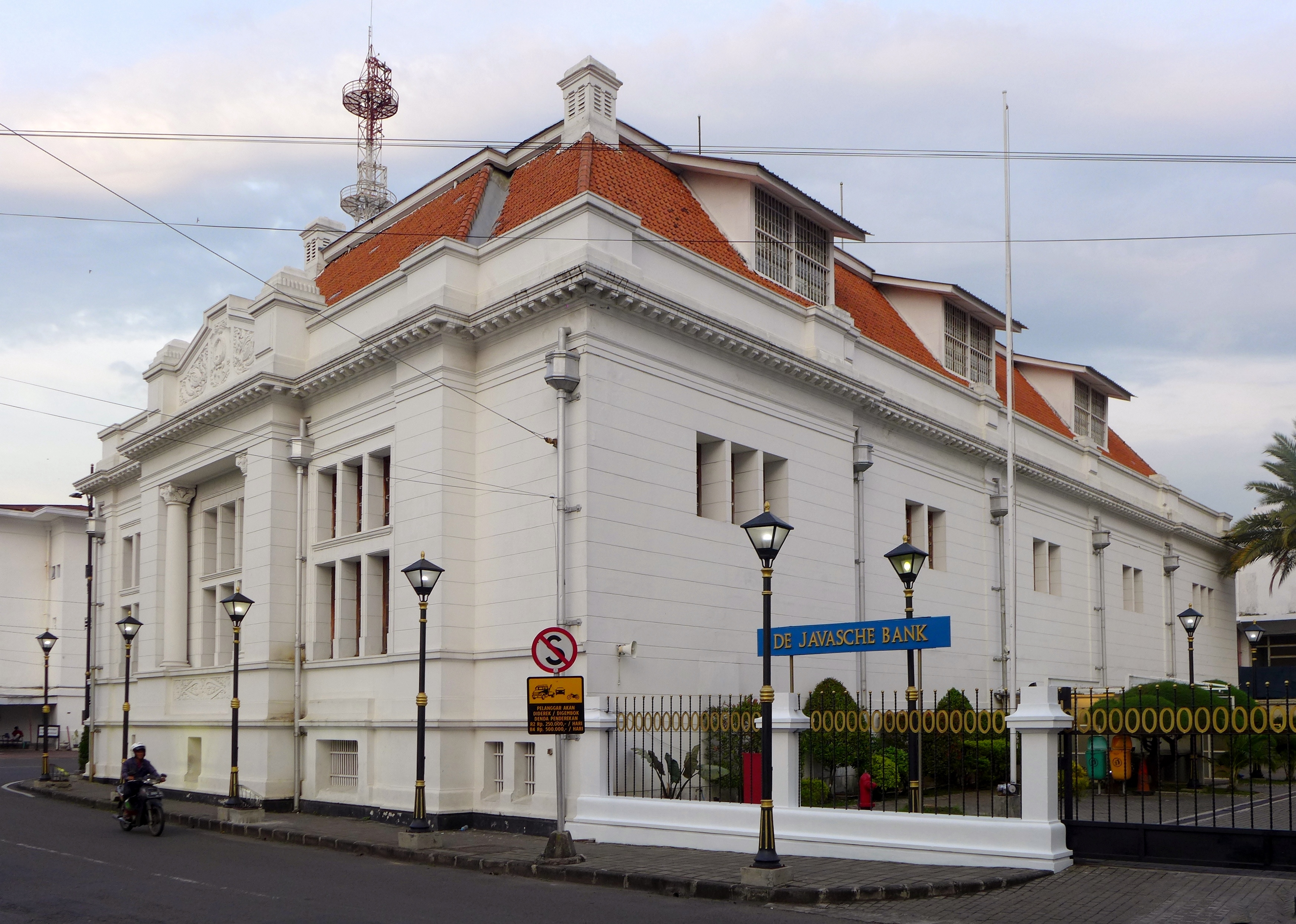
The Vault Beneath the Columns
In the basement of a grand Neo-Renaissance building on Surabaya's old commercial strip, a massive safe door still guards its chamber. Behind it, instead of gold bars or stacks of guilders, visitors find glass cases displaying the currencies that once circulated through the Dutch East Indies -- copper duits, silver guldens, Japanese occupation money, and the rupiah notes that followed independence. The Bank Indonesia Museum occupies the former De Javasche Bank branch, a building that handled colonial finances for over a century before becoming a monument to the economic story of the archipelago.
A Branch Office for Empire
De Javasche Bank established its Surabaya branch on 14 September 1829, when the city was already the commercial engine of East Java. For decades, a modest building served the purpose, but by the turn of the twentieth century the institution demanded something grander. The original structure was demolished in 1904, and in its place rose a building of 1,000 square metres designed by the Amsterdam architect Eduard Cuypers. A nephew of the legendary Pierre Cuypers -- who designed Amsterdam's Rijksmuseum and Central Station -- Eduard brought the family talent for monumental architecture to the tropics. His design echoed the De Javasche Bank headquarters in Batavia, blending Neo-Renaissance grandeur with subtle Javanese ornamentation. Arched windows, classical columns, and decorative flourishes gave the building the gravitas expected of a colonial central bank, while local motifs acknowledged the soil it stood on.
From Counting House to Nation
When Indonesia declared independence in 1945, the building's purpose shifted but its function remained. De Javasche Bank became Bank Indonesia, and the Surabaya branch continued operating in the same halls where Dutch clerks had once tallied trade revenues. For nearly three decades after independence, the building served as the central bank's local office, its vaults and teller windows adapting to a new nation's currency and regulations. In 1973, Bank Indonesia relocated to a more modern facility, and the Cuypers building fell quiet. The decades of disuse might have ended in demolition -- a fate that befell many colonial structures across Indonesia as cities modernized. Instead, Bank Indonesia undertook a careful restoration, and on 27 January 2012 the building reopened as a museum dedicated to the history of banking and currency in Indonesia.
Three Rooms, Three Centuries
The museum spreads across three floors, but its most evocative spaces are three purpose-built exhibition rooms. The Collection of Old Currencies Room occupies the former safe deposit area -- the same vault that once secured the colony's financial reserves. The irony is deliberate: where money was hoarded, it is now displayed. Visitors trace the evolution of Indonesian currency from pre-colonial trade beads and Chinese coins through Dutch guilders, the Japanese military scrip imposed during World War II, and the early rupiah notes of the fledgling republic. The Collection from Conservation Room preserves the physical story of the building itself, displaying original materials replaced during restoration -- tiles, brickwork, ironwork -- alongside architectural drawings and construction records. The Collection of Cultural Treasure Room houses vintage banking equipment: mechanical adding machines, embossing stamps, the heavy brass instruments of pre-digital finance.
Cuypers in the Tropics
Eduard Cuypers spent much of his career adapting European architectural traditions to Southeast Asian conditions. His work for De Javasche Bank in both Batavia and Surabaya shows a designer thinking carefully about how Neo-Renaissance formality could coexist with equatorial heat, monsoon rains, and the cultural expectations of a colonial society that wanted its institutions to look both powerful and refined. High ceilings allowed hot air to rise. Deep eaves sheltered walkways from tropical downpours. The Javanese ornamentation Cuypers incorporated was more than decoration -- it signaled that even a Dutch institution recognized, however selectively, the aesthetic traditions of its surroundings. Walking through the museum today, the building's architectural details tell a story parallel to the currency exhibits: one of cultural encounter, adaptation, and the gradual assertion of local identity within structures originally designed to project foreign authority.
From the Air
Located at 7.235S, 112.737E in central Surabaya, within the old commercial district near the Kali Mas river. The building sits in the Kota Lama (Old City) area, identifiable from the air by the cluster of colonial-era structures along Jalan Garuda. Nearest major airport is Juanda International (WARR), approximately 18 km to the south. Recommended viewing altitude: 2,000-3,000 feet for the Old City district. The Suramadu Bridge is visible to the northeast as a landmark for orientation.