The Mondo Building: Marble, Ambition, and a Banker's Revolution
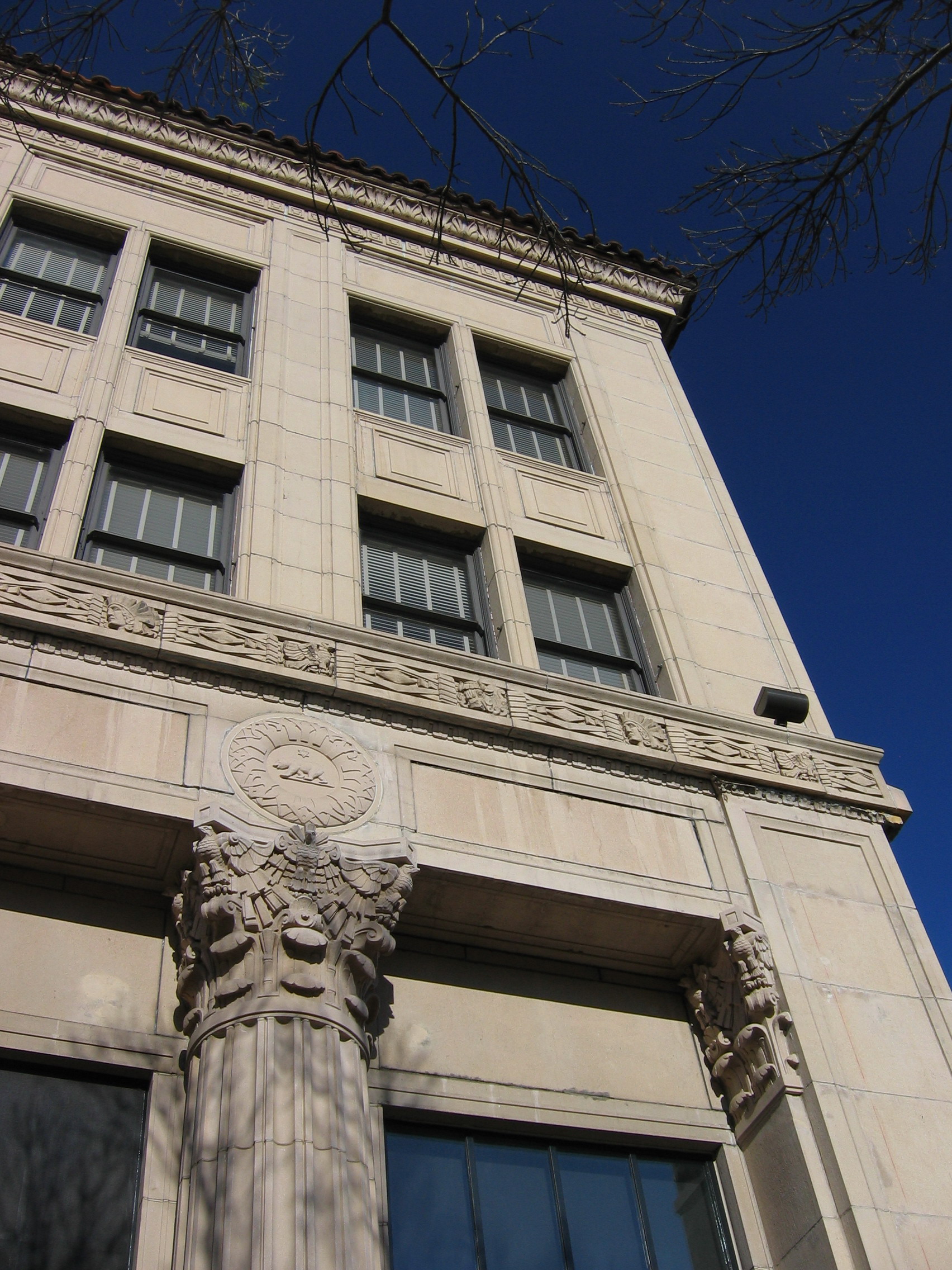
Five Corinthian columns face Main Street. Seven pilasters turn the corner onto Canal. Between the first and second floors, a decorative band of alternating panels runs the length of the facade - square reliefs depicting an Indian head, then an eagle, separated by diamond-patterned rectangles. The material is Travertine marble over a granite base, the style Classical Revival at its most confident, and the architect is Henry A. Minton, a man who spent much of the 1920s in a losing race to design bank branches faster than his client could open them. The client was Amadeo Pietro Giannini, and the building on the corner of Main and Canal in Merced was one small piece of the most aggressive banking expansion California had ever seen.
A Bank for People Without Banks
Giannini founded the Bank of Italy in San Francisco's North Beach neighborhood on October 17, 1904. His customers were not the wealthy. They were Italian immigrants, fishermen, produce sellers, and small farmers - people whom the established banks of the era considered too poor, too foreign, or too risky to serve. Giannini disagreed. He went door to door soliciting deposits, sometimes accepting as little as a dollar, and built a business model on volume and trust rather than exclusivity. After the 1906 earthquake, while other banks locked their vaults and waited, Giannini set up a plank desk on the waterfront and began making loans from a pile of gold coins he had smuggled out of the ruins in a produce wagon. It was a founding myth, but it was also true. By the time the Merced branch opened in 1928, the Bank of Italy operated hundreds of branches across California - the first statewide branch-banking network in the United States. In 1930, Giannini renamed it. The new name was Bank of America.
Minton's Race Against Growth
Henry A. Minton designed so many Bank of Italy branches that his firm became practically synonymous with the institution's architectural identity. Giannini wanted his banks to look permanent, prosperous, and civic - buildings that would reassure depositors in small agricultural towns that their money was safe. Minton delivered Classical Revival facades, Corinthian columns, and high-quality materials: Travertine marble imported from Italian quarries, ornamental terra cotta, decorative friezes. The Merced branch exemplifies his formula. The flat clay-tile roof caps a building designed to evoke Roman authority. The terra cotta mansards and the ornamental cornice suggest old-world craftsmanship transported to a Central Valley farm town. Inside, the proportions were generous - high ceilings, ample light - because a bank that felt expansive felt trustworthy. That Minton could maintain this level of detail across hundreds of branches, each adapted to its specific corner lot or main street, testifies to both his productivity and his understanding of what Giannini was selling: not just financial services, but the architecture of confidence.
Afterlives on Main Street
Banks outlast their bankers. Giannini died in 1949, and the institution he built evolved through mergers and acquisitions into a global financial conglomerate that bears little resemblance to the produce-wagon operation on the San Francisco waterfront. But his branch buildings remain, scattered across California's towns like civic monuments to a particular moment in American capitalism - the moment when banking decided the middle class was worth courting. In Merced, the building at Main and Canal became known locally as the Mondo Building. Parts of the first floor were covered with stucco in the 1950s, a practical but inelegant alteration. From 2004 through 2019, the University of California, Merced leased the building as administrative office space, an arrangement that kept the lights on while the young university constructed its campus outside of town. In 2019, the Merced County Office of Education purchased the building outright, converting it to conference, event, and office space. The Corinthian columns still face Main Street. The Travertine marble still catches the afternoon light.
Stone and Circumstance
The Bank of Italy in Merced was listed on the National Register of Historic Places, a recognition that the building matters beyond its commercial function. What Minton designed and Giannini financed was more than a bank branch. It was an argument - made in stone, marble, and terra cotta - that small-town California deserved the same architectural seriousness as San Francisco or Los Angeles. Walk past the building today and the decorative band still tells its story: eagle, Indian head, diamond, eagle, Indian head, diamond, repeating around the corner from Main onto Canal. The panels were fashionable motifs of the era, stamped from cast iron molds, but their rhythmic repetition gives the facade a quiet authority. Merced has grown and changed around it. The agricultural economy that originally justified a grand bank on this corner has given way to a more diverse mix of university, government, and service industries. The building remains, still finding uses, still anchoring its intersection with the weight of marble and the confidence of columns.
From the Air
Located at 37.30N, 120.48W at the intersection of Main and Canal Streets in downtown Merced, California. The building is not individually visible from altitude but sits in Merced's compact downtown grid. Nearest airports include Merced Regional Airport (KMCE) approximately 3 miles southwest and Castle Airport (KMER) about 7 miles northwest. Fresno Yosemite International (FAT) lies 55 miles southeast. Merced sits in the flat Central Valley at approximately 170 feet elevation with typically excellent visibility except during winter tule fog events.