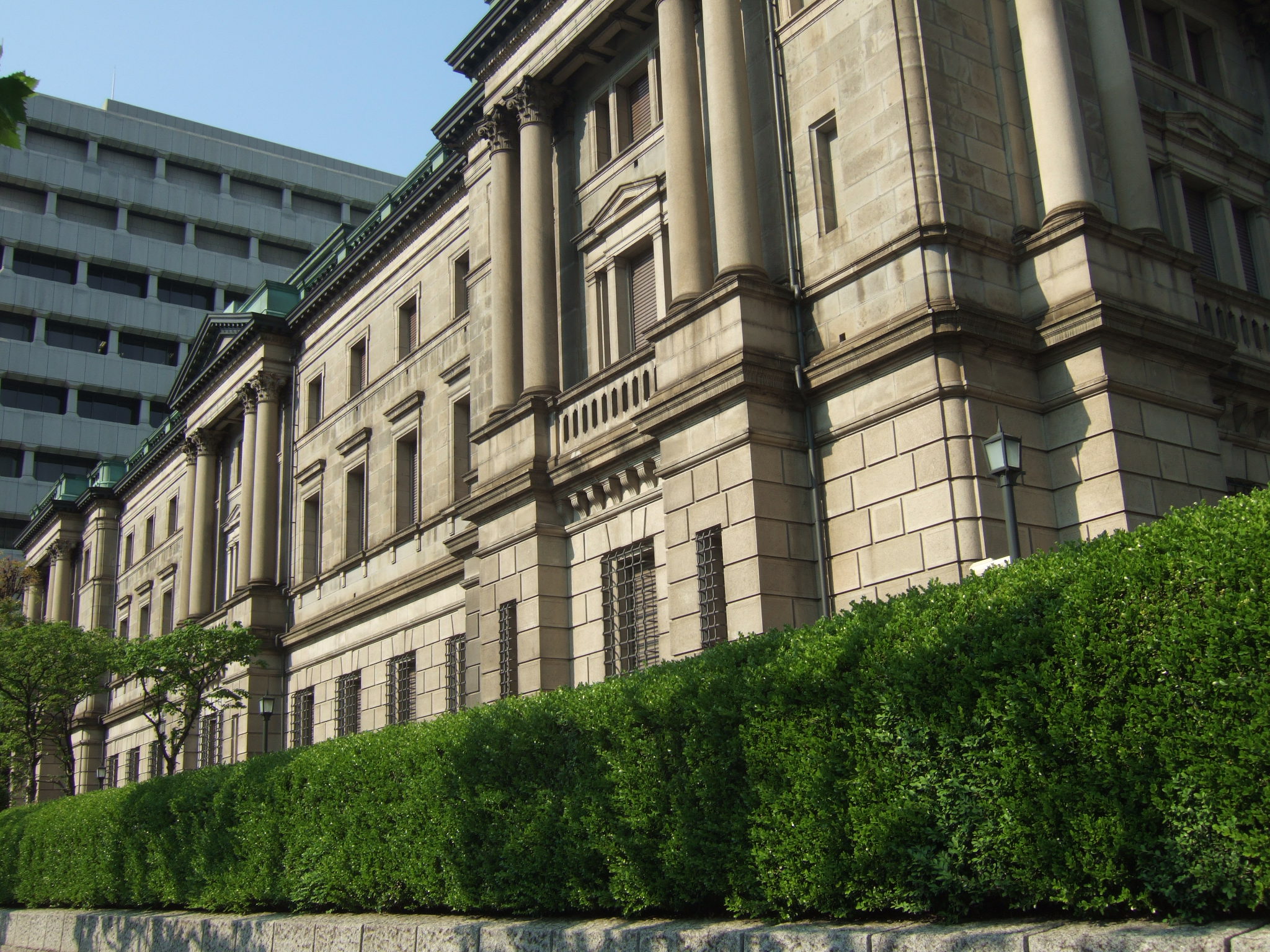
The Bank of Japan Headquarters: A Vault Beneath a Dome
Look down at the Bank of Japan headquarters from above and you might see a coincidence -- or a deliberate joke spanning a century. The building's footprint, as revealed by satellite and aerial photography, bears a striking resemblance to the kanji character for yen (円). Whether architect Tatsuno Kingo intended this when he completed the original structure in February 1896 is a matter of delightful debate, complicated by the fact that the simplified kanji was not standardized until 1946. What is certain is that Tatsuno, one of Japan's first generation of Western-trained architects, created a building of such solidity and grace that it has anchored the Nihonbashi district of central Tokyo for more than 130 years -- surviving an earthquake that flattened the surrounding city and earning recognition as one of Tokyo's most important architectural landmarks.
The Architect Who Built the Nation's Confidence
Tatsuno Kingo was a man with a mission. Born in 1854, he studied under the influential British architect Josiah Conder at the Imperial College of Engineering, becoming one of the first Japanese architects trained in Western building methods. Before designing the Bank of Japan, Tatsuno traveled to Europe and the United States to study bank architecture firsthand. He was particularly influenced by the National Bank of Belgium, designed by Henri Beyaert, and he prepared his initial design draft while in London. The resulting building -- known as the Honkan -- blended Neo-Baroque grandeur with practical engineering. Three floors above ground, one basement level, approximately 1,100 square meters of floor area. The first floor was constructed almost entirely of stone; the second and third floors of brick clad in thinly sliced granite. A central dome with four front columns and two on each side wing gave the facade a European authority. In the basement, a massive vault held the nation's reserves. Tatsuno would go on to design Tokyo Station in 1914, but the Bank of Japan was the building that established his reputation.
Shaken but Standing
On September 1, 1923, the Great Kanto Earthquake struck the Tokyo-Yokohama region with devastating force. Fires raged for days. Entire neighborhoods collapsed. The Bank of Japan's headquarters survived, but not without damage. In 1926, repairs were directed by Nagano, who had collaborated with Tatsuno as the bank's in-house engineer. Nagano then went further, designing two eastern extensions -- the Nigo-kan and Sango-kan -- erected between 1932 and 1938. He also added a northern extension, since demolished. For these additions, Nagano used reinforced concrete, a material far more earthquake-resistant than the stone and brick of the original. But he carefully designed the facades in the same eclectic style Tatsuno had used, creating a seamless visual continuity that made the entire complex look as though it had been conceived as a single design. The effect was deliberate: a central bank must project permanence, even when the ground beneath it has recently tried to swallow everything.
Layers of Time in Nihonbashi
The bank continued to grow. In 1966, Matsuda Hirata Architects designed a new northern extension, a modern structure with ten floors above ground and five below. It was completed in 1973. On February 5, 1974, the older parts of the complex -- Tatsuno's original Honkan and Nagano's extensions -- were designated an Important Cultural Property of Japan, recognizing the headquarters as one of the country's most significant modern architectural works. The building also earned a place among Tokyo's 50 Architectural Heritage Sites. The south annex, built between 1982 and 1984, houses the Currency Museum of the Bank of Japan, where visitors can handle replicas of historical coinage and trace the evolution of money in Japan. The Institute for Monetary and Economic Studies also operates from the annex, making this block of Nihonbashi a quietly powerful concentration of financial history and scholarship.
Bracing for the Next One
Japan sits on one of the most seismically active zones on Earth, and a building holding the nation's monetary reserves cannot afford to be merely historic -- it must be safe. In October 2016, the Bank of Japan began a major seismic isolation retrofit of the main building, installing modern technology to protect Tatsuno's 1896 structure against future earthquakes. The project represented a delicate balance: preserving the architectural integrity of an Important Cultural Property while incorporating twenty-first-century engineering beneath its foundations. The Honkan is open for guided tours, and visitors who walk its corridors tread on floors that span three centuries of Japanese ambition -- from Meiji-era internationalism to postwar reconstruction to the quiet confidence of a building that has been reinforced, restored, and prepared to stand for another hundred years.
From the Air
Located at 35.687°N, 139.771°E in the Nihonbashi district of Chuo, central Tokyo. From the air, the Bank of Japan headquarters occupies a large urban block whose shape has been noted to resemble the kanji for yen (円) -- best appreciated from directly above at 3,000-5,000 feet AGL. The building sits near the Nihonbashi bridge and the Nihonbashi River, roughly midway between the Imperial Palace grounds to the west and the Sumida River to the east. Tokyo Haneda Airport (RJTT) lies approximately 9 nautical miles to the south. The Imperial Palace East Gardens provide a useful visual landmark to the northwest.