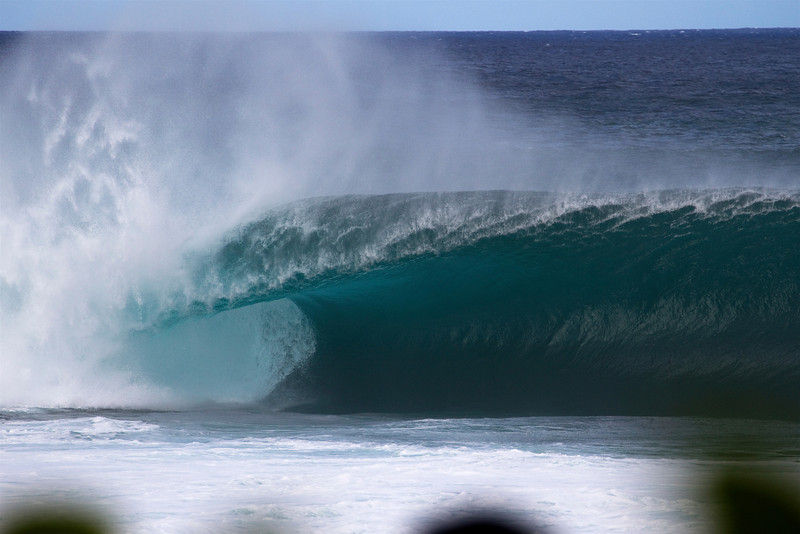
Banzai Pipeline
The name came from a ditch. In December 1961, surf filmmaker Bruce Brown was driving up the North Shore of Oahu with Californians Phil Edwards and Mike Diffenderfer when he stopped to film Edwards riding a few waves at an unnamed break off Ehukai Beach Park. A construction crew was installing an underground pipeline along Kamehameha Highway at the time, and Diffenderfer suggested they call the spot Pipeline. Brown used the name in his movie Surfing Hollow Days, The Chantays borrowed it for a 1963 hit instrumental, and within a few years the word had become inseparable from the most consequential wave in surfing -- a wave that has made careers, ended lives, and defined what it means to ride inside a tube of moving water.
Anatomy of a Killer
Pipeline breaks over a flat tabletop reef riddled with caverns that trap air and release it as the wave lurches upward. The effect produces the thick, hollow barrels that make Pipeline one of the most photographed waves on Earth. Below the surface, jagged lava spires wait for anyone who falls. There are three reefs, each progressively farther offshore in deeper water, that activate as swells increase in size. First Reef is the most commonly surfed, producing the classic left-breaking barrel. When a north swell hits, the peak forms an A-frame, with Pipeline peeling left and the equally famous Backdoor Pipeline peeling right. Second Reef starts breaking when waves exceed about 12 feet, offering longer walls and more power. At extreme size, Third Reef activates with giant waves that few surfers have the skill or nerve to ride. Sand accumulation on the reef can make waves unpredictable, violently closing out all at once. A strong west swell clears the sand; a strong north swell then delivers Pipeline at its best.
The Roster of the Brave
Phil Edwards is credited as the first person to surf Pipeline, filmed by Bruce Brown in that 1961 session. Greg Noll was the first to ride Second and Third Reef, in 1964. Joyce Hoffman was the first woman to take it on. From there the list reads like a hall of fame: Butch Van Artsdalen, Gerry Lopez -- who became so synonymous with the wave that he was called Mr. Pipeline -- Shaun Tomson, Tom Carroll, Kelly Slater, Andy Irons, John John Florence. Moana Jones Wong has earned the nickname "Queen of Pipeline." In 2024, Australian Molly Picklum became the first woman to score a perfect 10 at the break. But Pipeline's roster includes names that ended differently. Tahitian surfer Malik Joyeux, famous for charging the heavy wave at Teahupo'o, died here. Numerous surfers and photographers have been killed over the decades, earning Pipeline its reputation as one of the world's deadliest waves. Average wave height is nine feet. On a big day, it can reach twenty.
A Competition Stage, Eventually
Male professional surfers began competing at Pipeline in 1971 with events that would become the Pipe Masters, one of the most prestigious stops on the world tour. Bodyboarders followed with the IBA Pipeline Pro. The Pipeline Bodysurfing Classic proved you did not need a board at all to meet the wave. But there was no elite women's professional event at Pipeline until 2020 -- and that happened by accident. A male surfer was killed by a shark at Honolua Bay on Maui, forcing the women's Maui Pro to relocate, and the final heats were held alongside the men at Pipeline. The women proved they belonged, and Pipeline has hosted the top women's tour event since. The break's long exclusion of women from elite competition is part of its story now, alongside the footage and the fatalities.
The Wave and the Screen
Pipeline has appeared in film and television almost as long as it has been surfed. Bruce Brown's Surfing Hollow Days introduced it to the world. The 1974 Hawaii Five-O episode "The Banzai Pipeline" brought it to prime time. Blue Crush, the 2002 film about a female surfer preparing to ride Pipeline, was shot here and introduced the break to audiences who had never heard of reef breaks or tube rides. Surfline's annual Wave of the Winter competition, which invites surfers to submit videos from Oahu's North Shore, has turned Pipeline into content as much as challenge -- every session potentially filmed, every barrel a candidate for a clip. The wave does not care. It forms and breaks the same way it did before Phil Edwards paddled into it in 1961, indifferent to the cameras, the reputations, and the history built on its shoulders.
From the Air
Located at 21.66N, 158.05W off Ehukai Beach Park in Pupukea on Oahu's North Shore. The break is visible from the air during large winter swells as lines of white water forming over the reef approximately 100-200 yards offshore. The adjacent Kamehameha Highway runs along the coast. Nearest major airport is Daniel K. Inouye International Airport (PHNL), approximately 25 nautical miles to the south. Dillingham Airfield (PHDH) is closer, about 10 nautical miles to the west. Best viewed at 1,000-2,000 feet AGL during winter swell season (November-February).