Banzhuang
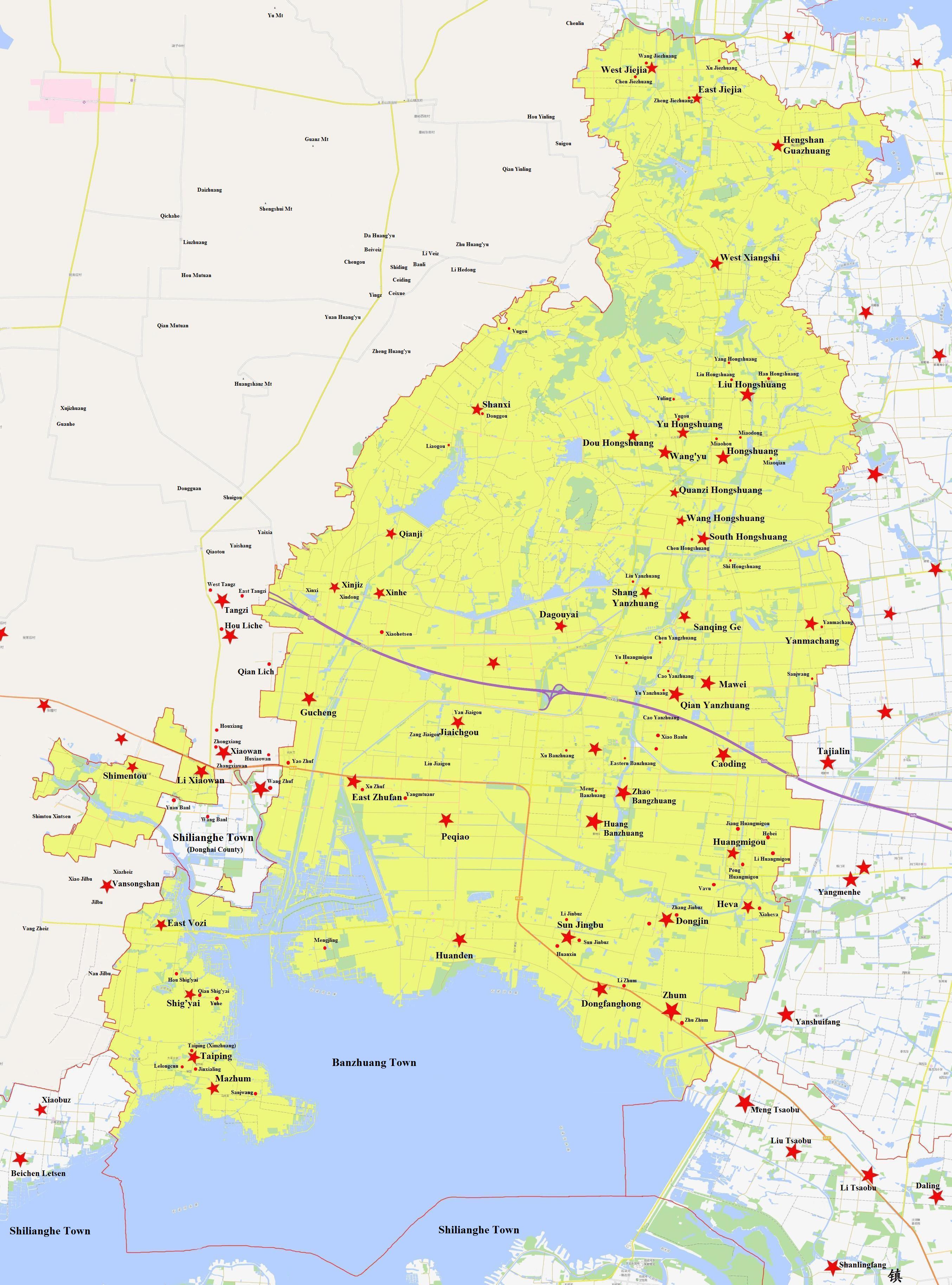
Banzhuang sits where Jiangsu Province meets Shandong -- a border that has shifted, dissolved, and reformed so many times that the town's administrative history reads like a summary of modern China's political upheavals. In the span of a single century, this corner of Ganyu District in Lianyungang has been governed by the Beiyang warlords, the Nationalist government, a Japanese occupation administration, competing Communist districts, and the People's Republic under multiple reorganization campaigns. Through it all, about 100,000 people have continued living on these 175 square kilometers, adapting to whatever name their town was given and whatever authority claimed it.
Borders That Would Not Stay Still
When the Nationalist government in Nanjing overthrew the Beiyang authorities, Ganyu became a county within Jiangsu's 8th Administrative District. The area that would become Banzhuang was then part of Ganyu County's 4th district, centered on what was called Jiagu City. Japanese invasion dissolved all of this -- the occupiers dismissed the local government and installed their own administration. When the Chinese Communist Party wrested control from the Japanese during the Second Sino-Japanese War, they divided the old 4th district into Zhumeng District in the south and Guyang District in the north. Even during the Chinese Civil War, the boundaries kept shifting: Zhumeng District briefly broke away from Ganyu County for several months in 1947, a forgotten micro-secession in a conflict measured in provinces and armies.
Between Two Provinces
After the CCP captured Nanjing, Jiangsu Province was temporarily abolished entirely. Ganyu County was absorbed into Shandong Province until Jiangsu was restored in 1953 -- a bureaucratic reshuffling that must have felt surreal to residents who woke up in a different province without moving a step. That same year, the 9th District was merged into the 7th, and when the People's Commune campaign swept through China, the towns were renamed yet again: Jiagushan People's Commune and Huandun People's Commune replaced whatever local identities had survived the previous rounds of reorganization.
The Reservoir and the Displaced
In 1958, construction of the Shilianghe Reservoir began, and Banzhuang experienced something more disruptive than any name change. Entire communities were told to relocate to make way for the rising waters. The migrations were poorly organized -- families arrived at their designated destinations to find nothing prepared, no housing, no infrastructure, no plan. The government did not reimburse displaced residents for their losses until fifty years later, by which point many of the original migrants had died or returned to their former homes on their own initiative. The reservoir episode left a scar on local memory that outlasted the political campaigns that preceded it.
A Town Assembled from Pieces
Modern Banzhuang is an administrative composite. In 1961, Jiagushan People's Commune was split into Banzhuang and Jiashan communes. The 1983 abolition of the commune system restored the old township names: Huandun, Banzhuang, and Jiashan. In 2001, Banzhuang Town absorbed Jiashan Township, and in January 2013, Jiangsu's provincial government merged Huandun Township into Banzhuang as well, creating the current entity. Beneath these official boundaries, natural villages continue to exist as they have for centuries, communities whose identities owe more to kinship, geography, and agricultural rhythm than to whatever administrative label happens to be in force. Banzhuang is, in this sense, a place that has survived its own history -- renamed, redrawn, and reorganized repeatedly, yet fundamentally unchanged in the daily lives of the people who call it home.
From the Air
Located at 34.85°N, 118.85°E in Ganyu District, Lianyungang, near the Jiangsu-Shandong provincial border. The Shilianghe Reservoir is visible to the southwest as a large body of water. The landscape is predominantly flat agricultural land with scattered villages. Nearest airport: Lianyungang Huaguoshan International Airport (ZSLG/LYG), approximately 50 km to the southeast. At 5,000-8,000 feet AGL, the patchwork of agricultural fields and the reservoir are the dominant visual features.