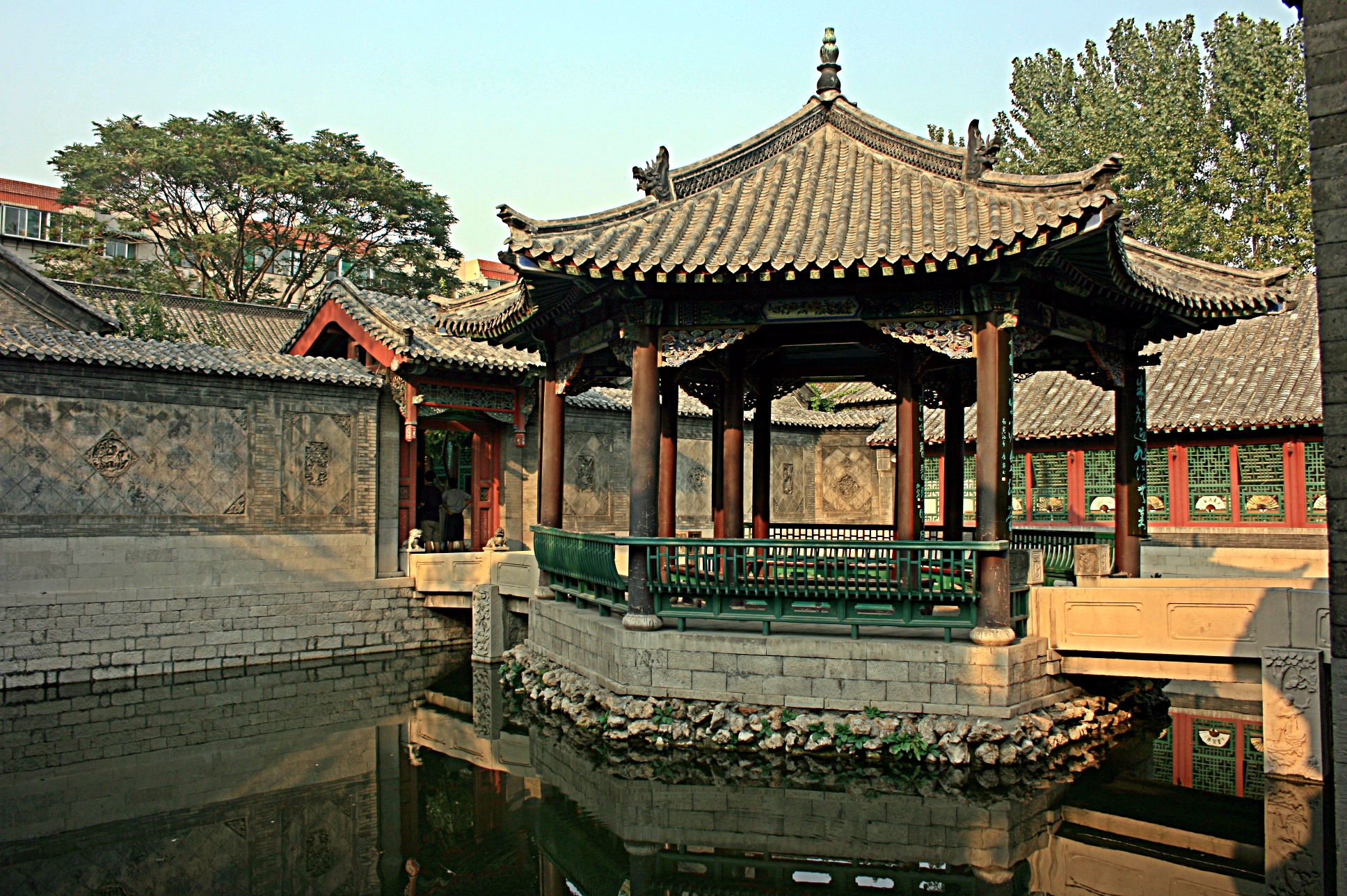
Baotu Spring
Three jets of water erupt from the earth in downtown Jinan, and they have been doing so since before the Spring and Autumn Annals recorded them roughly 2,500 years ago. The Baotu Spring -- sometimes translated as "Jet Spring" or "Spurting Spring" -- pushes water upward through three limestone outlets at rates that can reach 1.6 cubic meters per second, sending plumes that have historically reached heights of 26 meters. The Qianlong Emperor visited during the Qing dynasty and bestowed upon it the title "Number One Spring under the Heaven," a designation the spring still carries. In a city nicknamed the Spring City for its more than 70 named artesian springs, Baotu reigns supreme.
Water from Deep Time
The spring draws from an Ordovician karst aquifer that lies beneath the city, fed by a recharge area covering 1,500 square kilometers in the mountainous terrain to Jinan's south. The terrain slopes northward, creating the pressure that forces water upward through the limestone. Together, the springs fed by this aquifer discharge between 300,000 and 350,000 cubic meters per day. The water emerges at a constant 18 degrees Celsius year-round, a steady pulse in a city of four distinct seasons. Since the 1970s, however, the springs have stopped flowing several times when human consumption drew too heavily from the aquifer -- a reminder that even ancient water is not inexhaustible. The spring pool itself stretches 30 meters east to west and 18 meters north to south, a rectangular mirror reflecting pavilions that have stood on its banks for centuries.
Pavilions and a Garden of Ten Thousand Bamboo
Song dynasty builders erected Leyuan Hall to the north of the spring pool. The Guanlan Pavilion rose on its western bank during the Ming dynasty, and the Laihe Bridge was added to the east during the Wanli era. Close by stands the Wangheting Teahouse, where visitors sip tea brewed with the spring's own water. But the grandest structure in the surrounding park is the 10,000 Bamboo Garden -- 186 buildings arranged around 13 courtyards, connected by four pavilions and five bridges. Originally built during the Yuan dynasty, it served as the Shandong governor's residence in the Ming period before the poet Wang Ping purchased it in 1692. The military commander Zhang Huaizhi bought and expanded it between 1912 and 1927. Today the park covers 10.5 hectares, a green refuge established in 1956 that weaves together gardens bearing names like Hundred Flowers, Luoyuan, and Cang.
A Spring That Writes Poetry
Baotu Spring has drawn writers the way water draws roots. Zeng Gong wrote about it during the Song dynasty. Zhao Mengfu painted and described it in the Yuan. Pu Songling, author of the fantastical Strange Tales from a Chinese Studio, found inspiration here during the Qing. Both the Kangxi and Qianlong emperors left inscriptions at the spring during imperial visits. The park houses a memorial courtyard dedicated to the poet Li Qingzhao, one of China's most celebrated female writers, as well as memorials to painters Li Kuchan and Wang Xuetao. Each Chinese New Year, a lantern festival transforms the park for an entire month. Since the 1970s, an annual chrysanthemum show has drawn visitors from late October through November. Even the local beer -- Baotu Quan, produced by the Jinan Beer Group Corporation -- claims to be brewed with the spring's water.
The Spring City from Above
The Baotu Spring sits just southwest of Jinan's city center, on the outer edge of the old city moat near the western end of Quancheng Road. From this single source, water flows into Daming Lake via the old moat and then onward through the Xiaoqing River. The spring's name dates to the Song dynasty; before that, it was known as Baoliu and Lanquan. Whatever the name, the phenomenon remains the same -- water that fell as rain in the southern mountains, filtered through half a billion years of Ordovician limestone, rising with enough force to jet into the open air. In a city that has built its identity around the springs beneath its streets, Baotu is the heartbeat.
From the Air
Located at 36.66N, 117.01E in central Jinan, Shandong Province. The spring park is just southwest of the city center. Jinan Yaoqiang International Airport (ZSJN) lies approximately 30 km to the northeast. From cruising altitude, Daming Lake to the north provides a visible water reference. Best viewed at lower altitudes where the spring park's green footprint contrasts with the surrounding urban grid.