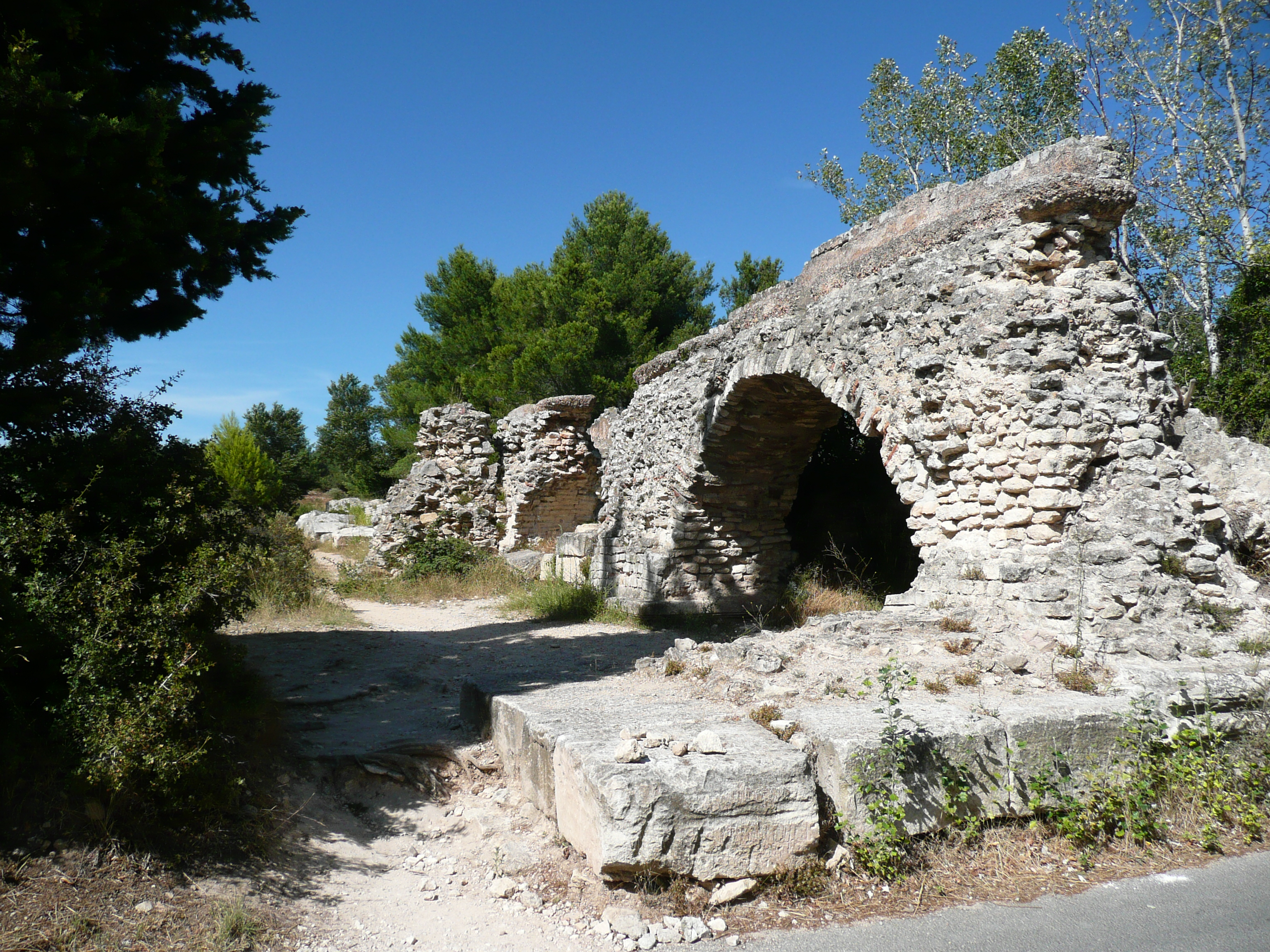
Barbegal aqueduct and mills
Sixteen water wheels, arranged in two parallel rows of eight, cascaded down a steep hillside near the town of Arles in southern France. Fed by a pair of Roman aqueducts, this complex ground an estimated 4.5 tonnes of flour per day -- with some estimates reaching 25 tonnes -- enough to supply bread for between 10,000 and 40,000 inhabitants of the Roman city of Arelate. The Barbegal aqueduct and mills have been called the greatest known concentration of mechanical power in the ancient world. They are also, remarkably, the ruins of something that might be described as an industrial factory, built 1,800 years before the Industrial Revolution.
An Ancient Factory Floor
The site sits 12 kilometers east-northeast of Arles near Fontvieille, where the Arles aqueduct passed a steep escarpment. The overshot water wheels were the key technology: water from the aqueduct poured onto the top of each wheel, its weight turning the mechanism before the outflow drove the next wheel down the slope. Substantial masonry remains of the water channels and individual mill foundations survive, along with a staircase climbing the hill. The mills operated from the beginning of the second century until roughly the end of the third century. Two aqueducts joined just north of the complex, and a sluice gate controlled the water supply, allowing operators to regulate production -- a level of industrial management that challenges assumptions about Roman economic sophistication.
Engineering Before Its Time
Vertical water mills were well documented in the Roman world. Vitruvius described them in De architectura in 25 BC, and Pliny the Elder mentioned them in his Natural History of 77 AD. But Barbegal went far beyond individual mills. The cascading arrangement -- each wheel's discharge driving the next -- multiplied the available power in a way that had few parallels until the medieval period. Scholars have suggested the mills may have served purposes beyond grain: sawing timber and stone were possibilities, as evidenced by a crank-activated frame saw found at a third-century mill in Hierapolis and another excavated at Ephesus. The science historian James Burke argued that Roman watermill technology like Barbegal's directly influenced the Cistercian monks and their waterpower innovations, which in turn helped spark the Industrial Revolution.
Walking Through the Ruins
Today, visitors park where a minor road crosses the massive remains of the original aqueduct. Olive orchards line both sides of the path as you walk south along the partially standing aqueduct, passing through a three-meter-deep rock-hewn cleft that emerges at the top of the mill complex. From here, the view opens dramatically: extensive farmland spans 180 degrees across the southern horizon, much as it did when the mills were running. The site is signposted as a Roman aqueduct rather than a mill, which undersells what stands here. The Arles Museum of Antiquity in town holds an informative reconstructed model that makes the cascading arrangement clear. The ruins themselves were slightly overgrown as of recent years, and the terrain demands care, but the scale of the masonry -- the channels, the foundations, the sheer ambition of the engineering -- speaks across the centuries.
Power Before Its Name
What makes Barbegal remarkable is not just its size but what it implies. This was not a single mill serving a village; it was a complex designed for volume production, located on a dedicated water supply, staffed and maintained as an ongoing operation for at least two centuries. It suggests an economy capable of thinking about production at scale, of investing infrastructure to feed a city rather than a household. A similar complex existed on the Janiculum hill in Rome, and there are hints of others at sites like Amida in Mesopotamia. Barbegal may have been the largest, but it was not unique -- which means the Roman world had a capacity for mechanized production that we are only beginning to understand. The ruins on this hillside in Provence are not just the remnants of a flour mill. They are evidence of an ancient world that was more industrial than we like to imagine.
From the Air
Located at 43.703N, 4.721E near Fontvieille, 12 km east-northeast of Arles. The aqueduct remains and hillside mill ruins are visible among olive orchards and farmland. Nimes-Ales-Camargue-Cevennes Airport (LFTW) lies 40 km northwest; Marseille-Provence (LFML) is 75 km east. The Alpilles ridge is visible to the north. Best viewed from 1,500-3,000 ft AGL.