Barcelona
In 1882, a 31-year-old architect named Antoni Gaudi took over construction of a church that its original designer had envisioned as a conventional Gothic revival. Gaudi spent the next 43 years transforming it into something unprecedented - a forest of stone columns branching like trees, facades dripping with sculptural narratives, towers spiraling toward heaven like nothing built before or since. He died in 1926, struck by a tram, with the Sagrada Familia perhaps one-quarter complete. Nearly a century later, construction continues, funded entirely by entrance fees from the six million annual visitors who come to witness an obsession made manifest in stone. The church is Barcelona distilled: ambitious beyond reason, beautiful in ways that break conventional rules, still unfinished after 140 years. The city that adopted Gaudi - he was born in nearby Reus - shares his character. Barcelona has been Iberian, Roman, Visigothic, Moorish briefly, Carolingian, independent, Aragonese, Spanish reluctantly. Each conquest left architecture; each occupation deepened the Catalan determination to remain distinct. The result is a Mediterranean port where Gothic quarters meet modernist masterpieces, where the language on street signs is not quite Spanish, where even the football club carries political weight.
The Gothic Quarter
The Barri Gotic sits on Roman foundations. Barcino was established as a colony by Augustus around 15 BC, and sections of the original walls still stand - you can see them incorporated into medieval buildings, Roman stones supporting Gothic arches. The cathedral, dedicated to Saint Eulalia who was martyred here in 304 AD, took 150 years to build starting in 1298. Its cloister houses thirteen white geese, one for each year of Eulalia's life when she was executed for refusing to renounce Christianity.
The narrow streets that wind through the quarter were laid out in medieval times, designed for pedestrians and carts, now filled with tourists and tapas bars. The Placa del Rei preserves the palace where Ferdinand and Isabella received Columbus after his first voyage to the Americas in 1493. The Jewish quarter, El Call, once housed one of Europe's largest Jewish communities before the pogrom of 1391 and the eventual expulsion in 1492. Excavations continue to reveal the layers beneath - Roman temple columns in a basement here, medieval mikvahs there, each dig adding to the palimpsest.
The Modernist Revolution
Between 1888 and 1930, Barcelona underwent an architectural transformation unmatched in any European city. The Eixample district - literally 'expansion' - was planned as a grid of chamfered blocks, each corner cut at 45 degrees to create octagonal intersections. Into this rational framework, architects poured irrational beauty. Gaudi designed Casa Batllo with a facade of colored tiles and skull-like balconies. Lluis Domenech i Montaner built the Palau de la Musica Catalana, its concert hall exploding with stained glass and sculptural excess.
The movement called Modernisme was Catalonia's answer to Art Nouveau, but with distinctly local character - drawing on Moorish influences, Gothic traditions, and natural forms. Wealthy industrialists competed to commission the most spectacular buildings. The Passeig de Gracia became an open-air museum of architectural one-upmanship. Gaudi's Park Guell, originally planned as a garden city for sixty homes, found only two buyers; it became a public park instead, its mosaic benches and gingerbread gatehouses now UNESCO World Heritage sites visited by millions.
The Anarchist City
Barcelona in the 1930s was the most politically radical city in Europe. Anarchist labor unions controlled entire industries. When Franco's nationalist uprising began in July 1936, workers seized the city, collectivized factories, and held Barcelona for the Republic for nearly three years. George Orwell fought here with the POUM militia; his Homage to Catalonia describes a city where waiters refused tips as bourgeois, where everyone called everyone else 'comrade,' where the social revolution seemed briefly real.
The dream ended in January 1939 when Franco's forces took the city. The repression that followed targeted not just Republicans but Catalan identity itself - the language was banned from public use, the flag forbidden, the autonomous government abolished. Franco's regime lasted until 1975. The scars remain visible in the city's fierce defense of its Catalan character, in the independence flags that hang from balconies, in the political dimension of every FC Barcelona match against Real Madrid. What looks like football is still, somehow, resistance.
The Olympic Transformation
The 1992 Summer Olympics remade Barcelona. The city had been industrial, its waterfront a working port closed to the public, its beaches contaminated. The Olympic bid, won in 1986, provided both funding and deadline for transformation. The port was opened, beaches created, the ring road completed, the telecommunications tower built on Montjuic, the waterfront district of Barceloneta converted from industrial to recreational.
The strategy worked almost too well. Barcelona became a model of urban regeneration studied worldwide. Tourism exploded - from two million visitors in 1990 to over twelve million by 2019. The success brought problems: housing costs that pushed residents out, streets overwhelmed by cruise ship passengers, resentment that occasionally boiled into anti-tourist protests. The city that reinvented itself for the Olympics now struggles with what that reinvention attracted. The challenge of the 2020s is managing success without losing the character that created it.
La Rambla and the Sea
La Rambla runs from Placa Catalunya to the waterfront, a tree-lined pedestrian boulevard that has been Barcelona's main promenade since the 18th century. The name comes from Arabic - 'ramla' meaning sandy riverbed - because a seasonal stream once flowed here. Now tourists flow instead, past flower stalls and newspaper kiosks and human statues, past the Boqueria market where ham legs hang above pyramids of fruit, past the opera house where anarchist bombs once exploded, down to the Columbus monument pointing toward a sea he sailed to find a route to Asia.
The Mediterranean defines Barcelona. The city spreads along the coast, hemmed by the Collserola hills behind, facing the sea that connects it to the wider world. The port that made Barcelona rich still operates, container ships loading alongside cruise liners. The beaches that did not exist before the Olympics now draw millions in summer. The seafood restaurants of Barceloneta serve what the fishing boats bring. The sea breeze tempers the summer heat, the humidity tangles the hair, and the light - the Mediterranean light that painters have chased for centuries - falls golden on Gaudi's spires at sunset.
From the Air
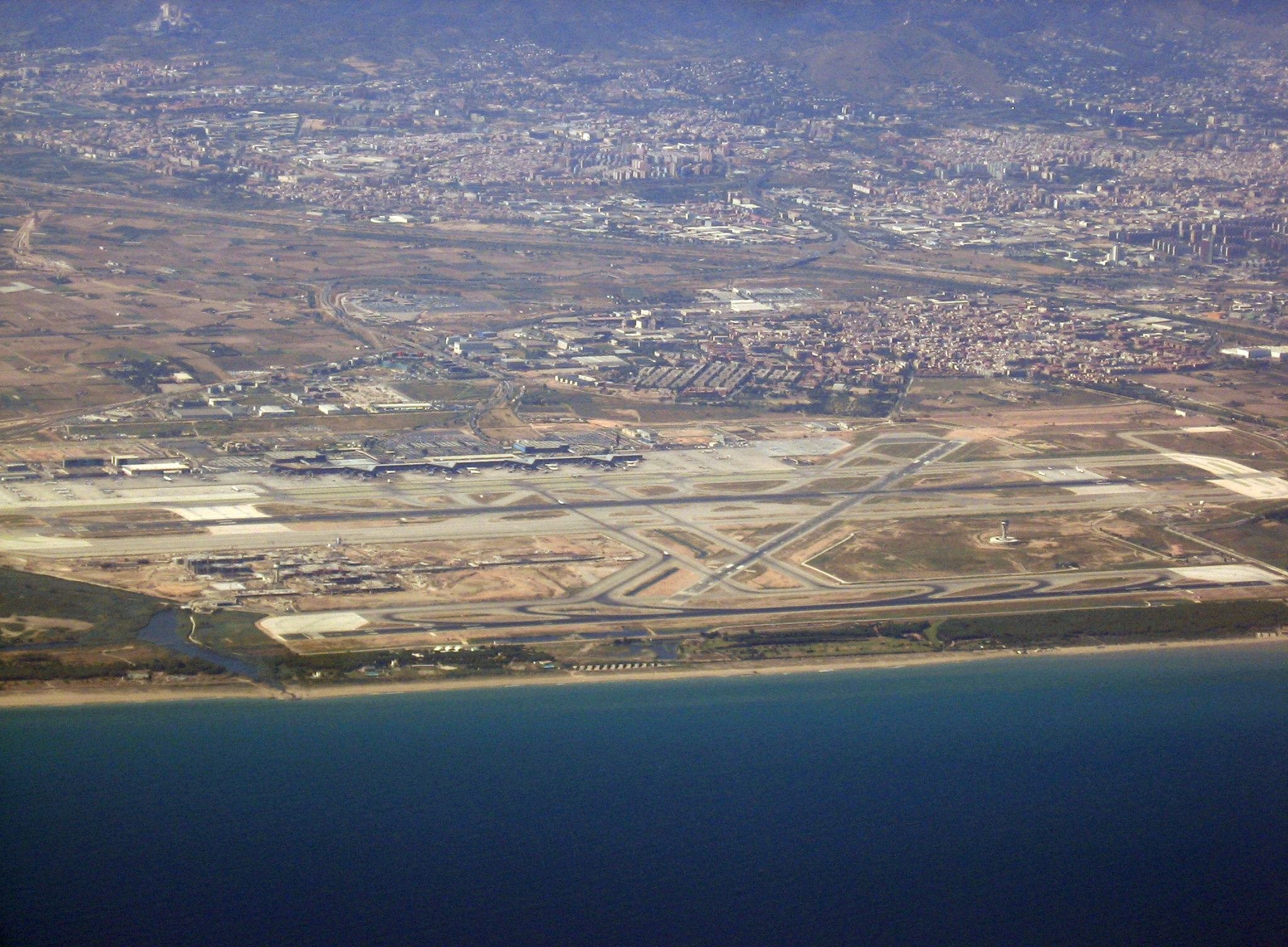
Barcelona (41.38°N, 2.17°E) stretches along the Mediterranean coast with the Collserola range (512m Tibidabo peak) forming a backdrop to the northwest. Barcelona-El Prat (LEBL/BCN) lies 12km southwest with three runways: 07L/25R (3,352m), 07R/25L (2,660m), and 02/20 (2,528m). The distinctive grid of the Eixample district is visible from altitude, with the diagonal Avinguda Diagonal cutting across. The Sagrada Familia's spires are identifiable in the northern Eixample. The Gothic Quarter clusters near the port. Montjuic hill (173m) with its castle and Olympic facilities rises southwest of the old city. The Forum district marks the northeastern waterfront with its distinctive triangular building. Weather is Mediterranean with hot summers, mild winters, occasional strong Tramontana winds from the north. Sea breeze effects are common on summer afternoons. Coastal fog can affect early morning operations.