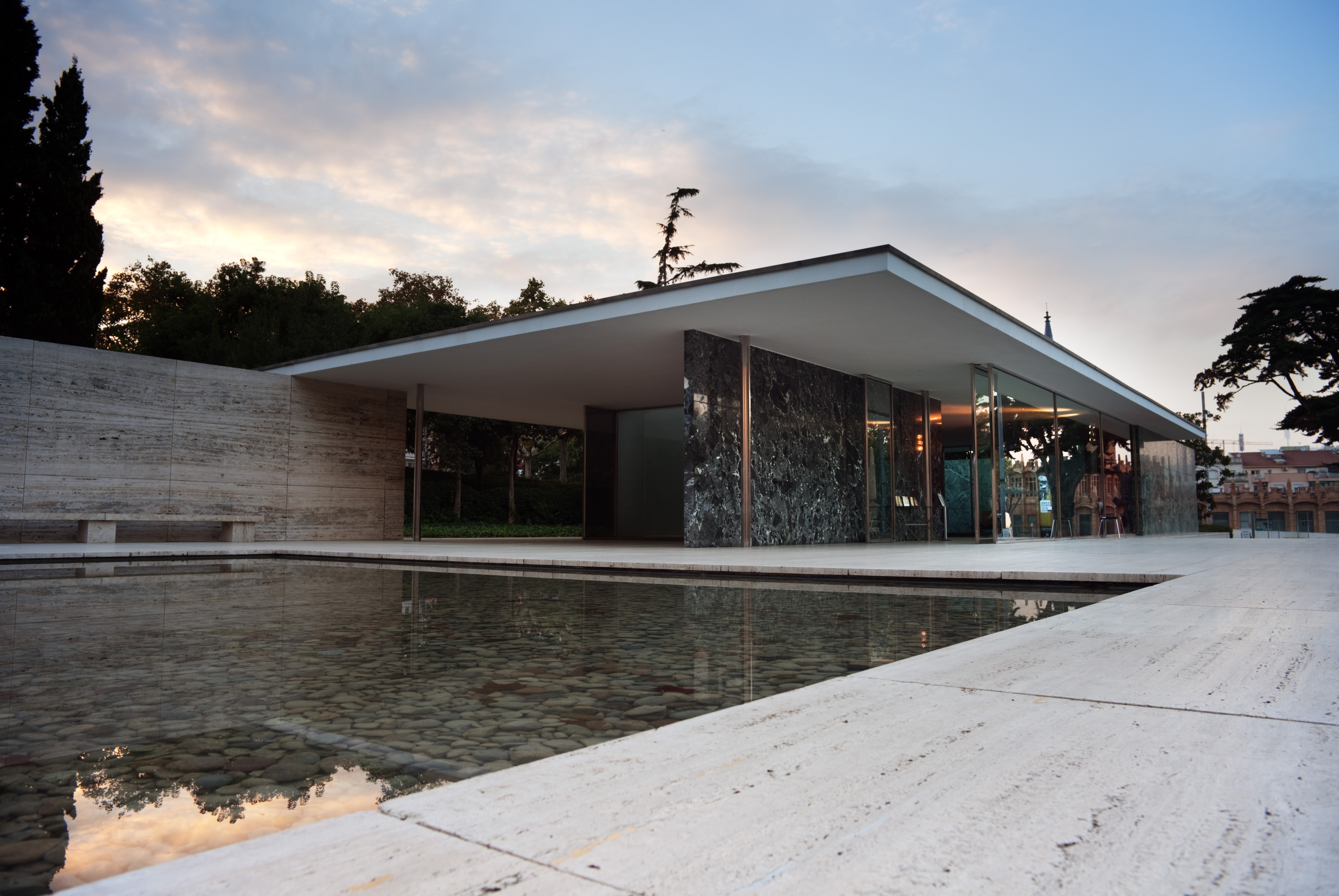
Barcelona Pavilion
"This building is not supposed to exist." Paul Goldberger's verdict on the Barcelona Pavilion captures the paradox of one of the most influential buildings of the twentieth century. Ludwig Mies van der Rohe designed it for the 1929 Barcelona International Exposition as Germany's national pavilion. It contained no exhibits. It had no conventional function. The building itself was the exhibit -- and it was demolished in early 1930, less than a year after it was completed. What stands on Montjuic today is a reconstruction, built between 1983 and 1986 by Catalan architects working from old photographs, historical drawings, and footings rediscovered in the earth.
Walls That Refuse to Be Walls
Mies designed the pavilion to dismantle the very idea of a room. Its walls do not enclose space -- they redirect it. Planes of Tinos verde antico marble, golden onyx, and tinted glass in grey, green, and white slide past one another without ever meeting at conventional corners. The roof floats on cruciform chrome-plated steel columns, hovering above the walls rather than resting on them. Visitors were not meant to walk through the building in a straight line but to take continuous turns, their movement shaped by surfaces that widen, narrow, and open unexpectedly onto reflecting pools. Mies called it "an ideal zone of tranquillity" -- a place designed to slow people down in the middle of a busy exposition, to make them aware of the space their bodies moved through.
Georg Kolbe's Dawn
In the smaller of the pavilion's two reflecting pools, Mies placed a bronze sculpture by Georg Kolbe titled Alba -- "Dawn." The figure of a woman, arms raised, stands in the water surrounded by walls of highly reflective stone and glass. The placement was calculated for maximum visual effect: the sculpture appears from multiple angles as visitors move through the building, reflected and re-reflected in the polished surfaces and still water. Mies was making a statement about the relationship between art and architecture -- that sculpture should not be applied to a building after the fact but should be integral to its spatial design, helping to define and interpret the space. The Barcelona Pavilion became one of the earliest and most celebrated examples of this idea.
The Ghost Building
For over fifty years after its demolition, the Barcelona Pavilion existed only in photographs, drawings, and architectural memory. It became a myth -- the building every architecture student studied but nobody could visit. When a group of Catalan architects proposed reconstructing it, Philip Johnson posed the essential question: "The problem before us is should a dream be realized or not? We have made such a myth of that building. Shouldn't it be left in the sacred vault of the memory bank?" They built it anyway. The reconstruction, completed in 1986, used the same types of materials Mies had specified -- the same marble, onyx, and glass. Architect Lance Hosey later concluded that while the reconstruction was a better physical artifact than the hastily built original, the 1929 pavilion was an irreplaceable product of its sociopolitical context. The debate continues.
A Living Laboratory
The reconstructed pavilion has not been treated as a frozen shrine. The Mies van der Rohe Foundation, which manages the site, has commissioned a series of artistic interventions that use the building as a canvas for contemporary ideas. Architects Kazuyo Sejima and Ryue Nishizawa of SANAA installed spiral acrylic walls inside. Ai Weiwei filled the two pools with coffee and milk. Andres Jaque revealed the pavilion's hidden basement and the maintenance infrastructure that keeps the serene experience running. Jordi Bernado simply removed the glass doors, altering the building's relationship to the outdoors. Each intervention keeps the pavilion alive as a site of architectural debate rather than a monument to a settled past. The Barcelona Chair -- designed by Mies and Lilly Reich specifically for the pavilion -- became one of the most iconic pieces of furniture in history. The building that was not supposed to exist has become, improbably, permanent.
From the Air
Located at 41.37N, 2.15E on Montjuic hill near the 1929 exposition grounds in Barcelona. The pavilion sits along Avinguda de Francesc Ferrer i Guardia, below the Palau Nacional. Barcelona-El Prat Airport (LEBL) is 8 km southwest. The low-profile pavilion is not individually visible from altitude, but Montjuic's exposition landscape -- the Palau Nacional, Magic Fountain, and descending terraces -- is clearly identifiable from 3,000-4,000 feet.