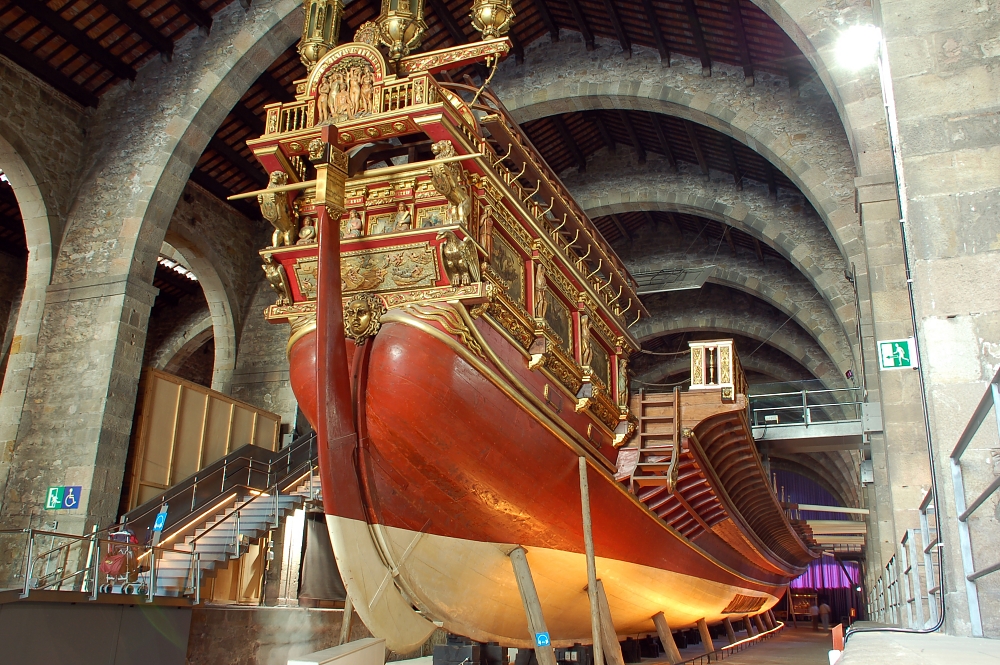
Barcelona Royal Shipyard
The word itself tells the story. "Drassanes" -- Catalan for shipyard -- derives from the Arabic dar as-sina'a, meaning "house of manufacture." The Metro station that serves Barcelona's Royal Shipyard carries this name, a linguistic fossil from the centuries when Islamic culture shaped the Iberian Peninsula. The building above the station is a different kind of fossil: a vast Gothic structure of stone arches and vaulted naves, built to house the war galleys of the Crown of Aragon. It sits at the edge of the old port, where the Mediterranean once lapped directly against its walls.
Four Centuries of Construction
The shipyard grew in stages, each expansion reflecting the ambitions of the Aragonese kings. In 1241, James I of Aragon decreed that no structures should be built on the coastline near the existing dockyard. In 1285, Peter III ordered the construction of a rectangular fortification with walls, towers, and no roof -- an open-air shipbuilding space. By the 14th century, the city walls had expanded to enclose the shipyard within the fortified city, and a roof was added to protect the galleys stored over winter. The 15th century brought a new wing called Porxo No, originally intended as a royal palace -- excavations show that only the foundations were ever built. Most remarkably, archaeologists discovered in 2012 that the current building is not the original medieval structure at all. In the late 16th century, the entire shipyard was rebuilt a few meters inland because the construction of Barcelona's port had changed the coastal currents, causing the old building to flood.
The Galley That Fought at Lepanto
At its peak under Alfonso V of Aragon, the shipyard could build twelve galleys simultaneously. These were not pleasure craft -- they were warships powered by oars and sail, designed for the violent close-quarters combat of Mediterranean naval warfare. The arsenal produced sails, cordage, and weapons, and stored food for the fleet. The shipyard's most famous product was the royal galley of Don John of Austria, known as the Real, built beginning in 1568 and launched in time to serve as the flagship at the Battle of Lepanto. That engagement -- fought on October 7, 1571, in the Gulf of Patras off the coast of Greece -- halted Ottoman naval expansion in the western Mediterranean and remains one of the largest naval battles in history. A full-scale reproduction of the Real is now the centerpiece of the Barcelona Maritime Museum, housed in the same Gothic naves where the original was built.
From Arsenal to Barracks to Battlefield
When shipbuilding moved to Cartagena in the 18th century, the Royal Shipyard became an artillery barracks for the Spanish Army. The building's vast naves, designed to shelter fifty-meter galleys, proved equally suited for storing and repairing cannon. In 1725, cavalry and infantry barracks were added. The military chapter did not end quietly. On July 19 and 20, 1936, as the Spanish Civil War began, the shipyard became a battleground. Militia from the Confederacion Nacional del Trabajo -- the anarcho-syndicalist labor union -- fought nationalist soldiers for control of the building. The CNT militia won, but the battle claimed the life of Francisco Ascaso, one of the most prominent anarchist leaders in Spain.
A Museum in a Monument
In 1935, the Barcelona city council acquired the building and decided to convert it into a maritime museum, which opened in 1941. The choice was inspired: the Gothic architecture that had sheltered galleys now sheltered the story of those galleys. After its 1381 renovation, the building featured eight naves, each 8.4 meters high and wide, roughly 60 meters long, supported by 17 columns of ashlar quarried from the nearby mountain of Montjuic. The materials came from across the medieval Crown of Aragon -- stone from Montjuic, sand from the beach, wood from the Baix Ebre and Gavarres, ropes and tiles from Valencia. In 1976, the shipyard was declared a Cultural Site of National Interest. Excavations during a 2012 restoration uncovered a Roman graveyard beneath the Gothic floor, adding yet another layer to a site where seven centuries of maritime history rest on top of two millennia of human presence at the water's edge.
From the Air
Located at 41.38N, 2.18E at Barcelona's Port Vell waterfront, at the southern end of La Rambla near the Columbus Monument. The shipyard's rectangular Gothic roofline is visible adjacent to the modern port facilities. Barcelona-El Prat Airport (LEBL) is 12 km southwest. Best viewed from 2,000-3,000 feet approaching from the sea, where the shipyard's long parallel naves contrast with the modern marina.