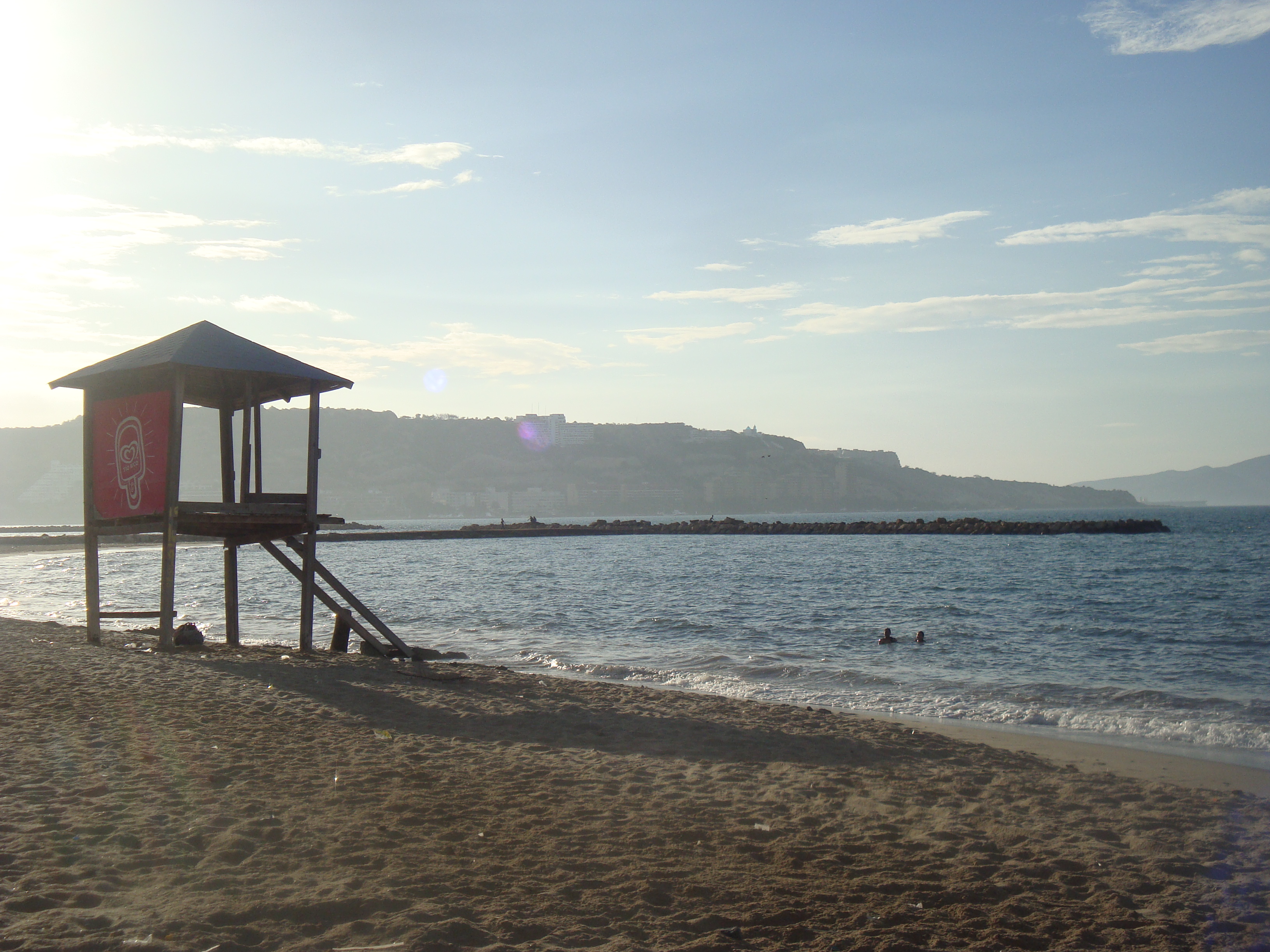
Barcelona, Venezuela
Under the main altar of the Cathedral of San Cristobal, seven bones rest in a reliquary -- one from each of seven saints. The church took 25 years to build, from 1748 to 1773, because an earthquake nearly destroyed it before it was finished. That pattern -- building, breaking, rebuilding -- defines Barcelona, Venezuela, a city that has been assembling and reassembling itself since Spanish colonists established it in 1671. Not to be confused with its famous Catalan namesake, this Barcelona sits where the Neveri River meets the Caribbean, a city shaped as much by water and tremor as by the people who refused to abandon it.
Blood and Stone at the Casa Fuerte
The most haunting site in Barcelona is a ruin. The Casa Fuerte began as a Franciscan convent before General Pedro Maria Freites and Santiago Marino transformed it into a fortress during the independence wars. In 1817, Royalist commander Aldana's forces besieged the building. On April 7, the fortress fell, and what followed was a massacre -- old men, women, and children murdered within its walls. The ruins still stand opposite the Plaza Bolivar, a deliberate memorial to what happened there. Reaching them requires crossing the Neveri River by the Boyaca bridge, a journey through the city's colonial core that passes the very plazas and avenues where the violence of independence played out two centuries ago.
Plazas That Remember
Barcelona's public squares carry the weight of history without buckling under it. The Plaza Boyaca, the city's central square since 1897, has barely changed since its construction in 1671. The Government House and the Iglesia de San Cristobal still face each other across its breadth, a symmetry that has survived earthquakes and revolutions. The statue of Major General Jose Antonio Anzoategui -- the state's namesake hero -- stands at the plaza's center. Nearby, the Tradition Museum occupies one of the city's oldest houses, also dating to 1671, with over 400 items spanning indigenous crafts, Spanish colonial religious art from the 16th century, and artifacts from Barcelona's long history as a trading port. The house once had direct access to the Neveri River, serving as a dock for boats arriving from neighboring islands.
Where Canals Meet the Caribbean
Modern Barcelona has grown far beyond its colonial core. The El Morro tourism complex spreads along the coast in an immense network of canals, a development built to house thousands of visitors in residences, condominiums, and hotels. Marinas and boatyards line the waterways, and virtually every dwelling has access to the sea. The Maremares Resort and Spa anchors the complex, while the nearby Centro Comercial Plaza Mayor echoes the colorful Dutch colonial architecture of Curacao. General Jose Antonio Anzoategui International Airport connects the city to Caracas and other Venezuelan states, and ferries run to Margarita Island. The Chimana Islands lie within easy reach by boat, offering coarse-sand beaches and crystal-clear waters surrounded by xerophytic vegetation.
The Shrine That Took Two Centuries
Perhaps nothing captures Barcelona's stubborn persistence like the Shrine of Nuestra Senora del Carmen. In the late 18th century, a group of devout locals founded the Confraternity of Our Lady of Carmen, seeking alms to build a shrine on land donated by Dona Felipa Chirinos. Then history intervened -- repeatedly. The independence wars, the conflict between conservatives and liberals, the federal war, and the continuous revolutions of the 19th century drained the guild's funds and halted construction again and again. It was not until 1896 that the shrine finally opened, after Governor Nicolas Rolando hired architect Ramon Irigoyen to finish the work. The floor is fine black and white marble from the quarries of Carrara, Italy. The stained glass, also Italian, ranks among the most striking in Venezuela. Nearly two centuries of setbacks produced a building that feels less like architecture than an act of defiance.
From the Air
Located at 10.13N, 64.68W on the Caribbean coast of northeastern Venezuela, at the mouth of the Neveri River. The El Morro canal complex is visible from altitude as a distinctive network of waterways along the coast. General Jose Antonio Anzoategui International Airport (SVBC) serves the city directly. The Jose Antonio Anzoategui Stadium (40,000 capacity, host of 2007 Copa America matches) is another visible landmark. Best viewed at 3,000-8,000 ft to see the contrast between the colonial city center and the modern canal developments.