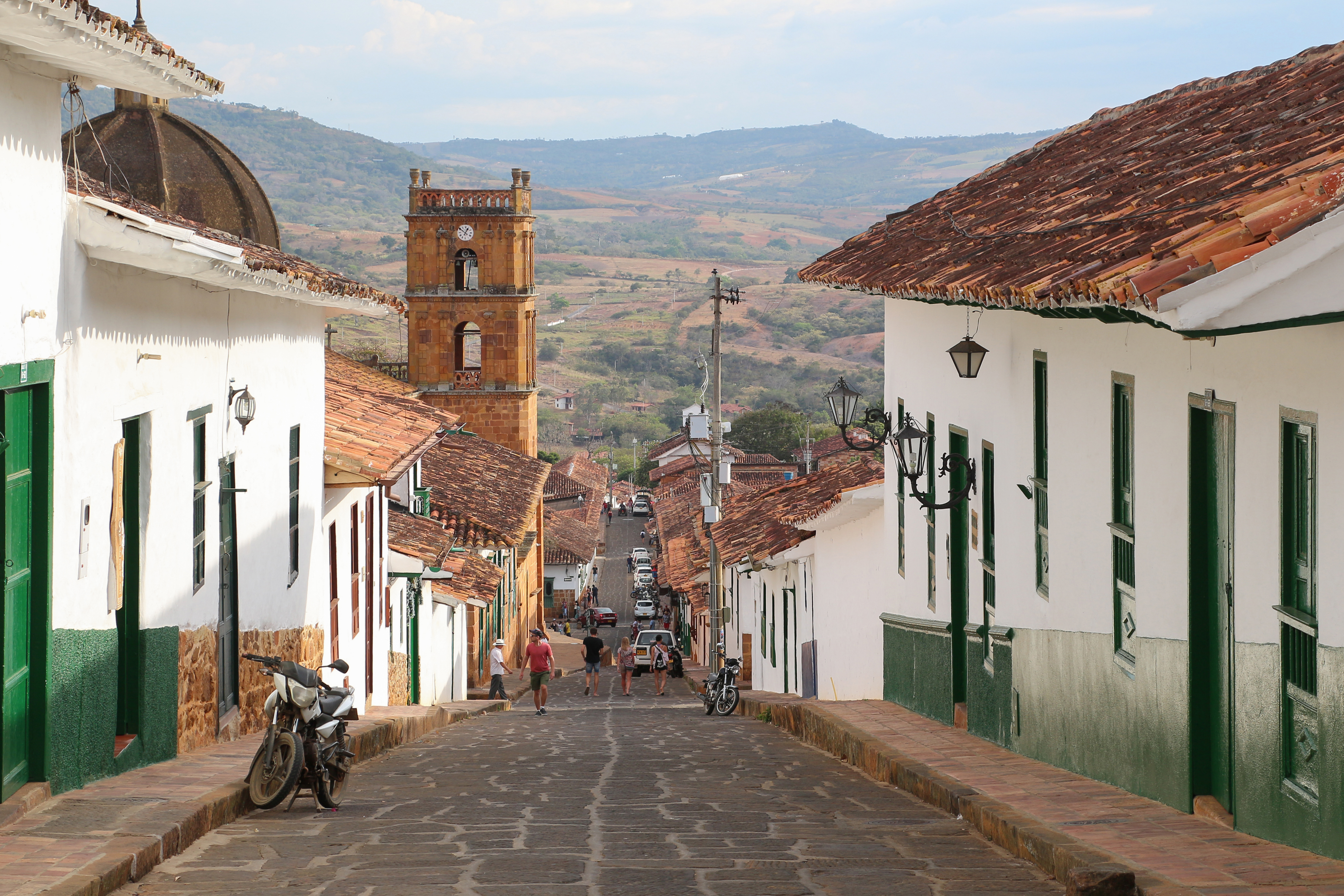
Barichara
The name means "Place of Rest" in the Guane dialect, and Barichara earns it. Perched on a ridge above the Suarez River canyon in Colombia's Santander Department, this town of golden sandstone streets and whitewashed walls has barely changed since the 18th century. Walk its cobblestoned lanes at dusk, when the low sun turns every facade the color of warm honey, and you begin to understand why Disney's animators came here before drawing the village in Encanto. But Barichara is not a movie set. It is a living town whose stone runs deeper than aesthetics -- into legend, into the bones of its cathedral, into the ancient footpath that connects it to a settlement founded nearly five centuries ago.
The Miracle in the Rock
Barichara's origin story begins with a peasant, a stone, and a vision. In 1702, according to local legend, a farmer stumbled upon a rock bearing what appeared to be the carved image of the Virgin Mary. Word spread through the countryside, and the stone became an object of veneration despite the skepticism of the local priest. By 1751, a parish church had been erected on the site, its name evolving from Vare-Florence to Vara-echada and finally to Barichara. The Catholic Church never officially recognized the miracle, but the town grew around the faith it inspired. Today, the Cathedral of the Immaculate Conception stands as a monument to that founding story. Ten monolithic stone columns, each five meters tall and 70 centimeters wide, support the structure -- carved from the same yellow sandstone that defines the town itself. The material is not decoration; it is identity.
Streets That Became a National Monument
In 1978, Colombia declared Barichara's historic center a national monument, calling it "a prime example of informal urban development in the Andalusian style." The designation recognized what visitors immediately sense: this is a place where the original 18th-century layout and late-colonial architecture have survived with remarkable integrity. The cemetery, renowned for its ornate grilles and windows, is itself built from the local stone. The chapels of San Antonio and Santa Barbara anchor the town's spiritual geography, while the house of former President Aquileo Parra connects Barichara to Colombia's political history. In 2010, the town became one of only 11 municipalities chosen for Colombia's inaugural Pueblos Patrimonio network, a recognition of its heritage and touristic potential. Puente Grande, one of Colombia's five most celebrated stone-and-lime mortar bridges, lies nearby. The architecture is not preserved under glass -- it is simply the way people here have always built.
The Camino Real to Guane
Nine kilometers from Barichara, down a stone path that winds along a canyon, sits Guane -- a settlement founded by the Spanish conquistador Martin Galeano in 1540. The trail connecting the two is the Camino Real, originally laid by the Guane people, an indigenous group whose civilization predated the Spanish arrival by centuries. The Guane were master craftsmen, skilled in ceramics and cotton weaving, worshippers of the Muisca god Ochica, who they believed had taught them agriculture. Their ancient footpath, known as Moncora, was later rebuilt with the heavy stone slabs that remain today. The walk takes about two hours, descending through dry scrubland and past stone walls into a village that feels suspended in the 16th century. Guane's Archaeological Museum holds remnants of the civilization that first named this land a place of rest, while the Church of Santa Lucia anchors the tiny plaza. The path itself has been a national monument since 1988.
A Town That Inspired a World
When Disney began developing Encanto in the years before its 2021 release, the production team -- including director Byron Howard, co-director Jared Bush, and songwriter Lin-Manuel Miranda -- traveled through Colombia with anthropologists, musicians, and architects. They visited Barichara, among other towns, and the influence is unmistakable. The Madrigal family's village, with its cobblestone streets and warm-toned stone buildings, carries the visual DNA of this Santander town. But Barichara's appeal extends beyond its Disney connection. The town's viewpoint, or mirador, offers panoramic views across the canyon. The waterfall at Salto del Mico and the bathing area at Chorreras draw visitors into the surrounding landscape. The Emilio Pradilla Gonzalez Cultural Center hosts exhibitions that root the town in its artistic present. Barichara remains, as its Guane name promised, a place of rest -- one that has been resting comfortably in its own beauty for over three hundred years.
From the Air
Located at 6.64N, 73.22W in Colombia's Santander Department, Barichara sits on a ridge above the Suarez River canyon at approximately 1,300 meters elevation. The nearest major airport is Palonegro International Airport (SKBG) in Bucaramanga, roughly 137 km northwest. From the air, the town's compact colonial grid of yellow sandstone buildings is visible against the green canyon landscape. The Camino Real trail to Guane traces a visible line along the canyon rim. Best viewed at 5,000-8,000 feet AGL for the relationship between the town and the dramatic canyon terrain.